
I had a conversation with philosopher Joe Atman recently that made me want to flip a table.
We were talking about consciousness, self-awareness, and how people navigate their lives. He kept circling back to this idea that’s everywhere now: let go of your past, live in the present moment, release your story.
I pushed back hard.
Not because I’m against mindfulness or presence. But because this obsession with “letting go” has become another way to avoid the real work of understanding yourself.
The Present Moment Industrial Complex
You see it everywhere. Instagram philosophers. Corporate wellness programs. Self-help books that all say the same thing: your past is holding you back, your story is just ego, the only truth is now.
It sounds profound. It feels liberating.
But here’s what nobody tells you: without your story, you have no context for the present moment. You’re just a consciousness floating through experiences with no framework to make sense of them.
Think about it. When you meet someone new, what do you do? You exchange stories. Where you’re from. What you do. What brought you here. Those aren’t just pleasantries or ego trips.
They’re the scaffolding of human connection.
Your Narrative Is Your Operating System
I’ve spent over a decade doing The Cameron Journal, interviewing hundreds of people on the podcast, working with founders on their messaging. You know what I’ve learned?
The people who understand their story are the ones who can navigate complexity without losing themselves.
Your narrative isn’t baggage. It’s your interpretive framework. It’s how you make sense of what happens to you. It’s why two people can experience the same event and walk away with completely different meanings.
When you know your story, you know:
- Why certain things trigger you
- What patterns keep showing up
- Where your blind spots live
- What you actually value versus what you think you should value
That’s not ego. That’s self-knowledge.
The Gap Between Narrative and Reality
In my work, I talk a lot about the delta between reality and how we talk about reality. The space between what’s actually happening and the story we tell about it.
That gap exists in the news. It exists in politics. And it absolutely exists in how we understand ourselves.
But the solution isn’t to abandon narrative altogether. The solution is to get better at understanding which story you’re telling and why.
I see this with consulting clients all the time. A founder comes to me because their messaging feels off. We dig in, and what we find isn’t a marketing problem. It’s a narrative problem.
They’re telling a story about their company that doesn’t match what they actually built. Or they’re avoiding their real story because it feels too messy, too personal, too complicated.
The breakthrough happens when they stop trying to escape their story and start owning it.
Why “Living in the Now” Doesn’t Work
Here’s what drives me crazy about the present-moment obsession: it treats your past like it’s optional.
Like you can just decide it doesn’t matter anymore.
But your past isn’t separate from your present. It’s encoded in how you perceive everything. Your nervous system remembers. Your body remembers. Your patterns remember.
Telling someone to “let go of their story” is like telling them to drive a car without knowing how they learned to drive. Sure, you can focus on the road right now. But if you don’t understand why you flinch at certain intersections or why you always take the long way home, you’re not really in control.
You’re just reacting.
The Real Work: Understanding Your Narrative
When Joe and I were talking, I kept coming back to this: the goal isn’t to transcend your story. The goal is to understand it so well that it stops running you.
That’s a completely different project.
It means asking questions like:
- What story have I been telling myself about who I am?
- Where did that story come from?
- What parts of it are actually true?
- What parts am I holding onto because they’re comfortable, even if they don’t serve me?
- What would change if I told a different story?
This isn’t navel-gazing. It’s strategic self-awareness.
Because once you understand your narrative, you can edit it. You can see where you’ve been stuck in a loop. You can identify the parts that need updating.
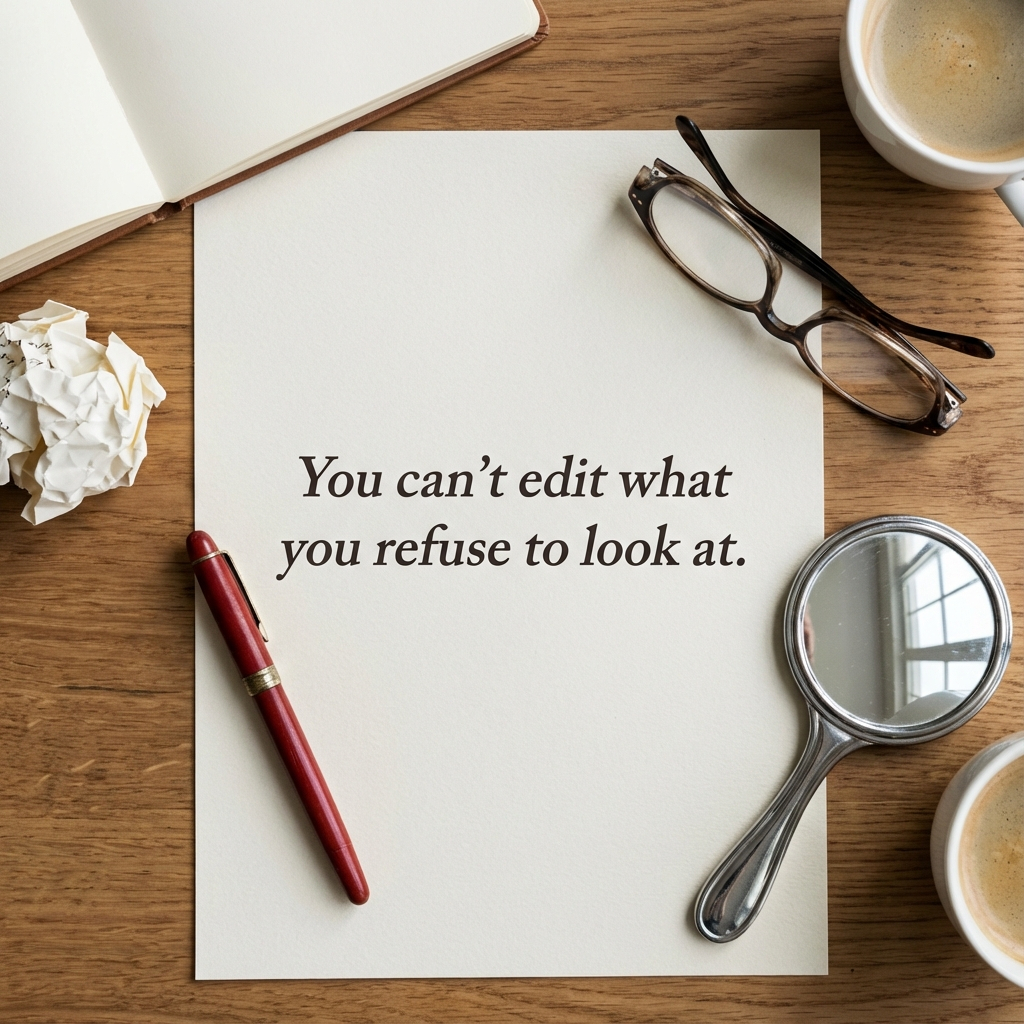
But you can’t edit what you refuse to look at.
Context Is Everything
I’ve always believed that context is vital. Whether I’m breaking down a news story or helping someone clarify their message, the work is the same: understanding how we got here and where we might be going next.
Your personal story is no different.
You didn’t just appear in this moment. You arrived here through a series of choices, circumstances, relationships, and events. Some of them you controlled. Most of them you didn’t.
But all of them shaped you.
When you ignore that context, you lose your ability to make sense of what’s happening now. You become reactive instead of responsive. You repeat patterns without understanding why.
And you miss the opportunity to choose what comes next.
Your Story Is the Only Thing You Truly Own
I’ve worked in theater, fashion, publishing, journalism. I’ve written five books. I’ve done over 300 podcast episodes. I’ve talked to authors, founders, philosophers, activists.
You know what all of them have in common?
The ones who succeed are the ones who own their story.
Not in a performative way. Not as personal branding. But as a genuine understanding of who they are, what they’ve been through, and what they’re trying to build.
Your story isn’t something to transcend or release. It’s the foundation of everything else.
It’s how you make decisions. It’s how you connect with other people. It’s how you know what matters and what doesn’t.
When you try to live without it, you’re not more present. You’re just unmoored.
The Path Forward
So no, I don’t think you should let go of your story.
I think you should understand it better than anyone else ever could.
I think you should interrogate it. Test it. See where it holds up and where it falls apart.
I think you should recognize that your narrative is the lens through which you see everything, and if you want to see more clearly, you need to understand that lens.
That’s the real work. Not escaping your story, but mastering it.
Not living in some imagined present moment where your past doesn’t matter, but integrating your past so fully that you can actually choose your present.
Because here’s the truth: you’re always telling yourself a story about who you are.
The only question is whether you’re aware of it.
Discover more from The Cameron Journal
Subscribe to get the latest posts sent to your email.