
I’ve always been suspicious of optimists.
Not because hope is wrong. I need hope as much as anyone. But I’ve watched too many people use optimism as a shield against hard truths, a way to avoid sitting with what’s actually happening in front of them.
Last month, philosopher Joe Atman told me that every negative can transform into something positive. It’s a beautiful idea. The kind that sounds profound in a quiet moment of reflection.
But I had to ask: what about the people who tried that and it destroyed them?
What about the entrepreneur who stayed optimistic about a failing business until she lost everything? What about the person who stayed in an abusive relationship because they believed love could fix it? What about the financial analysts who were so optimistic about the housing market in 2007 that they triggered a global economic collapse?
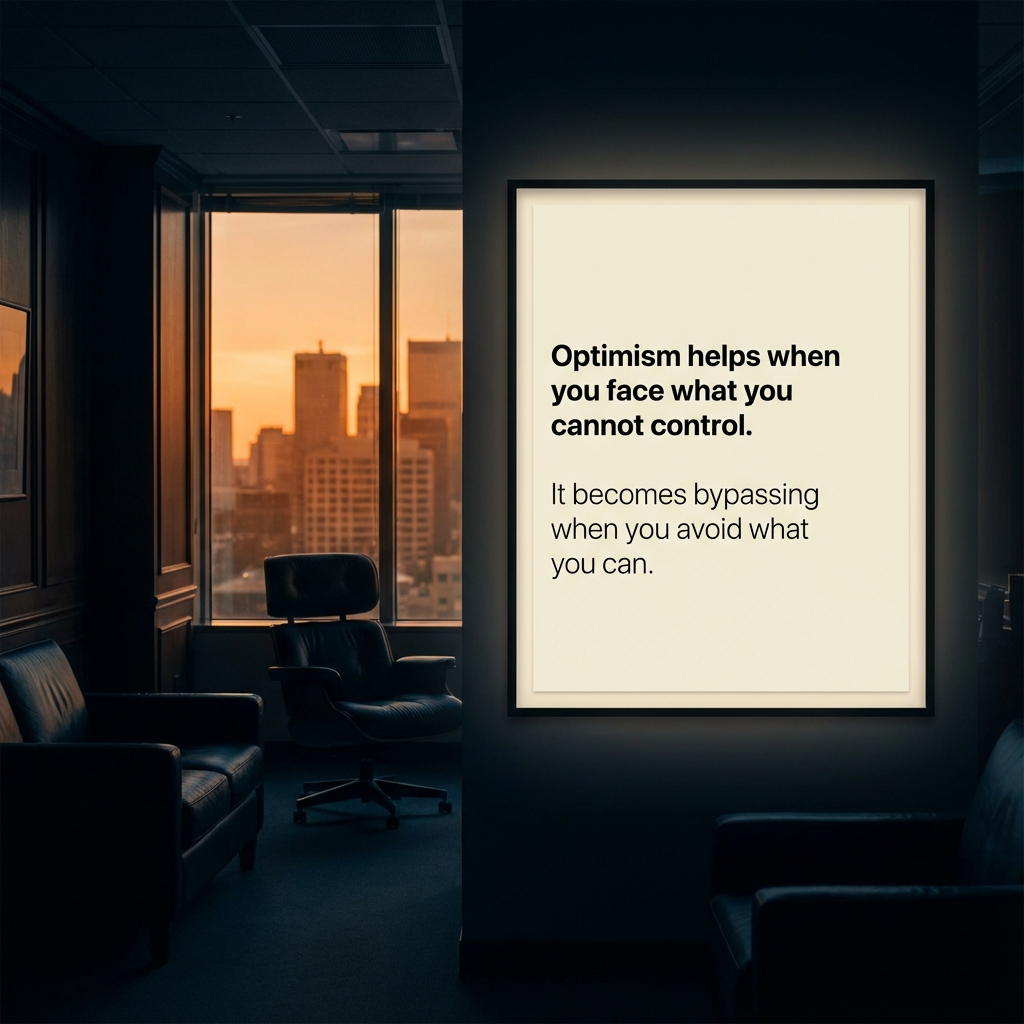
This isn’t about being negative. This is about understanding when optimism helps and when it becomes something else entirely.
The Science of Avoidance Dressed as Wisdom
Researchers have a term for what happens when people use spiritual or positive thinking to avoid difficult emotions: spiritual bypassing.
It’s formally defined as “a defensive psychological posture cultivated by a tendency to privilege or exaggerate spiritual beliefs, emotions, or experiences over and against psychological needs.” In plain language: using spirituality to dodge what you don’t want to feel.
The consequences are documented. Compulsive kindness. Spiritual narcissism. Emotional confusion.
Here’s the part that surprised me: research shows spiritual bypass “impedes a person’s ability to develop spiritually and increases the very pain from which the person is trying to disengage.”
The avoidance strategy backfires. You create more suffering, not less.
Studies found correlations between religiousness and staying in abusive relationships. Spiritual bypassing kept people trapped in genuinely harmful situations because they believed their faith or positive thinking would eventually fix things.
It didn’t.
When “Good Vibes Only” Destroys Your Health
The data on toxic positivity is even more stark.
Research shows unhappily married couples who maintain toxic positivity are 3 to 25 times more at risk for developing clinical depression than those who acknowledge their authentic emotions.
Read that again. Being fake-positive about a bad marriage doesn’t protect you. It triples your depression risk.
The physical consequences are real too. Suppressing negative emotions correlates with cardiovascular and respiratory disease. Your body keeps the score even when your mind tries to pretend everything is fine.
A study in the Journal of Personality and Social Psychology found that accepting negative emotions enhances psychological wellbeing. Validation of difficult feelings is protective, not harmful.
Another study had participants watch disturbing films. Those who suppressed their emotions had significantly more physiological arousal than those who let emotions show. Elevated heart rates. Pupil dilation. Sweat production.
They appeared calm. Inside, stress erupted.
This is what toxic positivity does. It makes you look fine while your body breaks down.
The Optimism That Costs Billions
Optimism bias is “one of the most consistent, prevalent, and robust biases documented in psychology and behavioral economics.”
Humans systematically overestimate positive events and underestimate negative ones. Across all cultures. All the time.
In business, there’s a growing body of evidence proving optimism bias represents one of the biggest single causes of risk for megaproject overspend. Oxford Health Plans lost $3 billion in shareholder value in a single day because of unrealistic optimism.
Multiple experts consider optimism bias to be one of the core causes of the financial crisis of 2007-2008. Collective unrealistic optimism produces large-scale economic disasters.
When Negativity Actually Works
Here’s where it gets interesting.
Studies show 30 to 35 percent of Americans employ something called defensive pessimism. They set low expectations strategically to motivate better performance.
And they tend to be very successful people.
Research demonstrates that defensive pessimists have significantly higher self-esteem over time compared to anxious people who don’t use this strategy. They scored higher on virtually all outcome measures in the study.
Defensive pessimists may outperform optimists of similar abilities. And here’s the kicker: asking people who use this coping style to adopt an optimistic outlook can reduce their task performance.
If you pressure defensive pessimists into being optimistic, their performance deteriorates.
Forced positivity actively harms certain personality types.
This matters because it means there’s no universal rule. The question isn’t whether optimism is good or bad. The question is: what does this situation require?
My Framework: When Optimism Helps vs. When It Hurts
After digging through the research and reflecting on my own experiences, I’ve developed a framework. It’s not perfect, but it helps me navigate when to lean into hope and when to sit with what’s hard.
Optimism helps when:
You’re facing something genuinely outside your control (like being laid off or dealing with illness)
You need motivation to take action on something you can influence
You’re supporting someone else through difficulty without dismissing their pain
You’re looking for meaning in tragedy after you’ve processed the grief
You’re building something new and need energy to push through obstacles
Optimism becomes spiritual bypassing when:
You use it to avoid acknowledging harm you’re experiencing or causing
You pressure others to “stay positive” when they need to feel their feelings
You ignore warning signs in relationships, business, or health because you believe positive thinking will fix it
You use spiritual concepts to justify staying in situations that require action
You feel shame about negative emotions and try to suppress them with forced gratitude
Research suggests that looking for silver linings is beneficial in uncontrollable contexts but harmful in situations people can control. Context determines whether optimism helps or hinders.
Viktor Frankl, who survived Nazi concentration camps, developed a concept called “tragic optimism.” It means acknowledging reality while finding meaning. Not denying difficulty. Not pretending everything happens for a reason. But refusing to let suffering be the final word.
That feels closer to what I’m after.
The Delta Between Narrative and Reality
In any given issue, there’s a delta between the reality of the situation and how we talk about it.
I’ve spent over 10 years trying to talk about things in that space between narrative and reality. The optimism narrative says every negative transforms into something positive. The reality is more complex.
Sometimes a negative is just a negative. Sometimes the lesson is that you need to leave. Sometimes the growth comes from acknowledging you can’t fix this with better thinking.
I’m not arguing for pessimism. I’m arguing for accuracy.
When Joe Atman told me every negative can become positive, he wasn’t wrong. But he wasn’t completely right either. Some negatives transform. Some don’t. And some people destroy themselves trying to force the transformation.
The wisdom is knowing which is which.
What This Means for You
If you’re someone who tends toward optimism, ask yourself: am I using this to see possibility or to avoid pain?
If you’re someone who tends toward pessimism, ask yourself: am I protecting myself or am I creating the outcome I fear?
The goal isn’t to land on one side. The goal is to match your response to what the situation actually requires.
Sometimes you need hope to keep moving. Sometimes you need to sit with what’s broken and let yourself feel it. Sometimes you need to acknowledge that your positive thinking is keeping you stuck in something that requires action.
Context is vital. Understanding the bigger picture matters. Knowing how we got here and where we might be going next helps.
But only if we do it in a sober way.
I’ve watched too many people use optimism to avoid hard truths. I’ve also watched people use cynicism the same way. Both are forms of avoidance.
The alternative is harder. It means staying with complexity. It means accepting that some situations call for hope and some call for grief and some call for anger and some call for walking away.
It means trusting yourself to know the difference.
That’s the framework I’m working with. Not perfect. Not universal. But honest about what optimism can and cannot do.
And in a world that wants simple answers, that might be the most optimistic thing I can offer.
Discover more from The Cameron Journal
Subscribe to get the latest posts sent to your email.