There are 2 distinctive USA’s and this book proves it
What if I told you that people are moving towards places that meet their values and staying away from areas that don’t meet their values? I’ve talked about the bubble that more and more people find themselves in; they are intellectually isolated on college campuses and elsewhere. According to Bill Bishop, author of The Big Sort, that isolationism is manifesting itself physically and he proved this by looking at what counties voted for Republicans or Democrats in every presidential election beginning in 1948 and moving forward. What he found was that overall, Republican counties get more Republican and Democratic counties get more democratic as time goes on.

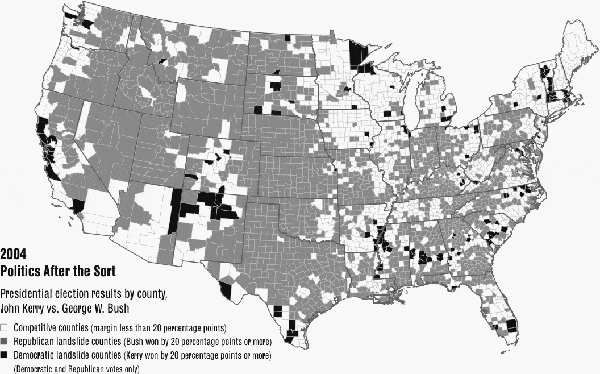
By the 2004 election, according to Bill’s data set, you could almost predict who was going to vote how, based on where they lived.
The advantage of this is that at the local level and even the state level, government can get much done. People generally agree on a central set of values and policy moves forward quickly. However, this divide makes any kind of national consensus practically impossible.
And I’ve come to an important conclusion: That’s exactly the way we want it
There are plenty of reasons for this kind of partisan divide. The first being that people on both sides of the aisle start from 2 fundamentally different value systems. On the left there is a value in community, that government can do good things and big things and that government is an important and valuable part of our lives on a variety of fronts. Socially, the left values open and new ideas in regards to gender, sexuality, personal choices, religion (or lack thereof) healthcare, and how we treat the environment. The right begins from a place that is usually religious based (which can also, but not always, begin from fear), a sense of lack, a deep seated desire to have government as far from their lives as possible, and a kind of social conservatism that reinforces traditional roles in society. Thanks to our winner-take-all system there is little quarter for allowing for in-between or centrist parties like the Green Party or the Libertarian party. The Big Sort’s effect on our political system is exacerbated by the electoral college. How many people vote for what candidate matters little compared to where those people live. When you vote for President you aren’t voting for the candidate themselves, you’re voting for electors to the electoral college who will vote for that candidate. This means that in presidential elections (the only election system in which we do it this way) it is less important to get the most actual votes but rather to get the most electors from each state (which is calculated by their total congressional districts plus their 2 senators).
This means that as people move towards areas that favor their already agreed upon political agenda, states are practically guaranteed to vote a certain way because the majority of the people that live there are practically guaranteed to vote a certain way.
The Big Sort is symptomatic of a larger problem. Increasingly, because of the very big differences in values that people have, people choose to isolate themselves. Online delivery of information, which requires the user to click on stories that interest them, further creates this balkanization. Conservative people read conservative blogs, liberals have their own (personal note: where do I fall?) and that means that each side is much less exposed to the ideas of their other. This extends into the physical world. Why would a Republican choose to live in a community that doesn’t share his or her values? Bill Bishop argues that they wouldn’t, and they try really hard not to live in those places (look at the above map for proof). When I asked Bill via email if things had gotten better or worse in 2008 and 2012 he gave a grim reply, “It’s gotten worse.” I’m sure more up to date maps would show even further separation between the America that begins from the fundamentals of conservatism and the America that begins from the fundamentals of Leftism.
This means that if you want great mass transit, open social ideals, and a greater sense of government involvement and community: move to a blue state and a blue county within that state. If you want traditional family values, less emphasis on transit besides the automobile, and less government involvement/independence and individualism then move to a red state and a red county within that state. What is even better is that no one has to tell anyone to do this, we’re doing it naturally, myself included. Between college students who are righteous against being offended and the right who creates their own media in order to make sure their “voice is heard;” no one in America is ready for political dialogue on a national level. This creates an inept and functionless national government leaving the states and cities within those states to solve their own problems without the heavy involvement of the federal government or any kind of national vision for the country that has moved the country forward so many times.
It’s exactly what we want and no one is invested in changing it.
We’re the people who left, we’re the people who wanted to get on leaky boats and come to America where there was as little government as we could stand. People have always been wary of big government and especially national government. We simply prefer local control where we can solve our own problems without outside help or meddling. It’s in our national fabric and in our very DNA. This means that under this sorting system the local government is empowered while the national government does progressively less and less due to a lack of consensus. The worst part is that this is happening at an entirely unconscious level. It’s just now being talked about.
What do you think? Have you recently moved to an area where people are more like you and share your opinions? Comment below!
Let me know what you think! on social media!
Facebook: The Cameron Cowan Show
Discover more from The Cameron Journal
Subscribe to get the latest posts sent to your email.