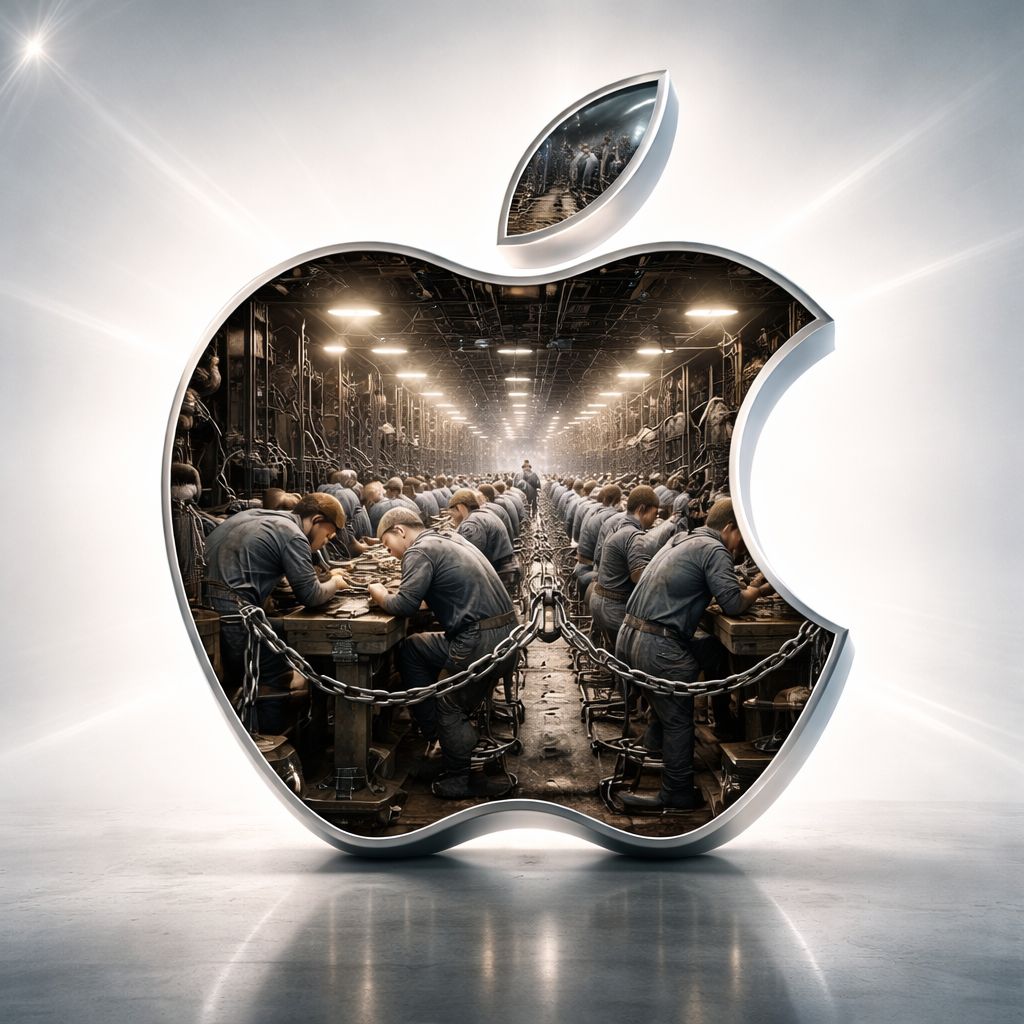
Between 2016 and 2021, under a secret five-year commitment made to Beijing, Apple invested $275 billion in the People’s Republic of China, a sum greater than all American and Canadian private investment in China combined, and equivalent, adjusted for inflation, to twice the total expenditure of the Marshall Plan that rebuilt sixteen European nations from the rubble of the Second World War. In the peak year prior to that pledge, Apple’s internal audit determined it was spending $55 billion annually inside China: not on components, not on raw materials, but exclusively on what stayed in the country, employee training, construction, wages, and the billions of dollars of proprietary machinery Apple placed on suppliers’ production lines and tagged, with no small irony, for Apple use only. To put that figure in context, the entire CHIPS and Science Act, the flagship Biden-era effort to reshore semiconductor fabrication to American soil, allocated $53 billion over four years. Apple was spending a CHIPS Act’s worth of investment in China every twelve months, for years running, in a single sector, in a single country.
Since 2008, Apple has trained 28 million workers on Chinese soil. That number exceeds the entire labor force of California, which would rank as the fifth-largest economy in the world were it a sovereign nation. The iPhone captures more than 80 percent of global smartphone industry profits while commanding fewer than 20 percent of unit sales, a ratio that tells you everything about the extraction model at work. And yet labor costs in China account for precisely 1.8 percent of the iPhone’s total value.
Foxconn, Apple’s largest contract manufacturer, has paid assembly workers as little as $2.76 per hour at its Shenzhen campus, with workers at smaller suppliers in Apple’s chain earning as little as $1.28 per hour. Reports by China Labor Watch documented workers completing more than 90 hours of overtime per month, nearly double what Chinese law permits, because base wages were insufficient to meet local living costs. In 2010 and 2011, at least 18 workers attempted suicide at Foxconn’s facilities, 14 of them fatally. Foxconn’s solution was to install nets around its buildings to prevent workers from jumping. This is the supply chain that produced your phone. This is what “cheap” actually means.
But the story of what “cheap” actually means does not end at the Foxconn production line. It extends, through a network of upstream suppliers and state-coordinated labor transfer programs, into one of the most extensively documented systems of political repression operating anywhere on the planet today. In China’s northwest, in the region the state designates the Xinjiang Uyghur Autonomous Region, the Chinese government has since 2017 imprisoned more than one million Uyghurs in what it calls “vocational education and training centres” and what leaked government documents, satellite imagery, survivor testimony, and the Chinese state’s own internal operations manuals describe as mass internment camps organised around coercive ideological re-education, predictive policing through AI-driven surveillance, forced labor deployment, and the systematic suppression of Muslim religious and cultural identity.
The China Cables, classified Chinese government documents obtained and verified by the International Consortium of Investigative Journalists, revealed in Beijing’s own administrative language the operational architecture of this system: instructions for surveillance, discipline, indefinite detention without charge, and the tracking of Uyghur citizens abroad through diplomatic missions. A subsequent leak, the Xinjiang Police Files, produced the first photographs taken inside the camps without official authorization, showing detainees in shackles, guards with clubs, and the hyper-militarised interior of facilities that the government had publicly insisted were pleasant schools. The United Nations Office of the High Commissioner for Human Rights concluded in 2022 that China’s actions in Xinjiang may constitute crimes against humanity.
The connection between this apparatus and the device in your pocket is documented. Uyghur workers who pass through China’s re-education facilities are transferred, under programmes the government labels “poverty alleviation” and “labor pairing,” to factories across China’s industrial zones, paid below minimum wage, unable to refuse placement without risking re-detention, and processed by a paramilitary organisation called the Xinjiang Production and Construction Corps, which sits at the heart of the forced labor economy.
Investigations by the Australian Strategic Policy Institute traced over a thousand Uyghur transfers to O-Film, a manufacturer of camera components for iPhones. The Tech Transparency Project documented Apple’s extensive supply chain links to companies operating within or drawing workers from Xinjiang. In response to the Uyghur Forced Labor Prevention Act, signed into law by President Biden in December 2021 and requiring American importers to certify their supply chains are free of Xinjiang forced labor, Apple lobbied Congress to water down key provisions of the bill, to extend compliance deadlines, to shift the burden of identifying Chinese forced labor companies from buyers to the federal government, and to limit public disclosure requirements.
Five major auditing firms withdrew from Xinjiang because they could not conduct credible audits under the conditions of authoritarian surveillance that the Chinese government maintains there. Apple has continued to insist it found no evidence of forced labor anywhere it operates. The camps, the transfers, the shackles in the photographs, the government’s own operations manuals: none of this, Apple assures us, has touched their supply chain.
None of this happened because of corporate villainy in the conspiratorial sense. It happened because of a geopolitical design hatched in Washington more than fifty years ago and carried forward with bipartisan consensus ever since. When Richard Nixon landed in Beijing in February 1972, the first sitting American president to set foot in the People’s Republic, he was not making a humanitarian gesture. He was executing a cold strategic masterstroke born of triangular diplomacy, the foreign policy doctrine he and Henry Kissinger had constructed to exploit the Sino-Soviet split.
After years of ideological rupture between Moscow and Beijing, the two largest communist states on Earth had become bitter adversaries: Soviet and Chinese troops had clashed along the Ussuri River as recently as 1969, and the Soviets had even quietly asked the Nixon White House how it would respond to a Soviet nuclear strike on China. Nixon saw an opportunity. By drawing China toward the American orbit, offering integration into the international trade system, diplomatic recognition, and the implicit promise of economic modernisation, the United States could drive a wedge between its two greatest rivals, force the Soviet Union to compete for American favor, and structurally fragment the communist bloc from within. It worked. The Soviet Union ceased to exist in 1991.
Deng Xiaoping, who understood this logic well, opened China’s manufacturing capacity to American capital with the same strategic clarity that Nixon had brought to the original rapprochement. The invitation of American corporations into China was not a capitulation. It was a deliberate policy of controlled engagement: absorb Western technology and capital, build indigenous industrial capacity on the back of foreign investment, and emerge from the transaction as a peer competitor rather than a dependent.
The American political establishment, from the Clinton administration’s shepherding of China into the World Trade Organization in 2001 to the decades of quarterly earnings calls in which Wall Street applauded offshoring as shareholder value creation, blessed this arrangement at every stage. American corporations did not steal into China against the wishes of the republic. They were sent there by the republic’s own logic, a logic that prioritized the containment of Soviet power, the extraction of cheap goods, and the maximization of profit margins, in that order.
What happened next is the story that makes the current hysteria so richly dishonest. Apple, responding with perfect internal rationality to the incentive structures that American consumers and American policy jointly created, built a supply chain in China so sophisticated and so deeply embedded that Tim Cook himself, in a 2017 interview, admitted that a meeting of American tooling engineers, the specialised manufacturing workforce on which precision electronics production depends, could barely fill a room, while the equivalent meeting in China would fill multiple football stadiums.
The vocational school for advanced electronics manufacturing in China is, in large measure, the Apple corporation. Having trained its suppliers to extraordinary levels of precision and then encouraged those suppliers to diversify their customer base to prevent dependency, Apple told its suppliers, in effect, to grow with other companies as fast as they grew with Apple, it then watched those suppliers extend the same manufacturing competence to Huawei, OPPO, Vivo, and Xiaomi, who now hold 55 percent of global smartphone market share. Apple did not merely build a supply chain. It built an industry. And that industry, predictably and without apology, became Chinese.
The American consumer stands in the rubble of this arrangement and calls it betrayal. This is the central imposture that demands to be named. Foxconn pays its workers between $3 and $3.63 per hour. The federal minimum wage in the United States is $7.25 per hour, a figure that has not been raised since 2009 and that itself does not approach a living wage in any major American city. California’s minimum wage is $16.50 per hour. Economists at Wedbush Securities estimate that an iPhone manufactured entirely by American workers would cost approximately $3,500. Other estimates, accounting for the full supply chain and the absence of the specialized tooling workforce that China has spent decades developing, range considerably higher, as high as $8,000 for one iPhone.
Commerce Secretary Howard Lutnick, in one of the more hallucinatory public statements of the current administration, described the American manufacturing future he envisions as one involving “millions and millions of human beings screwing in little screws.” What he neglected to mention is what those human beings would be paid for their labor, what those screws would cost as a consequence, and whether the American consumer who currently upgrades their $900 iPhone every two years would be willing to pay $3,500 to $8,000 for the next one. The silence on this question is, itself, the answer.
The American consumer is not a passive victim in this arrangement. They are its primary architect. Every purchasing decision aggregated across millions of American consumers is a vote cast in the only democratic process that capitalism genuinely respects.
For decades, the American consumer voted, with unmistakable clarity, for cheap. They voted for it at Walmart, which built an entire logistics empire on the premise that Chinese-manufactured goods could be sold to American consumers at prices American-manufactured goods could not match. They voted for it, waiting in line outside every Apple store when a new model was released. They voted for it in the quarterly earnings reports, they applauded as index fund holders, understanding on some level that the profit margins they were celebrating were sustained by the suppression of labor costs on the other side of the planet. And then, having cast those votes consistently and enthusiastically for forty years, they turned around and accused the corporations that tallied those votes of national betrayal. This is not politics. This is the rage of a deluded consumer who knows nothing about how the system they are complicit in actually works.
There is a history available to the American consumer that ought to produce something rather more than rage at corporations. It is a history written in the blood of people who faced, with a courage that the contemporary American political imagination seems constitutionally incapable of recovering, the actual conditions required to discipline capital. On May 9, 1934, thirty-two thousand dockworkers shut down every port on the Pacific Coast from Bellingham, Washington, to San Diego, California. Shippers attempted to break the strike by force. What followed on July 5, 1934 (Bloody Thursday) was open warfare on the San Francisco waterfront: police and hired security forces attacking strikers with tear gas and live ammunition, killing two workers and wounding dozens more. The longshoremen did not yield. The strike ignited a four-day general strike that paralyzed the entire city of San Francisco. They won.
In Flint, Michigan, in December 1936, workers at General Motors deployed a tactic that the company had never encountered: they did not walk off the job but occupied the factory floor, camping inside the plants and making it physically impossible to resume production or to bring in replacement workers. When security guards and police stormed the Chevrolet plant in January 1937, releasing tear gas into the crowd, the workers fought back with fists, bottles, fire hoses, and car door hinges. They held the plants for forty-four days. General Motors, one of the richest corporations on the planet, a company that had never once recognized a union, capitulated. The United Auto Workers had won.
On Memorial Day 1937, supporters of the Steel Workers Organizing Committee marched toward Republic Steel’s South Chicago plant and were attacked by police who fired into the crowd: ten workers killed, eighty-four injured. Republic Steel refused to recognize the union. Four years later, in 1941, under sustained pressure, it finally did. The Ludlow Massacre of 1914, in which the Colorado National Guard and company guards attacked a tent colony of striking coal miners, killing two women and eleven children, did not break the miners’ movement. It radicalized it. At the Battle of Matewan in 1920, a police chief named Sid Hatfield and a group of armed miners faced down a squad of Baldwin-Felts detective agency men who had come to evict striking families, and seven of those detectives ended the day dead. The miners celebrated.
These were not gentle people making strongly worded statements. They were workers who had arrived at the elemental conclusion that capital would yield nothing without existential pressure, that the question of who controlled the conditions of labor was a political question, settled by force or not at all. Union membership in the United States grew from 2.8 million workers in 1933 to 8.4 million by 1941, and to nearly 15 million by 1945, covering a third of the non-farm workforce. At its peak in the mid-1950s, private-sector union density reached 35 percent.
The American middle class, the weekends, the eight-hour day, the employer-sponsored healthcare, the pension, and the living wage were not gifted to workers by enlightened executives. It was extracted from those executives by a movement willing to die for the right to bargain. And then, systematically and with the enthusiastic assistance of an American public that had absorbed fifty years of red-baiting and anti-union propaganda, it was dismantled. The Taft-Hartley Act of 1947 began the legal erosion. The Reagan administration’s destruction of the air traffic controllers’ union in 1981 announced that the state itself would function as a strikebreaker. By 2022, private-sector union density had collapsed to 6 percent, the lowest rate in over a century. One in twenty private-sector workers belongs to a union today, down from one in three in the 1950s.
The Economic Policy Institute has documented the direct causal relationship between this collapse and the stagnation of American wages: as union density fell, the wage premium that unions had historically extended even to non-union workers evaporated, and income inequality returned to levels not seen since the 1920s. In 1978, the top one percent of Americans received 8.9 percent of all national income. By 2007, that figure had risen to 23.5 percent. The Wall Street Journal reported in February 2025 that the top ten percent of American households now account for nearly fifty percent of all consumer spending, up from thirty-six percent in 1989.
The American economy has bifurcated into a class of affluent consumers capable of absorbing price increases and a working majority for whom cost is not a preference but a survival constraint, a majority whose wages are suppressed, in part, by the very union decline that made cheap offshored goods seem necessary in the first place. This is not a coincidence. This is the system working as designed. Cheap goods from China were, among other things, a compensation mechanism: a way of maintaining the consumption levels of a workforce whose real wages were being systematically compressed. The price of an iPhone was kept low so that workers paid low wages could still buy iPhones. The circle of exploitation was complete and, from the perspective of capital, elegant.
Into this situation walks Donald Trump, waving a tariff poster in the Rose Garden and calling it Liberation Day. On April 2, 2025, his administration announced reciprocal tariffs at rates unseen since the Smoot-Hawley era of the 1930s, applied to virtually every trading partner on Earth, allies and adversaries alike. Canada, whose economy shrank 1.6 percent in the second quarter of 2025, largely due to falling exports. The European Union, slapped with a 20 percent levy and simultaneously squeezed by Chinese industrial overproduction flooding its markets. Vietnam and India, the very countries to which Apple had begun diversifying its assembly operations to reduce China dependence, tariffed into unviability.
Within days of Liberation Day, Apple had lost $800 billion in market capitalization. Every American with money in an index fund watched their largest holding evaporate. Trump exempted smartphones and computers from the tariff regime almost immediately. He had blinked. And in blinking, he had done something remarkable: he had granted Apple, the corporation whose China entanglement most directly enables Beijing’s “Made in China 2025” industrial strategy, a specific exemption from the only policy instrument he possessed. The tariffs on Chinese kitchenware remain. The tariffs on advanced electronics do not. In August 2025, Tim Cook presented Trump with a custom-designed 24-karat gold plaque featuring engraved glass.
This is late capitalism at the precise moment of its most spectacular self-revelation. Ernest Mandel, whose 1975 treatise gave the concept its canonical formulation, described the terminal phase as one characterized by the dominance of multinational corporations, rampant financialization, mass consumerism built on the suppression of wages, and the systematic externalization of costs, onto labor, onto the environment, onto the future, that the system refuses to account for in price. Fredric Jameson deepened the analysis by arguing that late capitalist societies lose their connection to history entirely: they become societies of the eternal present, defined by the consumption of surfaces, constitutionally incapable of understanding how they arrived at their current condition or what it would actually cost to change it.
The American consumer who demands $700 smartphones, $100 sneakers, $15 t-shirts, and simultaneously demands that manufacturing return to American shores and that Chinese labor be paid American wages, is not confused about economics. They are the perfect Jameson subject: a person so embedded in the logic of commodity consumption that they have lost the historical imagination required to understand what the commodity actually costs, who actually pays, and what it would mean to pay honestly.
And here is where the indictment must extend beyond the consumer and onto a section of the Western Left that has added its own particular species of moral failure to the wreckage. There is a political tendency, rooted in what is correctly called campism, whose logic runs as follows: the United States is an imperial power; China opposes the United States; therefore, China is progressive; and therefore any criticism of China’s domestic conduct is objectively in the service of American imperialism. This is not an analysis, and it collapses immediately under the weight of its own implications.
It means that the more than one million Uyghurs documented by the United Nations, by the Council on Foreign Relations, by the United States Holocaust Memorial Museum’s genocide prevention center, and by China’s own leaked government files have been arbitrarily detained in a system of mass internment camps, and must be dismissed as fabrications of the American national security state. It means that the Xinjiang Police Files, photographs taken inside those facilities by officials who did not intend them for public consumption, must be disbelieved. It means that the operational manuals for the camps, verified by independent forensic linguists and intelligence analysts as authentic Chinese government documents, must be ignored. The campist does not say: the evidence is wrong. The campist says: the evidence is irrelevant, because the country producing the evidence is America, and America is the enemy. This is not solidarity with oppressed peoples. It is solidarity with whichever state apparatus happens to be opposing Washington at any given moment, regardless of what that apparatus is doing to the human beings under its control.
The historical logic used to underpin this position is no more robust than the moral logic. Sections of the campist Left have adopted, with apparent sincerity, Beijing’s own official account of Xinjiang as ancient and unbroken Chinese territory, a claim that requires rewriting both the actual history of the region and the elementary principles of how the Left has always understood the national question. Xinjiang, whose name means simply “New Frontier,” was conquered by the Qing dynasty in the mid-eighteenth century in a campaign of imperial expansion that was, by any honest account, exactly that: imperial expansion.
The Qing were not Chinese in the ethnic sense the contemporary state deploys; they were Manchu. The territory was incorporated by force, administered by external officials, and regarded, on numerous occasions, by the Qing policy elite themselves as a colony that might at any moment be abandoned. The people who have lived there continuously as Uyghurs, speaking Turkic languages and practicing Islam for centuries, did not arrive as the guests of a sovereign Beijing. They were there long before Beijing had any jurisdiction over the land, and their assertions of political identity have a history as long and as legitimate as any national movement that the Left has ever chosen to support. To argue, as the campist position requires, that dynastic Chinese empires’ intermittent administrative claims over a region they often could not militarily hold confer legitimacy on the mass imprisonment of its Muslim population in the twenty-first century, is not a Left analysis. It is the logic of every settler-colonial state that has ever justified dispossession by appealing to ancient maps.
The connection between this failure of the Left and the consumer economy described throughout here is structural. Apple lobbied against legislation designed to break the forced labor system feeding its supply chain. The American consumer bought the products that made that lobbying necessary. And a section of the Western Left, committed to a campist framework that treats every Chinese state atrocity as an American propaganda operation, provided the intellectual cover that made sustained accountability impossible.
These are not three separate stories. They are one story about a system in which the extraction of cheap goods from authoritarian states, the suppression of any political force capable of disciplining that extraction, and the ideological justification of that suppression by people who call themselves leftists have all converged into a single, self-sustaining structure. The Left that is genuinely interested in the liberation of working people, all working people, including the Uyghur workers transferred by state decree to factory floors at below-minimum wages without the right to refuse, cannot continue to exempt China from the same internationalist standards it correctly applies to every other state apparatus. The test of a genuine socialist internationalism is not whether you oppose the empire you live inside. That is the minimum. The test is whether you are willing to oppose oppression regardless of which flag flies above it.
Consumer power, collectively deployed with discipline and duration, is a form of political force that capital genuinely fears because capital requires consumption to survive. If American consumers had organized, decades ago, around the principle of paying the honest price for domestically manufactured goods, if they had sustained that commitment with a fraction of the ferocity that the 1934 dockworkers sustained their eighty-three-day strike, the calculation of offshoring would have been different. If they had preserved the union density that made the postwar middle class possible, the wage suppression that made Chinese labor comparatively cheap would have been arrested. If they had recognized that the right to refuse, to boycott, to withhold, to strike as consumers and as workers simultaneously, is not merely available to them but constitutes the only democratic language that the market actually speaks, the trajectory of the last forty years might have looked different. The power was always there. The will was not. And without the will, the power is inert.
The factories will not return because Trump imposes tariffs in his deluded Liberation Day orgy. They will return, if they return at all, because Americans rediscover the courage of the people who shut down San Francisco in 1934, who held the floors of General Motors plants for forty-four days in January 1937, who died on a Chicago street on Memorial Day of that same year because they understood that the conditions of labor were a political question and not a market outcome.
The outrage over corporate disloyalty is not wrong. It is merely misdirected, and, in its misdirection, it is useful to exactly the class of people it imagines it is targeting. The corporation goes where the incentives are. Change the incentives, or accept the consequences. Everything else is noise. And the American consumer, scroll-weary and conviction-free, continues to generate an extraordinary quantity of noise while paying, with perfect punctuality, the price that the system charges for their silence.
Discover more from The Cameron Journal
Subscribe to get the latest posts sent to your email.