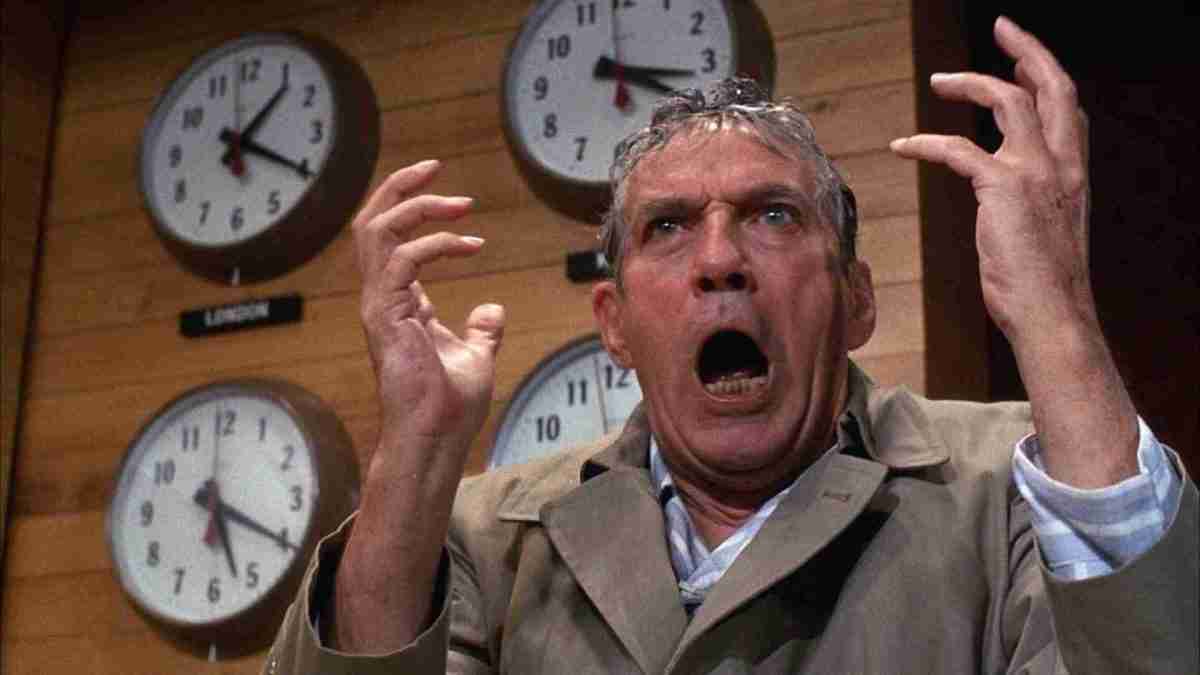
Most everyone reading this will not have been alive when Network came out in 1976. It is one the best socio-political movies ever produced. Starring Faye Dunaway and an eclectic cast of characters, it examines the life of aging evening news caster Howard Beale on the fictional UBS network. At the time in the 70s, evening news was king. It was the new internet and when the TV spoke, everyone listened. In this scenario, Howard Beale is plagued by a divorce and low ratings/share which at the time of the volatile TV business could make someone a darling one week and dead in the water the next.
As you can imagine, this creates a firestorm of reporters and network executives that descend down onto the news division of UBS. They wish him away and tell him that he’s out immediately. However, this is not to be the end of his fate. They give him a chance to talk once more as a goodbye and he announces on air that he has, “run out of bullshit.” He then goes on a deluded rant of epic proportions and much to delight of Faye Dunaway’s character, does the best overnight TV ratings in years. At this time, overnight ratings were very important for all programming and gauged how much viewers actually cared about what was on and of course ratings mean advertising dollars.
Having quality programming on your network, back in the 70s was vital. Local TV stations were not wedded to the TV networks the way they are now. Back then some TV networks didn’t even host all the programming from the same network. Especially in small town states, they would pick and choose what to air from what network. The networks would vie for affiliates with quality programming. Most major markets had a representative for each of the networks. If you would like to Continue reading about the history of TV (in particular cable TV), you could check out this post over on Infinity Dish to learn more – it really has changed so much over the years.
In this movie universe, it was no different. UBS had been the distant 4th network for several years. Until Howard Beale and his rantings started. That’s when VP of programming Diana Christensen (brilliantly played by Faye Dunaway) decides that if they can capture the energy of Howard Beale and his anthem of “We’re mad as hell and we’re not going to take it anymore.” On the side of this, Faye Dunaway’s Diana Christensen engages in a disastrous romance with the head of the news division at UBS. It’s quite obvious that she takes on new men and disposes of them just as quickly with a completely disregard for their feelings and her own. Rather than face the reality of feelings, she’d rather dump him to start up a new romcom next week with a new character. It’s a tremendous comparison not only to the public addiction to the neat structure of TV shows but also to what happens when reality fades from view.
In the beginning, it starts out as commentary news, but people get bored with it and just as they are about to go back to the old format of news, Howard goes off again, clothed in pajamas and a raincoat he tells everyone to get mad about the world around them, he tells them to get really mad about what is going on around them and how the world is changing. The ratings hit the roof and The Howard Beale Show is born as Diana gleeful struts around the UBS offices thinking only of the market share UBS was about to gain from his rantings on reality.
In the background of this, Diana is arranging a new show where they do a fictionalization of real terrorist acts of a black resistance group (much to the dislike of one of their leaders) and engages in a romance with the head of News who managed to get himself quit-fired in the process of creating this new kind of programming. The TV business was changing and news was changing. Alongside this film, many of the things we now complain about in media were slowly becoming trends. In the world of 1976, institutions that previously had been revered had been found to have holes. The government had lied about Vietnam and President Nixon and gotten on TV and lied to the entire nation and the entire world about the break-in at the Watergate hotel. Nothing seemed real or believable anymore. When there are gaps in reality, we want to fill it with something and we did: with TV.
Now, we get to the important part.
Imagine, if the character of Howard Beale was aware of reality TV. Indeed, Diana’s concept of creating stories around real life terrorist events was a very early form of a genre that would start with survivalist shows and give us everything from Big Brother to Keeping up with the Kardashians. Indeed, reality TV has become exactly what the fictional Howard Beale warned us about. He didn’t want people to get confused about what was actual reality and what was a creation of storytelling. But between 1976 and now, that line has become increasingly blurred. For so many people, reality is what is on TV and that content, thanks to the tablet and smartphone is now carried with us, everywhere, at all times.
While TV, at it’s pinnacle in the late 70s, never achieved the horrors of what Howard Beale was talking about, the technology that succeeded it, the internet, certainly has. Celebrities have had fake deaths, conspiracy theories have run amok with no basis in fact and now people can become famous simply for being on TV and living their lives. It does not matter how much it is produced or how much fake drama is created, it is taken for granted that it is a kind of reality and that regular non-TV people (the rest of us) are something quite different. Just as he pointed in the speech about how people only read so much information from a shrinking group of sources; the same problem plagues us today. If people knew as much about food deserts, hunger, government spending, and economic policy as they do about the latest entertainment news, our society would change quickly. But that is no longer in the everyday reality of most people. Thanks to virtual reality and augmented reality (think PokemonGO), this is only going to get worse.
Imagine what Howard Beale would think of the very concept of “augmented reality” or “reality TV?” How can the vivacity of the human experience be distilled down to 42 minutes of easily consumable content? How could a world of people looking at their phones to capture imaginary creatures be something that we could find uplifting and valuable?
The real question is this: what kind of world do we want to live in?
I’ll leave the reader with this:
Discover more from The Cameron Journal
Subscribe to get the latest posts sent to your email.