
Welcome to The Cameron Journal Newsletter. Each week, Cameron Lee Cowan wraps up the headlines with commentary, helping you navigate today’s media narratives, how they are affecting our Culture, Lifestyle, and Society.
Update from Cameron
Refresh Your Inbox with Newsletters
Vee and TV newsletter
Never miss a hidden gem again when it comes to TV Shows. In less than a minute, get all the curated TV show release updates in your mail. ReleasesTV’s free newsletter, run by fellow TV Enthusiast—Vee, delivers a quick weekly update on the latest upcoming shows (new and renewed).
Check out his TV newsletter, you may just like it.
If you like The Cameron Journal newsletter and are looking for other newsletters, you should check out this list. I hope you find something interesting to read that you love just as much as The Cameron Journal.
Sign up for CameronJournal+
If you love these newsletters and want to support my work breaking down news narratives at The Cameron Journal, please consider signing up for CameronJournal+. You will get exclusive content for CJ+ subscribers, access to our Discord, and special hangouts with me. It’s the coolest club in town! Don’t want to subscribe but want to support? I take donations at Kofi.
The News Narratives of the Week
Don’t forget to join me on Monday for The Cameron Journal Newshour, and we’ll be back on Tuesday for the State of the Union
Attack on Iran
We’ve been anticipating a major attack on Iran given the movement of US air assets into the region over the past few weeks, and it appears that today is that day. Overnight, just as I was about to go to sleep, the New York Times announced that the US and Israel had launched attacks on Iran, including bombing an elementary school (there has been backlash online about this already). Reportedly, 87 girls were killed at the girl’s elementary school because it was on a military base and in a building where essential military equipment and staff were also working.
I found this tweet to be a helpful breakdown of the situation. According to some reports, Israel started the attacks and then the US and even the UK joined in the attacks. Some reports say that the straight of Hormuz (much of world trade and oil shipping) has been closed, but those reports are more rumors than anything else. Hezbollah is not currently doing anything and according to some rumors, Iran is not going to hold back on using all of its resources to strike back.
After sleeping, I was out running errands when the report arrived that Ali Khamenei, the supreme leader of Iran, has been killed (presumably in his bunker outside of Tehran). Before his death, and presumably ordered by him, Iran struck back at its neighbors and US military installations in the region. Iran fired missiles that killed people in Dubai, Tel Aviv, Haifa, and points in Qatar, Kuwait, Bahrain, and Jordan.
According to Israel, they have also killed the Iranian Defense Minister, and that leaves Iran without much leadership at this moment. What will their response be from now on? Who will the world be negotiating with? Who will take over the Iranian government? How will it continue to operate, and will this inspire protestors to get involved and use this moment to topple the regime? However, for those hoping that this will lead to regime change or an embrace of the West, it appears that is not quite the case. Cyrus Jenssen reposted this YouTube comment he received that I thought described the situation accurately.
There will likely be more updates after you read this, so keep an eye on my X (formerly known as Twitter) for the latest updates.
Georgia Election Fraud Update
I’ve been hearing some interesting things on YouTube about the 2020 election and the recent seizure of ballots by the FBI has part of President Trump’s investigation into his loss. And let’s not forget, Georgia was a focus at the time when President Trump called Ben Raffensberger, the Secretary of State, and Brian Kemp the governor of Georgia (both GOP) and asked him to vindicate 11,780 votes because that was the difference between him and Biden at the time. Kemp rebuffed his demands to “find me 11,780 votes” it appears that after multiple independent counts in Arizona in 2021, Georgia is the latest target. So I decided I would put together what I could find so far on everything for you.
1) Fulton count has some issues with “sloppy” and “disorganized” processes, but both the state board of elections (GOP) and the Secretary of State (also GOP) found nothing criminal or that was affecting vote counts. They have found that Fulton County does not have ballet images for all ballots scanned and that there were some double scans, but that was standard human error and did not impact the count.
2) The seizure is seen as dangerous to future elections and that although the warrant may have misled the judge, the precedent could allow the Federal government to seize election records and ballots anywhere and everywhere in future elections. Considering we have an election in November, this is an important detail.
3) Back in 2020, the state board of elections referred 35 cases of voter fraud for criminal prosecution, and those cases have already moved forward. You can see all the cases filed across the country at this helpful link from the Heritage Foundation.
4) The motivation for the seizure in Fulton County came from those inside the White House, who are still hard-core election deniers. You can read the affidavit for the search right here.
5) The bulk of the evidence and research that was used to get the warrant for the seizure of voting records for the 2020 election came from Kevin Moncla. His company has produced a 263-page report on the various election violations, particularly in Fulton County, in the 2020 election. You can read the full report here, but I’ll give you some highlights. Those highlights include poorly prepared machines, encryption keys that were exposed to open view in a text document, various other violations of voting laws at the state and federal level. The most damning part that looks a bit suspicious to me is the voter turn out. According to Moncla, Fulton County had the highest voter turn out in the nation at 98% in the 2020 election. That’s unusual but excusable. What has raised a red flag for me, is where he reports that there were more votes than voters. According to him, the number of votes cast is 113% of the eligible voters in Fulton County. A few being improperly cast would be normal, but that’s a big overage. Now, that could be explained by double counted ballots that were later corrected before certification. It could also be explained by provisional ballots. But a reason for that definitely needs to be found. You can learn more about Kevin and his research at this ProPublica article.
6) Judges in other states have stopped the Trump administration from accessing voter lists, although some states like Texas have complied with the demand.
7) The Georgia state Board of Elections has declined to seize control of Fulton County elections (for now) in a recent decision. Although there is a possibility of doing it later, possibly in time for the 2026 mid-term election.
I have not seen reports of any arrests so far and right now, both the FBI and Fulton County are in mediation talks about the ballot records and how that will proceed. I will admit that some of the problems that Kevin has brought up so seem like they need to be investigated, but also can’t believe that it has taken this long to get these answers.
He presents evidence from the county reporting systems, but then we would have questions around the certification process, and it would be interesting to see Fulton County people involved in the election present their case against these allegations. Fulton County did use Dominion voting machines (per Moncla) and Dominion has already sued and won against Fox News in court regarding the 2020 election, and they had to prove that what Fox News said was false, and they cleared that standard. I think the biggest issue is that the DoJ did not do its investigation, it appears to have relied on a variety of election deniers to get the job done. This is similar to what happened in Arizona in 2021.
I definitely see how Fulton County was sloppy, and given the controversy around the count in that election that’s not the processes needed to dispel this narrative. I will say that I am open to more questions and investigations than I was before I did this deep dive. I would encourage you to look through the links and research for yourself to learn more.
Citrini Gives a Vision
This week, Citrini research shoved its way into the middle of the AI debate. They accomplished this by writing an article describing a future in 2028 where the economy starts to completely fall apart due to the rise of AI. The US is primarily a white-collar service economy (no one mentions our trade surplus in services) and how when companies start to use AI and lay people off (which is already starting) that compounds in less spending which then sends companies to cut head count and invest in more AI to do those jobs, and it comes a “cycle with no natural brake.” This also creates other problems. AI doesn’t pay taxes at the individual level, and AI doesn’t consume anything.
Their main thesis is that anything in the economy that is predicated on reducing frictions is doomed. Retail and e-commerce are also in trouble. Humans don’t have time to price match across 5 different websites, but AI certainly does. Much of the financialized economy (insurance, bonds and so on) starts to collapse as the underlying assets no longer pay out the money that they are supposed to pay out. This then causes a capital crisis, with assets beginning to collapse. And they go on and on about all the areas of the economy that are impacted by the layoffs and the resulting mass unemployment. They also point out that these former white-collar workers will start to fill in to service sector jobs like food delivery and such and that depresses wages there too, even has new dashboards help drivers find the best deliveries and companies have to pay up to drivers to get them to take their deliveries. People will be ordering less food by delivery, too, leaving more people trying to get a cut of the ever-fewer dollars moving through the economy. Those that can save money do because they fear they are next in the layoff cycle.
For the first time, probably in human history, we have invented a machine that will not create more jobs than it destroys. Citrini says that construction and healthcare employment “remain flat” in their 2028 scenario. And let’s face it, if people aren’t spending as much we won’t need to build as much housing (because no one can pay) and we already have too much commercial retail space so that will crater as well. This is really great news for China where they make tangible objects, but the question then becomes, who will buy them and with what money? China’s factories are already well-automated and require very little human interaction. Re-industrialization may provide some jobs in construction and support services, but who will buy the goods these factories will make? Increasingly, fewer and fewer people will have income to consume products, and much of the global economy is predicated on this. They even get into how AI agents will use cryptocurrency to cut out the credit/debit card companies. The very basis of American wealth and power (and other country’s too) could be seriously impacted as the cost of knowledge and services dips to zero.
Citrini Research ends the article by reminding us that we don’t have to walk blindly into this future. Jamie Dimon over at J.P. Morgan has mentioned that business and government need to start working on a transition plan now before things get bad, protests break out, and things become a powder keg.
I’m reminded of a couple of interviews that I had on the podcast. The first was back in 2024 with Stefan Fehr who said employment won’t exist by the end of the decade and Ron Hetrick who said we would have on growth simply because of demographics. In this case, having fewer people and fewer workers could actually be a good thing (read as a question).
What this article does is tell a compelling story and a frightening one. It is good to point out that a similar pattern happened to blue-collar workers as factories left in the 1990s and 2000s for cheaper labor overseas. However, other jobs were created, a few people retrained, some never recovered and some kids grew up in houses where they never even got off the ground. However, what makes this different is that we are talking about the bulk of consumer spending being removed from the economy and no new jobs to be created in their place? Many blue-collar workers found a new place in a shifting economy, this time there will not be a new job to go and get. I will say that it is my guess that human labor of any kind will become quite expensive and that doesn’t even get us to the new robots that Elon Musk is created and how everything else might be getting automated too. As Ron Hetrick lamented, he wished that technology were busy making it easier to put roofs on houses. Citrini asks the questions, “And who will buy the houses and pay for the new roof?” New factories and new jobs won’t save us this time but it is not clear what will. Are we going to have to talk about UBI? Are we going to be talking about major deflation of money, so things become cheaper (but will cause a major debt crisis).
We don’t have those answers right now, but it appears that we’re going to need them quickly. There has been some push backalready on this piece. Lots of talk about white-collar workers finding new paths in blue collar jobs in the real world where the government steps in to create new employment projects. However, I seriously doubt someone who was working at Salesforce will easily slot into a job at a desalination plant. Any job that requires a human will be in high-demand without something to moderate this economic change. But we are going to need to think about what is the future of the real, human economy. What place will humans play in the economy of tomorrow? What does money mean? What does “retirement” and all of these terms mean in real terms?
Articles of Interest
Keep up with The Cameron Journal Podcast and The Living Joke

The Interview:


The Cameron Journal Newshour:
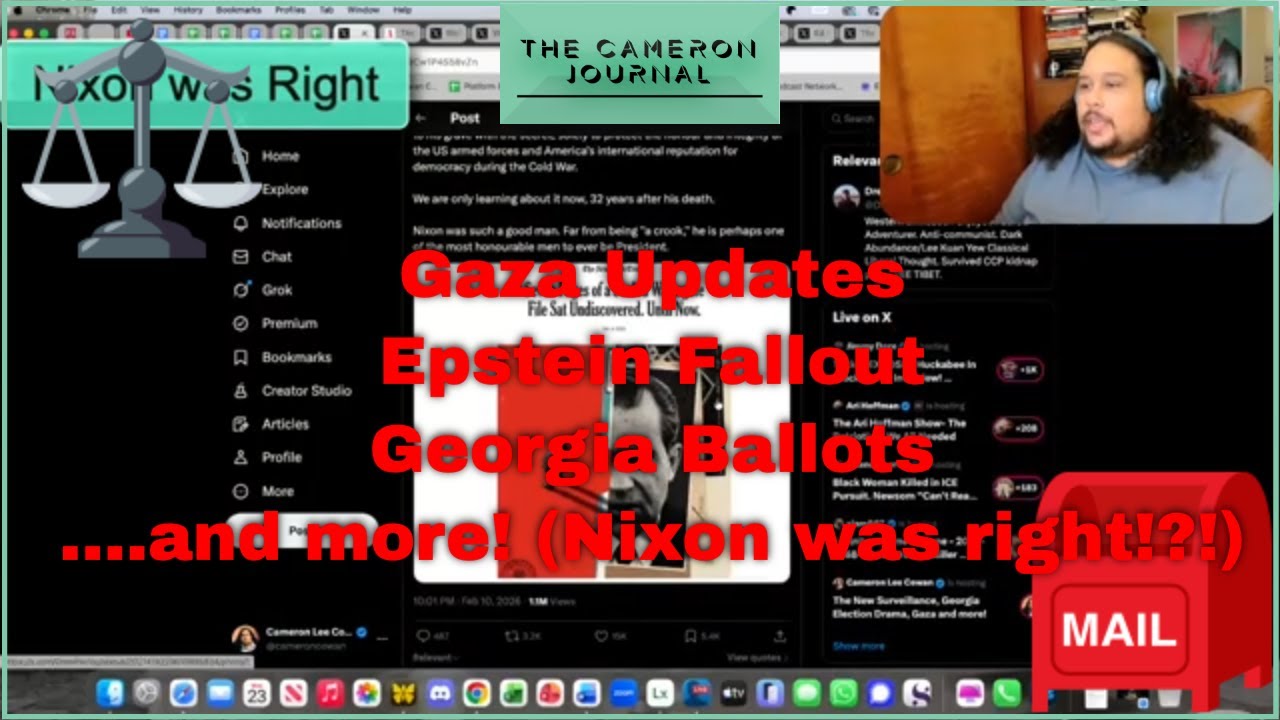
The Living Joke:

The World is Hard, This is Not
If you’re new here, my name is Cameron Lee Cowan M.A. MFA, and I’m the Creative Director here at The Cameron Journal. You can learn more about me on the about page. I do research and commentary on politics, culture, and the world around us. Each week I send out the latest news narratives, the latest videos from The Cameron Journal and commentary about the week’s events. Remember, The World is Hard, This is Not.
Discover more from The Cameron Journal
Subscribe to get the latest posts sent to your email.