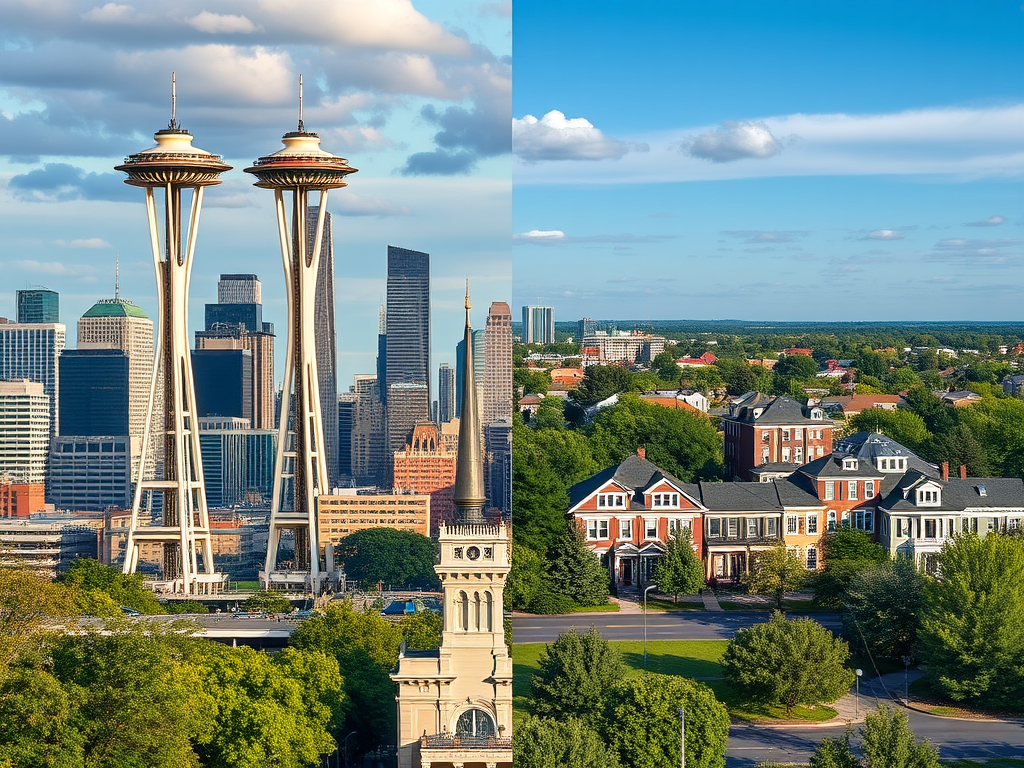

I spent years in Seattle because it sounded right.
When people asked where I lived, “Seattle” landed differently than “Wilmington, Delaware.” It signaled something—ambition, maybe, or cultural awareness. The kind of place where things happen.
The rent was brutal. A decent apartment cost what a mortgage runs in most of the country. But I told myself that’s just what it costs to be where opportunity lives.
Then I moved to Wilmington. Close enough to NYC when I needed it. A fraction of the cost. And I realized something uncomfortable about my previous decade of geography decisions.
I’d been optimizing for how it sounded, not how it worked.
The Invisible Variable in Career Geography
Labor economists have a term for what I was doing: geographic mismatch. It’s not about whether jobs exist in a place. It’s about whether the place matches how you actually function.
Research shows that job seekers are 35% less likely to apply for positions just 10 miles away from where they live. Distance matters more to career decisions than pure economic theory suggests.
But here’s what the data reveals: geographic mismatch only accounts for about 5.3% of aggregate unemployment. The jobs exist. People just won’t—or can’t—move to them.
Why?
The standard explanation points to housing costs, family ties, moving expenses. All true. But there’s something else happening.
We’re Running 200,000-Year-Old Software
Your brain evolved in small tribal groups where status meant survival. Being part of the prestigious group—the one with resources, influence, recognition—kept you alive.
That software still runs.
When you tell someone you live in San Francisco or Austin or Seattle, you’re not just sharing geographic information. You’re signaling tribal membership. You belong to the group that matters.
Wilmington doesn’t trigger that response. Neither does Carmel, Indiana or Alpharetta, Georgia.
Even when the economics make more sense. Even when the quality of life measures higher. Even when career growth potential exists.
The fashionable address disease overrides the spreadsheet.
What the Participation Data Actually Shows
Here’s where it gets interesting.
Cities with high labor force participation rates—places like Greater Minneapolis-St. Paul at 72%—share something beyond strong job markets.
People actually show up. Consistently. Without burning out.
Compare that to regions posting 55-58% participation rates. The gap isn’t explained by job availability alone. It reflects something about how well a city’s infrastructure, culture, and pace support sustained workforce engagement.
Not just employment. Engagement.
The places where people can be the version of themselves that does their best work.
The Rhythm Question Nobody Asks
I’ve talked to dozens of professionals who moved to major metros for career advancement and found themselves exhausted within two years.
Not from the work. From the place.
The pace didn’t match their nervous system. The constant stimulation that energizes some people depletes others. The networking expectations that feel natural to extroverts feel like performance art to introverts.
This isn’t about work ethic or ambition. It’s about fit.
Some people thrive in high-density, high-intensity environments. Others do their best thinking in quieter places with more space and less noise.
Neither is better. But pretending the difference doesn’t matter—or that everyone should optimize for the same type of environment—creates unnecessary friction.
The Mobility Paradox
Americans are moving less than ever. Cross-county migration dropped from roughly 6% per year in 1980 to about 3% recently.
Even displaced workers facing job loss don’t relocate at the rates they once did—despite clear evidence that moving to growing areas correlates with higher wages for lower-skilled workers.
The economic incentive exists. The movement doesn’t happen.
Part of that is housing costs. Part is family ties. But part is also this: people have learned that chasing the “right” city based on conventional career advice doesn’t always deliver the promised outcomes.
The narrative says go to the big city, build your network, climb the ladder.
The reality includes brutal commutes, housing insecurity, and the creeping sense that you’re working to afford the place you’re working in.
What Changed My Thinking
Seattle worked when I was young. I got jobs, built experience, made connections. The city served its purpose.
But as I got older, the cost stopped making sense. I wasn’t getting proportionally more opportunity for the exponentially higher expense.
Wilmington gave me proximity to New York without spending $5,000 monthly on a closet. I could still access the networks and opportunities when needed. But my baseline quality of life improved dramatically.
The unsexy move turned out to be the smart one.
The Real Tradeoffs
I’m not going to tell you that small or mid-sized cities solve all problems. They don’t.
You’ll have fewer employers in your specific niche. Networking happens less organically. Cultural amenities and events don’t match major metros. If you have kids, school quality varies wildly.
And here’s the career risk nobody talks about: if your company downsizes or your role disappears, you might have only one or two other employers in your field locally.
This strategy works better for mid-to-late career professionals who already have established networks and can land remote roles if needed. Early-career people building from scratch face different math.
But the lower cost structure creates something valuable: runway.
Runway to start a business. Runway to take a risk. Runway to say no to opportunities that don’t fit.
The Vibe Check Matters
Data helps. Economic analysis matters. But ultimately, you need to visit a place and see if the vibes are right.
Voting patterns matter. Local culture matters. The pace of life matters.
You can’t optimize your way around fundamental misalignment between who you are and how a place operates.
Some people need the energy of dense urban environments. Others need space to think. Some thrive on constant social interaction. Others need quiet to do their best work.
The question isn’t which is better. The question is: which matches how you actually function?
What I’m Watching
Remote work changed the equation for a lot of professionals. You can now access high-paying jobs without living in high-cost cities.
But I’m seeing a counter-trend: companies pulling back on remote flexibility, requiring return to office, using location as a sorting mechanism.
The window might be closing on the “live anywhere, work anywhere” promise.
Which means the geography decision still matters. Maybe more than ever.
Because if you’re going to be tied to a location anyway—whether by office requirements or by choice—you might as well choose a place that fits how you work, not just what sounds impressive.
The Unfashionable Truth
Career geography is still largely a status game.
We optimize for the place that signals the right things to the right people. The address that looks good on LinkedIn. The city that makes us sound like we’re going somewhere.
But status doesn’t pay your rent. It doesn’t give you back the hours you spend commuting. It doesn’t make you more productive or creative or satisfied.
Sometimes the smartest career move is the one nobody’s heard of.
The mid-sized city with good companies and reasonable housing. The smaller metro with strong fundamentals and less competition. The place that doesn’t make for great cocktail party conversation but lets you build the life you actually want.
I spent years making geography decisions based on how they sounded.
I’m done with that.
The question now is simpler: does this place let me do my best work and live my best life?
Everything else is just noise.
Discover more from The Cameron Journal
Subscribe to get the latest posts sent to your email.