A small home can still offer a real piano experience. The room simply sets the limits before taste or budget gets a vote.
Measure the full playing footprint first
Most buyers check the width of the keyboard and stop there. That misses how the instrument fits into everyday life in a room.
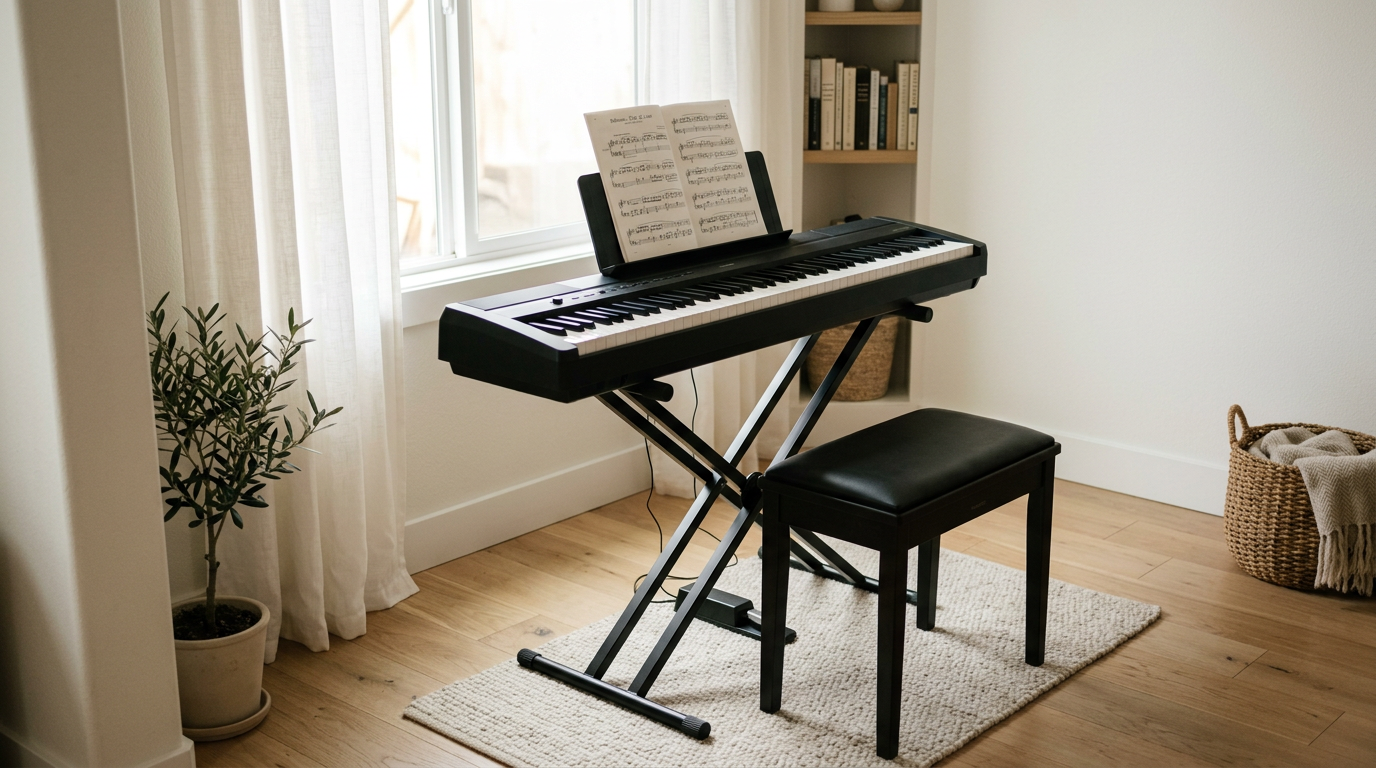
A keyboard on a stand needs floor room for legs that splay wider than the case. A bench needs pull-out room behind it, plus foot space for pedals. Doors and closet fronts near the spot need clearance to open while someone is seated. A simple way to test the arrangement is to mark the outline on the floor with painter’s tape and sit inside it for a few minutes with a chair.
Leave room for sound as well. Check the manufacturer’s placement guidance so walls or furniture don’t obstruct the speakers or ventilation. Headphone cables need enough slack to avoid catching on furniture, and power cables need a nearby outlet. No cable should cross a walkway where feet can snag it at night.
Think about daily movement too. A hallway corner might fit the measurements but block traffic when the bench is out. A bedroom wall might work for practice but leave no space for a teacher to sit nearby. Small rooms punish tight fits more than spec sheets suggest.
Tape doesn’t lie.
Once the true footprint is clear, every later choice gets easier. Key count and cabinet style become practical choices rather than guesses.
Decide what kind of music player you are
Is the main goal piano lessons, accompaniment, songwriting, or exploring different sounds? All can be enjoyable, but they place different demands on an instrument. Name the priority before comparing feature lists.
A piano-focused player wants a steady grand tone with touch that responds to soft and loud playing. Lessons and classical repertoire assume that touch stays consistent. A keyboard with hundreds of flashing styles can distract from that work.
A hobbyist or songwriter often wants the opposite. Arranger keyboards pack in hundreds of preset voices and auto-accompaniment that adds drums and bass behind chords. Preset rhythms can make a living room jam feel full without a band. For pop chords or sketching ideas for music production, that variety is the point.
Kids and casual players often sit between those poles. They may start on simple tunes and drift toward lessons or beats. A middle-ground model with decent piano tone and some extra voices can keep both paths open.
Sound engines shape this choice. Most home models use sampling, which plays back short recordings of real instruments. Other instruments use modeling or combine it with sampling. Price alone doesn’t tell you which approach will sound best to you. Ears matter more than brochures, so compare the same piano voice at both low and louder home volumes.
Small usability touches help too. Registration memory stores a favorite sound for one-touch recall, while panel lock stops a stray elbow from changing voices mid-piece. Both make practice a little easier where the panel is always within reach.
Choose key count with space in mind
A full piano keyboard has 88 keys, giving access to the standard piano range without octave-shift workarounds. That can be useful for lessons and repertoire using low bass or high treble notes. Measure the particular case rather than assuming it fits an available wall. Bench clearance adds depth to every option.
Smaller options include 76- and 61-key models. Their shorter cases can be easier to place or store, although dimensions and weight still vary. Measure the desk or closet opening as carefully as the playing area. A shorter range may be sufficient for pop accompaniment, simple melodies, or exploring an interest in music.
A shorter keyboard limits the available note range, but not every piece needs all 88 keys. Check the music you want to learn with a teacher if possible. Octave-shift buttons can help in some arrangements but aren’t a convenient substitute for missing keys in every passage.
Key count says nothing about touch by itself. A 61-key model almost always has light synth action, while 88-key models can have light or weighted action. Shoppers should judge size and feel as separate questions. Pick size for the room and repertoire, then pick feel for hands and goals.
How to test size at home
Lay tape for case width and bench depth. Sit and mime wide chords to see if elbows hit furniture. If the movement feels cramped, daily practice will feel worse.
Match action quality to hands and budget
Action is the feel of keys under fingers. Synth action is generally light and springy. It can suit organ parts, synth sounds, and accompaniment, but it feels different from an acoustic piano. For piano lessons, ask the teacher what action will support the student’s goals.
Piano-style models use hammer action that mimics real hammers. Keys carry more weight, with graded hammer action heavier in bass and lighter in treble. Semi-weighted models sit between those poles. That middle feel can suit songwriters who split time between piano and synth.
Price and feel interact in awkward ways. A very cheap weighted model can feel sluggish or noisy, while a well-made semi-weighted model can feel quick and even. Notice fatigue and release noise during a store test. Some mechanical sound is normal, so compare models at the volume and in the conditions you expect at home rather than assuming every click indicates a fault. If hands hurt or tone jumps from soft to loud with no middle, keep looking.
When comparing prices in Italy, a broad category search such as pianoforte tastiera can help you compare instrument types before narrowing by feel and size. That comparison helps clarify whether the budget fits a simple weighted slab or a lighter touch with better speakers.
Don’t judge action with store volume cranked up. Test at quiet home levels with a plain piano tone. Play scales slowly, then quickly. Hold the sustain pedal through chords and listen. Low seating makes any action feel heavier, so use the bench height planned for home.
Pick between a slab and a furniture cabinet
Slabs are bare keyboards without built-in legs. They sit on a separate X-stand or Z-stand and pair with a loose bench and plug-in pedal. Setup takes minutes, and teardown is just as quick. That flexibility helps in rooms where the instrument must share space with guests or work.
Furniture-style models combine the keyboard with a dedicated cabinet or base and may include an integrated pedal unit. Check the specific construction, stability, and pedal functions. No instrument should be treated as furniture to climb or lean on, especially around children.
Floor space surprises many buyers. A slab on a stand doesn’t always take less room than a cabinet. X-stands splay wide for stability, and that footprint can exceed the neat rectangle of a cabinet. Z-stands run narrower but still need room for feet and crossbars. Always compare the full stand footprint with shoes on, not the slab width alone.
Think about storage too. A slab can move to a closet for a party and slide back later, with a folding stand tucked behind a door. A cabinet needs a fixed spot and room to dust around legs.
Stability matters for touch. Light X-stands can rock during loud passages. Check weight ratings and sit-test pedaling before buying. A cheap stand can make a good action feel uncertain.
Plan for two volumes in one home
Small homes need both aloud playing and quiet practice. Built-in speakers cover daytime playing and lessons where a teacher needs to hear tone in air. Headphones cover late nights and thin walls. A home instrument should handle both without fuss.
Speaker size and cabinet depth shape aloud tone more than watt numbers. Compact slabs with small rear speakers can sound thin when pushed. Test at home volume, not showroom volume. If low chords distort at modest levels, that flaw will grate.
Headphone practice needs a jack that is easy to reach with cable slack, whether on the front edge or side. Check that the volume control stays within reach while seated. A quiet-practice setup involves more than the jack. Well-fitting closed-back headphones can limit sound leakage, though isolation varies with the design and listening volume.
Headphones don’t make playing silent. Keys thump on landing and pedals click, and that mechanical noise travels through floors and desks. Mechanical noise late at night can still bother neighbors or light sleepers downstairs. A suitable mat beneath the stand or cabinet and pedals may reduce some transmitted vibration, but it won’t soundproof the room. Test with someone listening nearby and agree on practice hours if needed.
Wireless listening needs care. Bluetooth MIDI carries note data to apps, while Bluetooth audio carries actual sound. The two aren’t the same, and many keyboards support one without the other. Bluetooth headphones can add delay that throws off timing, and pairing is uneven. A wired pair stays the safer pick for practice.
Check sound, connections, and true cost
Polyphony sets how many notes can ring at once. Sustained tones and layered voices draw from the same pool. Higher counts give more headroom for thick pedaling. Match the number to playing style rather than chasing it as a score.
Connectivity decides how keys fit with phones and computers. USB MIDI links to learning apps and recording programs, while standard MIDI ports link to older gear. Line outputs feed home speakers or an interface. Check cable types before buying.
Tone and speakers should be judged together. Longer piano samples with smooth decay suit solo practice. Layered voices suit band-style play. Small speakers hide flaws at low volume but expose them when pushed. Play the same passage through speakers and wired headphones to hear the sound engine apart from the cabinet.
Count the full kit before comparing price tags. Check whether a stand, bench, and sustain pedal are included or must be bought separately. A cover can be a useful optional extra. That pedal isn’t a luxury for piano tone. Include those extras in the initial budget rather than treating them as an afterthought.
Finish with store policies. Don’t count on an uncomfortable action becoming suitable after purchase. A clear return window gives room to test in the room where the instrument will stay. A written warranty with local service beats vague promises.
Small rooms reward clear priorities. Fit comes first, then touch that matches music goals. Quiet options and connections come next. Get those points right and even a compact corner can host steady progress for years. Measure twice and let the room decide.
Discover more from The Cameron Journal
Subscribe to get the latest posts sent to your email.