Setting an asking price is one of the most consequential decisions you will make when preparing to sell. The right number should reflect what qualified buyers are likely to pay in your market, not simply what you hope to receive. Whether you plan to list soon or want to sell your house on your own terms, a clear pricing process can help you avoid costly guesswork.
A strong price is built from recent local evidence, your home’s condition, competing listings, and your preferred timeline. It should also leave room to respond to real buyer feedback once the home is on the market.
Table Of Contents
- Why Your Starting Price Matters
- Market Value Versus Personal Value
- How Comparable Sales Shape Your Price
- Account for Condition, Updates, and Repairs
- Read Your Local Market Before Listing
- Use Online Estimates Carefully
- Choose a Pricing Strategy That Fits Your Goal
- Common Pricing Mistakes to Avoid
- A Pre-Listing Pricing Checklist
- Questions to Ask Before Setting the Price
Why Your Starting Price Matters
The first weeks of a listing often provide the clearest signal about buyer interest. Buyers who are actively searching tend to compare new homes with recently sold properties and current alternatives. If an asking price appears out of step with those choices, some buyers may never schedule a showing.
Pricing too high can also make later negotiations harder. A home that sits without compelling interest may prompt buyers to wonder whether it has concerns about condition, location, or value. A competitive price, on the other hand, does not automatically mean accepting less. It can expand the pool of interested buyers and improve the chance of receiving stronger terms.
Market Value Versus Personal Value
Market value is the price a typical informed buyer may be willing to pay under current local conditions. Personal value is different. It includes memories, effort, and money invested in the property, all of which can matter deeply to an owner but may not translate directly into buyer demand.
For example, a seller may have spent heavily on a custom kitchen designed for their household. Buyers may appreciate it, but they may not assign it the same dollar value, especially if nearby homes with comparable kitchens sold for less. Improvements can help a home compete, yet the cost of an upgrade is not a guarantee of an equal increase in sale price.
How Comparable Sales Shape Your Price
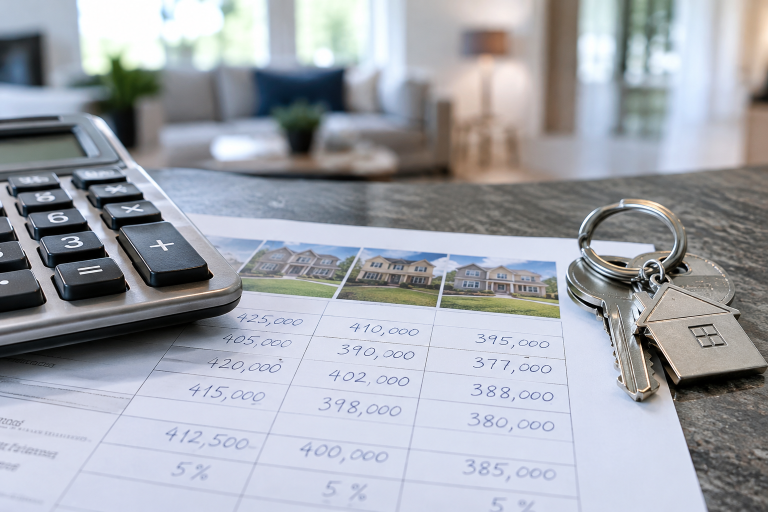
Comparable sales, often called comps, are among the most useful starting points for a realistic range. A comparative market analysis can help organize recent sold homes, active listings, and pending sales into a clearer view of local value.
What to compare
- Homes in the same neighborhood, subdivision, or similar school area.
- Square footage, lot size, age, layout, bedrooms, bathrooms, and parking.
- Sales completed in the past few months when enough relevant data is available.
- Condition, renovation level, views, traffic exposure, and other location differences.
- Sold prices first, while using active and pending listings to understand current competition.
No two homes are identical, so the goal is not to find a perfect match. It is to identify a supportable range after accounting for meaningful differences.
Account for Condition, Updates, and Repairs
Condition affects both price and buyer confidence. A newer roof, updated heating and cooling equipment, documented electrical work, or a finished basement may support a stronger position against similar homes. Keep receipts, permits, warranties, and contractor information for major work, since buyers may ask for details.
Also identify deferred maintenance honestly. Water damage, aging systems, peeling paint, damaged flooring, and unfinished repairs can narrow the buyer pool or lead to requests during inspection. Separate work into two lists: repairs that protect value or reduce objections, and cosmetic projects that may improve presentation without necessarily adding equivalent value.
Read Your Local Market Before Listing
National housing headlines are useful context, but neighborhood conditions should drive your decision. Review inventory, days on market, recent price reductions, and the number of similar homes available. Broader existing-home sales data can provide market context, but it cannot replace local evidence.
In a seller’s market, limited supply and strong demand may give well-positioned homes more leverage. In a buyer’s market, more alternatives can make pricing and presentation especially important. A balanced market falls between those conditions. Mortgage rates can also affect affordability, which may change the number of buyers able to compete at a given price.
Use Online Estimates Carefully
Automated valuations can be helpful as an early reference point, but they are not a promise of what your home will sell for. These models rely on available property records, past transactions, and market patterns. They may not fully account for renovation quality, deferred maintenance, unusual layouts, noise, views, or features that are difficult to measure from public data.
Compare more than one estimate, then test each range against actual recent sales and current listings. Treat the results as a starting conversation, not the final answer.
Choose a Pricing Strategy That Fits Your Goal
- Set a market-aligned price. Choose a number supported by local sales and competition when your priority is attracting serious buyers.
- Price for speed. If timing matters, a more competitive position may generate broader attention.
- Price for flexibility. Sellers with more time may test a higher range, but they should monitor feedback closely.
- Plan review points. Decide in advance when to reassess showings, online activity, feedback, and offers.
The best approach depends on your financial goals, move date, property condition, and the alternatives available to buyers.
Common Pricing Mistakes to Avoid
- Basing the price on what a neighbor received years ago rather than current evidence.
- Adding the full cost of every renovation to the asking price.
- Starting high solely because a reduction can be made later.
- Ignoring how the home compares in condition with active listings.
- Changing the price without also reviewing photos, access, staging, and buyer feedback.
- Using a tax assessment as the primary measure of market value.
A Pre-Listing Pricing Checklist
- Review at least three relevant recent sales.
- Check homes that buyers can currently tour in your price range.
- Document improvements, repairs, and known defects.
- Estimate selling costs and likely net proceeds.
- Set a target timeframe for receiving an offer.
- Select a price range supported by evidence.
- Choose a date to review the strategy if response is limited.
Questions to Ask Before Setting the Price
- Which recent sales are the closest matches, and why?
- How does this home compare with current competition?
- Which features support the suggested range?
- Which repairs could affect buyer interest?
- How many similar homes are available now?
- What price range is most likely to reach qualified buyers?
- When should the price or marketing plan be reviewed?
Conclusion
A well-supported listing price begins with evidence instead of emotion. Recent comparable sales, local competition, property condition, buyer demand, and your timeline should all shape the decision. Start with a reasonable range, present the home well, and remain willing to adjust when the market gives you useful feedback.
Discover more from The Cameron Journal
Subscribe to get the latest posts sent to your email.