Streaming services have made listening to music extremely easy. If you think of a song, you can play it right away. An algorithm even learns your preferences and habits and selects music for you. Certainly, this ease is convenient, and it’s nice to have technology doing the work for you, but the problem is that you lose something essential in the process – the feeling that you deliberately chose a song, put thought and effort into it, and that it has meaning for you.
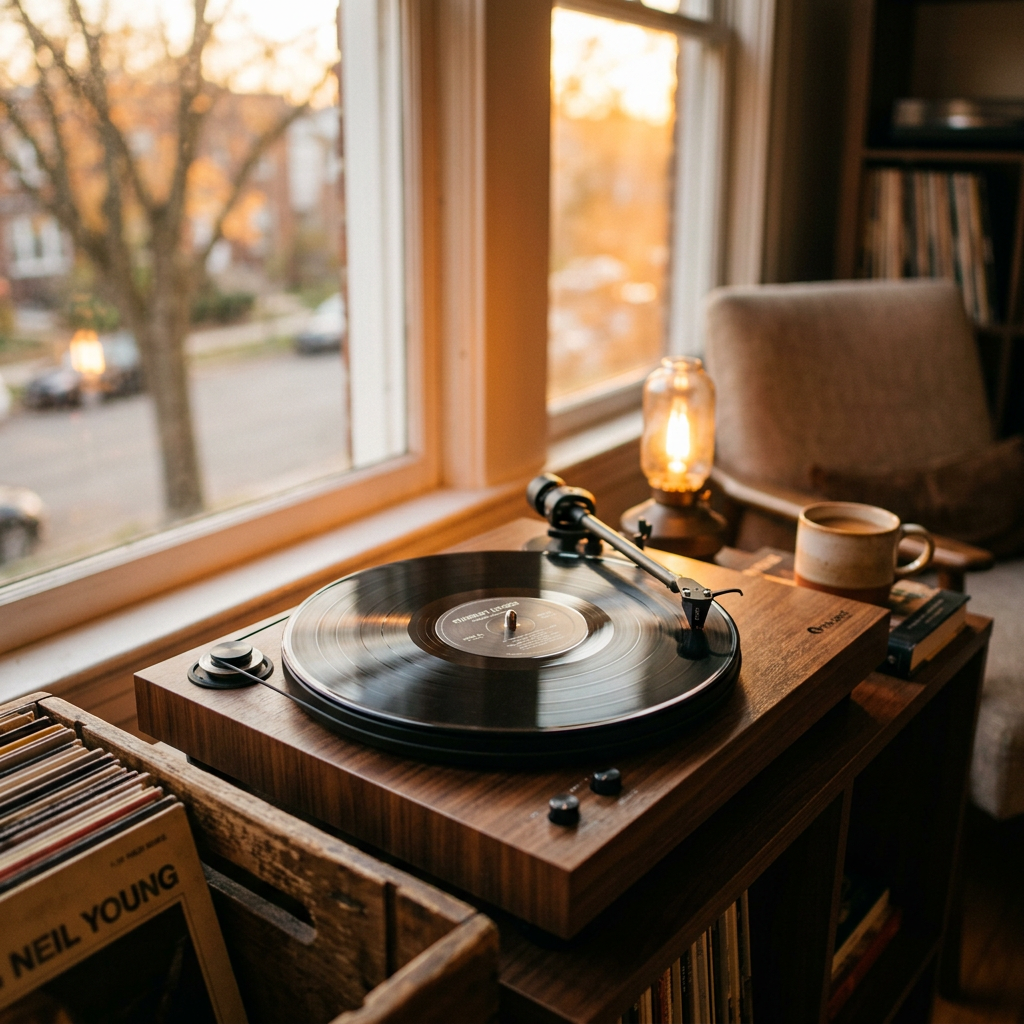
This is why people are returning to physical, tangible formats once again. When you decide to play a vinyl record, you are not mindlessly scrolling through an app. You are physically taking the record, carefully lowering the needle, and you are watching the vinyl spin. The experience demands your attention, and that’s the whole point of it.
The difference in terms of mental space that a passive and a mindful, active experience create couldn’t be bigger. When we interact physically with music – when we handle an object, look at the sleeve, and engage with the music for the duration of Side A and B – we create stronger memories related to the music and experience. The music becomes associated with a moment in your mind rather than just inheriting the status of background music. This is what digital music strips away from us all too easily: feelings.
The Mixtape As An Act Of Care
The cassette mixtape was never about the quality of the audio. It was a way to say “I thought about you enough to spend a couple of hours on this.” You chose the songs, you sequenced them, you labeled the tape in careful handwriting. The act of making it was inseparable from the meaning it carried.
Digital playlists are the functional successor to that tradition, but they’ve lost most of the weight. Sending someone a Spotify link takes eleven seconds. There’s no friction, and without friction there’s no visible effort, and without visible effort it’s hard to feel the intention behind it. Mixtape culture was about the labor of curation. That labor communicated something no algorithm can replicate.
Converting a playlist into a physical vinyl record brings that labor back. You’re not just sharing a list of songs – you’re commissioning an object that exists in the world, that takes up space, that someone will hold in their hands. The digital content becomes an artifact. That transformation matters more than it might seem.
Understanding The Physical Constraints – and Why They Help You
A regular 12-inch vinyl record will play some 22 minutes of audio per side at 33 1/3 RPM. That’s the maximum amount. You might go over and add your grooves tighter, pushing down the volume, however, everything will sound worse. At 45 RPM, you lose the extra room and play 12-15 minutes, but the sound is so much better – higher presence, increased bass response.
What those constraints do is that they make you have to give up on stuff you would normally put. A Spotify list can take 400 tracks, and nobody cares. A vinyl record can’t. So you pick. And when you’re forced to pick, you pick without lying. The songs on a wax record are the songs that actually count.
This is the process that makes for good curation. Imagine it like a photographer thinks about printing. You have hundreds of images from a trip on your phone, and most of them are forgotten there. Print twelve of them, frame six, and those are the photos that express that journey. The constraint gives the value.
From Curation To Creation
Once your tracklist is locked, your audio files are ready, and your sequence is dialed in, the next step is working with a specialist to turn the files into a physical object. This is where lathe-cut vinyl services come in – unlike commercial pressing plants that require minimum orders in the hundreds or thousands, lathe-cutting can produce a single bespoke record, one copy, cut to order.
A Custom Vinyl Record service handles the technical conversion from your digital files to physical grooves, meaning you don’t need to be an audio engineer to get a good result. What you do need to handle is the curatorial side – the song selection, the sequence, the source files – because those decisions belong to you.
Sequencing Your Tracks For Analog Playback
Sequencing your album isn’t just an artistic thing, it’s also a smart move as far as vinyl production goes. The outer edge of a record can physically hold more dynamic, low-end information than the inner part of the record, and there’s a real technical reason for that.
As the record spins, each revolution at the inner grooves covers less physical distance. The stylus moves faster relative to the groove, which makes it harder to track wide, deep bass frequencies accurately. This is called inner-groove distortion, and it’s why the final tracks on a side tend to sound slightly compressed or harsh on poorly sequenced records.
So how does this apply to your sequencing? Place your most energetic, bass-forward tracks at the start of each side. As you move toward the inner grooves, transition to acoustic material, vocals-only arrangements, or quieter songs with less low-end content. This isn’t just good audio engineering – it often makes narrative sense too. Big opener, quieter closer. Energy first, reflection last.
Also consider the transition between Side A and Side B as a structural break. A natural moment to shift the emotional register of the record, the way a film uses an intermission.
Preparing Your Audio Files
The sound quality of the final record is very much dependent on the quality of the audio you provide. It is true that vinyl is an analog medium, but nearly all modern vinyl cutting is done from a digital file. The analog signal is re-created in the cutting head as it engraves the groove, but if you present the cutting source with a poor-quality MP3, the resulting record will show that.
For the best results, provide a lossless audio format – WAV, AIFF, or FLAC – that contains 100% of the audio that was available from the recording, rather than an audio file that’s had bits of it stripped away in the name of reducing file size.
In the case of tracks you’ve obtained as MP3s, aim to make them 320kbps-grade wherever possible. The artifacts of lossy compression will be heard on a decent playback rig long before the limits of vinyl become apparent. (Or of your ears, for that matter. Even the difference between a 128kbps MP3 and 320kbps MP3 on a car stereo is pretty clear.)
One other consideration: the mastering for vinyl process sometimes involves adjusting extreme low-frequency stereo width, because a stylus physically cannot track very wide bass signals without jumping out of the groove. A good lathe-cut service will account for this automatically, but it’s worth understanding why your record might sound slightly different from the original studio mix.
Designing The Sleeve and Physical Package
Designing the visual package is often the part of custom record-making that people give the least thought or budget to, and it’s where they make a mistake. The sleeve is half the art. When someone picks up a record you made for them, the sleeve is what they see first. It sets the emotional tone before the needle even touches the groove.
Here are a few things that are worth thinking about as you work on the physical presentation of your gift:
Make sure the cover image means something to the person who’ll be receiving it. Photo of you both, art that relates to the theme of the songs, a portrait. Generic design says generic thought.
Fonts matter, and you should be thoughtful about what you choose for the track listing and title. Clean sans-serif all caps says something different than a vaguely medieval serif. Generally, the former says modern and spare, the latter says warmth and history. Avoid mixing more than two typefaces on a single jacket.
The inside of the sleeve is the best place for Liner Notes. This is an amazingly underused part of custom record-making. Why these songs? What does each one mark? A paragraph or even just a sentence or two each transforms the record from a music delivery mechanism into a personal document. It’s the handwritten label on the cassette, scaled up.
The weight and finish of the sleeve is worth considering. Tactile media is felt as much as seen. A heavy stock matte feels different in the hand than a thin, glossy one, and that difference registers.
The Right Occasions – and The Right Room To Listen
Some gifts fit this format better than others. A wedding playlist pressed to vinyl – the songs that played at the reception, or the songs that defined the relationship – becomes something fundamentally different from a framed photo. It’s playable. It’s active. Years later, you drop the needle and you’re back in the room.
The same logic applies to anniversaries, milestone birthdays, the end of a significant chapter, a tribute to someone who’s gone. Any occasion where music was present, and where the music carried emotional weight, is an occasion where a physical record makes sense. It creates a time capsule that doesn’t just sit on a shelf – it can be revisited, replayed, shared with people who weren’t there.
And when you finally play it, give the experience the space it deserves. A turntable doesn’t need to be expensive to sound good, but it does need a preamp – either built into the deck or external – to boost the phono signal to line level for your speakers or amplifier. Beyond the equipment, it’s about attention. Put the phone down. Sit somewhere you can watch the record spin. Let Side A end and physically get up to flip it. That interruption isn’t an inconvenience. It’s a built-in pause to reflect on what you just heard.
The experience of listening to a physical record you made is different from listening to a playlist. You know every song on it. You chose each one deliberately. That changes how the music lands – more presence, more weight, more connection. You stop being a consumer and become something closer to a curator of your own life’s soundtrack.
Discover more from The Cameron Journal
Subscribe to get the latest posts sent to your email.