Welcome to The Cameron Journal Newsletter. Each week, Cameron Lee Cowan wraps up the headlines with commentary, helping you navigate today’s media narratives and how they are affecting our Culture, Lifestyle, and Society.
Update from Cameron
It was the first heat wave here in New England. I did not haul the window AC upstairs yet, but it was sweltering at 81 degrees this week. It’s much cooler today and through the week, but the heat is coming, despite it being early April and unusually hot this time of year. If your first thought is about climate change, you would be correct, and there’s a heat bubble in the Arctic that is responsible for all of this weather. And if you really want a fright, you can go find out that the big current in the Atlantic that moves cold water from the Arctic down to the middle latitudes is slowing down and could stop, basically at any time, and there’s no way to get it moving again; it’s basic thermal dynamics.
In any case, this week was busy. I had some wonderful conversations that you’ll see coming up, but do keep an eye on the podcast because we have Kanwal Rekhi and Celina Mattocks coming up this week for interviews. Kanwal and I talk about the rise of India and the success of Indian immigrants in the US, and Celina and I talk about how she is using AI to train people in new roles.
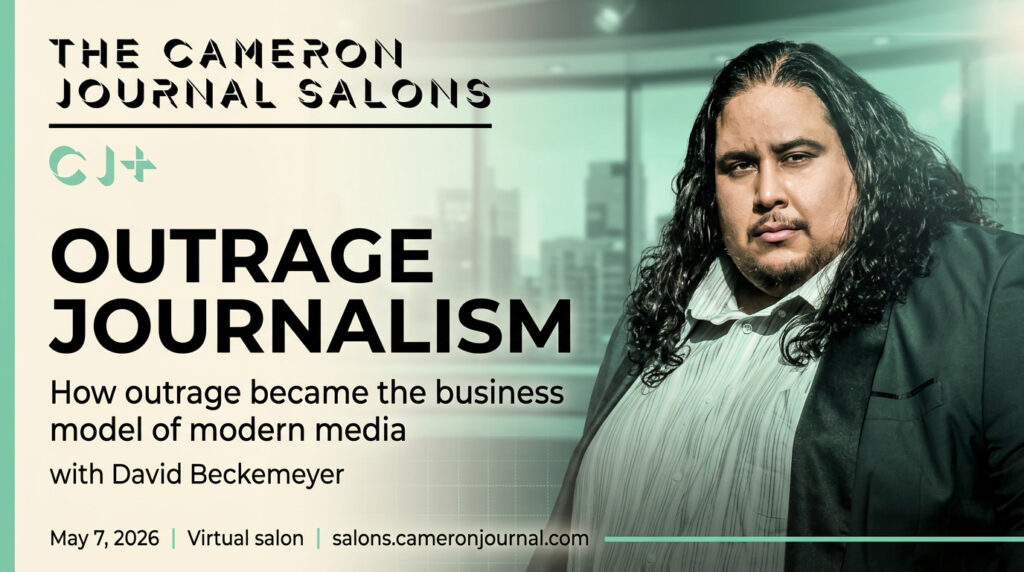
I also want to mention that my new series for Cameron Journal Salons will begin on May 7, 2026 with an evening with me and some guests (more on that soon). David Beckemeyer will be joining. This is a private event; it will not be openly streamed, and you’ll need to sign up for it. Details will follow! Watch this space!
Before we get into the headlines, I have a small anecdote that I find entertaining and so emblematic of the times in which we find ourselves. Apparently, Kash Patel’s drinking is so out of control that he likes to lock himself in rooms, and they keep breaching equipment handy in case they need to break him out. He’s also late to meetings, and rumors are flying around DC about his unstable behavior. Now that TMZ (yes, the celebrity people) has opened a DC office, not only are the adultery and gay sex rumors going to fly around, but perhaps they’ll catch Patel drinking around town. If they can find Ellen DeGeneres and Britany Spears every 10 minutes, just imagine what they can do in a town with far fewer publicists!
Refresh Your Inbox
If you like The Cameron Journal newsletter and are looking for other newsletters, you should check out this list. I hope you find something interesting to read that you love just as much as The Cameron Journal.
Join CameronJournal+
If you love these newsletters and want to support my work breaking down news narratives at The Cameron Journal, please consider signing up for CameronJournal+. You can also upgrade your Substack subscription to Paid and get ad free newsletters!
You will get exclusive content for CJ+ subscribers
Access to our Discord, and special hangouts with me
Ad-free newsletters
It’s the coolest club in town! Don’t want to subscribe but want to support? I take donations at Kofi.
The carry-on that pays for itself

Paid $65 in bag fees just to arrive with wrinkled dresses? Or left half your wardrobe at home trying to avoid those fees?

Luhxe Travel Bag was designed by women tired of the trade-offs. The built-in closet system with hangers fits 14 days of outfits wrinkle-free, plus 5 pairs of shoes—all in airline-approved carry-on size. Made from premium, eco-friendly PU leather.

No baggage claim. No compromises. No fees. 80,000+ overpackers already made the switch.
The News Narratives of the Week
Don’t forget to join me on Monday for The Cameron Journal Newshour
Burning Warehouses, Missing Scientists, and Violence
You’ve probably not heard about the latest trend in leftist social circles because the mainstream media is entirely ignoring it. You might have seen the now viral video of a man lighting toilet paper and paper products on fire in a warehouse that serviced Kimberly-Clark (Scott and other brands). However, that lit a spark in more ways than one. The number of warehouse fires is now up to 29, and Sam Altman of OpenAI has now had two separate attacks on his home. There are even rumors of people pouring expansion foaminto toilets in bathrooms so all the plumbing has to come out and be re-done. And on top of all of that, 10 US nuclear scientists have gone missing in recent weeks. When someone at the White House Press Corps asked about it this week, the ever enigmatic Karoline Levitt replied that it was “worth looking into.” The Manhattan Institute is worried that Leftist activism against Palantir (which is busy building a media critique AI system) could threaten national security. There are some strange things going on; let’s go through all of this because I have a theory.
One thing I want to mention right at the top of this is that the worker in question didn’t work for Kimberly-Clark; he worked for a warehouse contractor. That is one of the unique things about capitalism in the last 40 years: companies have reduced headcount and overhead costs by shifting certain jobs onto contractors. This is especially true in services like cleaning, food service, and even warehouse work. Why own the warehouses when you can hire someone to deal with that for you? This theory of management came to the forefront in the late 1970s, and I talk about how Tyson Chicken figured out that the most expensive part of their business was owning chickens, and how they’ve offloaded that onto small farmers who go under, in my essay 1977: The Rise of Discounters and Deregulation.
It is the ultimate alienation from labor. It is not just that the surplus-labor value of his work goes to someone else (the business owner), but that he is doing work for a company that itself uses an intermediary to avoid dealing with the worker in question. The worker’s surplus labor value is changing hands like it’s at a casino. I’m sure that no one is thinking that this is a factor in his arson but I can’t help but wonder if the relationship between workers, companies and their labor would be different (and possibly less violent) if companies still employed everyone that worked for them rather than a series of vendors that provide all these services across dozens of companies that are all eating from the same economic pie.
Now back to the fires, the words he said on the live during the Kimberly Clark warehouse fire have become a sort of slogan, “You just had to pay us enough to live.” If there is one thing that unites people right now, it’s low wages. Jobs don’t pay enough anymore to live a decent life. The cost of living was already high before the pandemic, and the post-pandemic inflation has made life genuinely unaffordable for the average person. Economists will point to rising average household income of $68,000 a year and say “they’ve never had it so good.” and I would remind that median income is a modest $45,000 (all numbers from the Fed) and that on a median salary (where higher salaries weigh less on the numbers) the average person can’t afford a house or even, in many markets, housing of any kind. And that doesn’t factor in other costs like healthcare and food, which are rising and are becoming out of reach for ordinary people. We are long past eating less avocado toast and taking fewer trips to Starbucks. An average person going out to get any job on offer has no guarantee that having a job will secure them a decent life.
The fact that the average person, working an average job, at an average wage, is not guaranteed a decent living is a national economic emergency. Full stop, read it again.
I remember the “vibe cession” from a few years ago, and the pundits on TV and elsewhere laughed it off, but there was a reason people felt the economy wasn’t good: it wasn’t showing up in their paychecks. Almost everyone has a side hustle now, whether it’s Uber or DoorDash, or investing or crypto; everyone has something on the side to make extra money to live, thrive, or build a future. It used to be the case that you could just show up to a job and secure a decent life. It was so common that sitcoms made fun of it. But now that’s no longer a thing until you reach the top 20% of the job market, which requires skills, education, and connections. Upward mobility hasn’t been a thing for most of the last 15 years (see my book America’s Lost Generation for more on that). And now we don’t have to worry about upward mobility; survival is becoming questionable. Minimum wage workers don’t make enough money to hardly function in society in any real way, they are stuck at the bottom, working a job that doesn’t provide a basic life and that story is now crawling its way up the income ladder to where now the going figure, based on many studies and stories is that to live a middle class American lifestyle like many folks grew up with costs about $120,000 a year. This means that you have to be in the top 20% of income to replicate your own childhood (supposing you’re about 35-50 as you read this right now). It is no wonder that people feel like the economy is not good and we’re in a recession, because unless you own assets (which are going up), the economy is not working for you.
Which brings me back to the warehouse fires. I know we’re going on a whole journey, but stick with me. The lesson we can learn from the warehouse fires is quite simple: you can only screw with people for so long before they will rise up and destroy everything out of sheer nihilism. The fact that it has taken this long is the surprising part. In another day and time, this would have happened 25 years ago, but the American people, being the patient sort, waited it out for quite some time. Now, what is the point of working if it doesn’t pay for your own survival? Why are we doing this?
And that’s when we hook back to the nuclear scientists. We live in a time that is so divorced from reality and any sense of groundedness that warehouses are on fire, nuclear scientists are dead or missing, and the White House doesn’t have an opinion on either matter, and the media isn’t covering the crisis at hand. On top of that, Peter Thiel, in his 10-plus-year war on the media, seeks to undermine the entire media ecosystem because he is frightened of living in a society where people can say what they want, including about him.
Make no mistake, we are in a polycrisis. And some would say that’s a return to how things have always been, and the last several decades were an aberration that we’ll never see again. I suppose that is so, and it even applies to trust in institutions and the media. We have left behind the era of Walter Cronkite and a unified narrative, which Peter Thiel seeks to dominate. One message is clear: we are in a crisis, we need real leadership, and the people are rising up to say, “no more greed.”
The solution to this is simple: raise salaries, raise a social safety net for people. Build a society where people’s everyday lives are good, and watch our country thrive. When the people thrive, the whole society thrives and grows in ways that we cannot imagine. And that idea is the heart of my political theory: Individual Collectivism. But that is a story for another day.
AI and Education
Education is always an issue in this country. From the earliest days of public schools in Massachusetts to the nature of what prayers should be said in school (to the eventual end of school prayer in 1961), how we educate America’s children is a perennial issue for people. I was reminded of this today when I saw a post about how many men’s tawdry opinions of women and current right-wing politics began in school, with them being bullied by a, usually female, teacher, and it showed the carelessness of the bureaucratic state. The comment section is filled with dudes talking about how much they feel like the education system screwed them over for reading ahead, doing homework in class, or other infractions because teachers didn’t like them or didn’t like how they didn’t follow along with the system.
It has always been my view that public education is essential for a functional society and a functioning democracy. However, individual students are often not well served by the public school system, and, as I always tell people, I never went to a K-12 public school. I have an outsider’s view of the thing. However, it is always described in the same way we might describe a dungeon in a video game: a crucible through which one must pass. I shudder at the thought despite the fact that 12-year-old me was desperate to go to school and get out of being stuck at home all day, every day with my Mom. There are two interesting things I saw on the education front this week, and they have to do with AI and Florida’s voucher program.
New schools like Alpha School are bringing AI directly into the classroom through AI-powered learning and “guides” instead of teachers, encouraging kids to explore their interests and the subjects at hand. This is juxtaposed with a new essay out from the Manhattan Institute about the “success” of school vouchers. The school voucher debate is something I’ve been aware of since the early 00s when Colorado considered it. I talk about it a bit in my signature education essay, “Teachers and Chalkboards.” According to their new article, Florida is the new poster child for the success of these programs. 53% of students now go to schools selected by their families, and there has been a rise in religious education, especially. Now that transportation scholarships and education money is more available, more families will likely opt out of the assigned public school in their neighborhood and choose from a wider range of options.
I will grant that according to US News and World Report, Florida is #1 in higher education, #22 in K-12 education, and in their ranking, 6th best in education nationally. However, now that the program is universal from 2023, there have been issues with funding not reaching schools, 30,000 students are lost in the system, and public schools are facing a funding crunch that has left both parents and schools reeling from all the changes. The state did not anticipate the demand, and the system was not fully prepared for the number of families seeking to take advantage of the program. Reforms are underway in the state legislature in Tallahassee.
I think something is lost when we don’t have universal, high-quality, standardized public education. In studying the world’s education systems, parental choice is vital (this is the basis of the modern German system); however, turning our education system into a hodgepodge of charter schools, religious schools, and specialty places like Alpha School seems shortsighted. The idea that any child can be enrolled in a local school in their neighborhood, with no out-of-pocket cost to the parent, is vital. It is the various failures of the education system as it stands that cause parents to demand options. Florida is wise to have transportation grants to help students get to the school of their choice, and that is essential for families that rely on the school bus to get their kids to school.
Despite the problems with the teachers’ unions (which I acknowledge), I still feel strongly that these systems will simply remove the kids who have options or parents who are especially attentive and will leave other children behind. The Florida story bears this out, with local schools losing funding and resources because those who can leave have left. The retort to that argument would be, “Well, why don’t those parents leave, too?” The answer to that question is as variable as every family in any given school district. I wouldn’t venture to list any reasons, but they could include access to the system, lifestyle, scheduling, number of children, and so on. I am always drawn back to the conclusion I reached while working on my education essay (link above): the biggest barrier to education was the family’s socio-economic status. It had nothing to do with the funding of the schools, how many laptops they bought or how well the school was funded (we didn’t have AI back when I wrote it!). Kids from wealthier backgrounds do better because they have the resources to get a tutor, do homework, and not have to work to help out with bills or watch younger siblings. Their homes are quieter and less chaotic, and they can focus on their studies and receive support in those efforts.
So, I have only one question. Do parents need school vouchers and AI, or do we need a decent social safety net in this country that would give more parents the means and mental bandwidth to invest in their children’s education? I lean more towards improving people’s lives so they can invest in their kids’ education. All children should have access to high-quality education, and those kids should come from homes where they can thrive, rather than going to school because that’s where they can get a decent meal and a few moments of quiet. The Alpha School sounds like fun, and I’m sure many parents are glad they can afford religious education, but we lose something when we lose the universality of public education, and that’s worth considering too.
Articles of Interest
Keep up with The Cameron Journal Podcast and The Living Joke
The Interview:

The Cameron Journal Newshour:

The Living Joke:

The World is Hard, This is Not
If you’re new here, my name is Cameron Lee Cowan M.A. MFA, and I’m the Creative Director here at The Cameron Journal. You can learn more about me on the about page. I do research and commentary on politics, culture, and the world around us. Each week, I send out the latest news narratives, the latest videos from The Cameron Journal, and commentary about the week’s events. If you’d like to explore what The Cameron Journal can do for you beyond the news, just reply to this newsletter and we’ll connect you to the team.
Remember, The World is Hard, This is Not.
Discover more from The Cameron Journal
Subscribe to get the latest posts sent to your email.