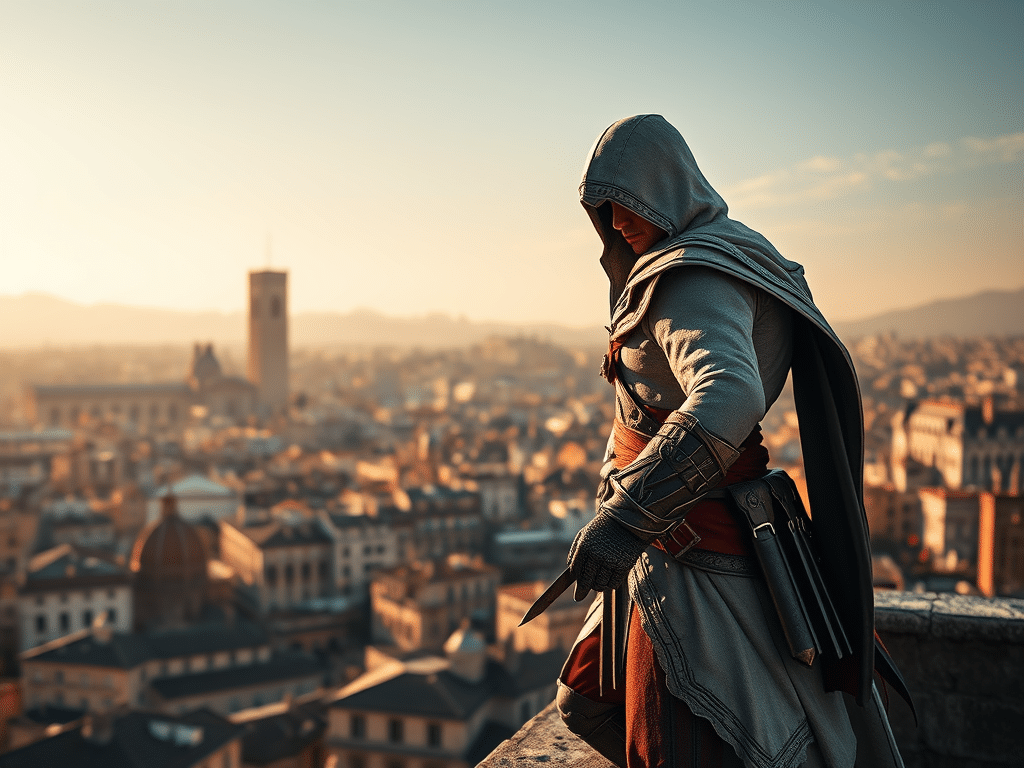
Assassins Creed is one of the largest franchises out there and has been incredibly popular since it released “Assassins Creed” in 2009. With daring leaps of faith from dizzying heights, stealth, action, betrayal, political and religious intrigue were so refreshingly fun and exciting. Ubisoft would then knock it out of the park again with the trilogy involving Ezio Auditore da Firenze. The trilogy consisted of Assassins Creed: II, Assassins Creed: Revelations and Assassins Creed: Brotherhood.
The Italian assassin, lurking in the shadows or nimbly sprinting along a rooftop, climbing dizzying heights, is a compelling story, brand new open-world setting, and expanded gameplay elements like parkour system fluidity and a deeper focus on stealth and combat while also introducing a new economic system and a more engaging narrative. These games were received incredibly well. Although issues during development and release are inevitable and a necessary component to learning and improving the formula for making a cash-cow, Ubisoft began pushing development teams harder to meet release windows and deadlines, with a “do it now, fix it later” attitude. This has led to a marked drop in quality overall. A never-ending cesspool of sequels that no one asked for.

I want to introduce you to the slippery, icy slope Ubisoft insists on skiing down at terminal velocity. At some point after the release of the final chapter in the Ezio trilogy, Ubisoft was riding high on their brand new cash cow, clad in a white cloak and armed to the teeth. The Assassins Creed franchise took on what I like to call “The Copy + Paste Effect.”
A business and game development strategy of continually reusing assets, etc., to pump out new games in a franchise on a schedule. The inherit reuse of assets, etc. in itself is something commonly practiced, normal and economical; when a corporation gets hold of it and it is attached to the biggest cash cow franchise they have, “The Copy+Paste Effect” makes for minimal effort, loveless, lifeless, bland, boring, tedious, unneccessary, insensitive, out of touch, unfinished, bugged, glitched, unoptimized sequels, with brain dead unituitive AI intellegance. Pointless crafting systems, “charging” a button for almost every action, open worlds that are empty and an afterthought, the giant glowing light on your minimap of your goal, the compass bar at the top of the screen, the button that allows you to see the way forward in case you get lost, unpolished multiplayer, long wait times for online pvp, unbalanced gameplay mechanics and oodles and oodles of loading screens.
I cannot say that Ubisoft has not put improvements into the various games over the years, instead something I like to call a “Non-fix” will happen, repeatedly. A “Non-fix” is an adjustment to, a revamping of, or a supposedly improved mechanic; an example of this is having a robust yet simple skill tree system, “simplifying” it so now the skill tree system is so convoluted it will have a 5-minute unskippable tutorial. Another example would be removing mechanics or deliberately denying players access to mechanics. Lest we forget, “The Legend Of Zelda” franchise has been refusing to put a dedicated jump button back into the game since Zelda II in 1987, over 30 years ago, until the release of “The Legend Of Zelda: Breath Of The Wild.”
A message to the Ubisoft customers: You guys are in an abusive relationship, and they are gaslighting you into thinking it’s your fault. If no one else is going to say it, I will. Ubisoft fans may be the most loyal fans and customers, they may also be the dumbest battery sucking, franchise apologists, I have ever encountered. Every time a new Assassins Creed is released, the exact same issues are present, and every online commentator or YouTuber reacts the exact same way post-Assassins Creed’s Ezio Trilogy. Surprisingly, after a strong lineup of humongous Ls for Ubisoft, it’s frankly amazing that there is still anyone out there defending them.
Discover more from The Cameron Journal
Subscribe to get the latest posts sent to your email.