I wasn’t thinking about the current geopolitical situation as a cold war until someone reframed it for me. That Intel analyst on TikTok made a compelling case that changed how I read everything happening right now. The chip restrictions. The Iran strikes. Venezuela. The Panama Canal. Cuba. All of it. Once you see it through that lens, the disconnected pieces snap together.
This isn’t just about Taiwan’s democracy or China’s historical claims. This is about semiconductors, energy control, and strategic positioning for a century-long competition. And most mainstream coverage is missing the through-line that connects it all.
The One Thing Western Coverage Consistently Misses
China thinks in generations and centuries.
In the United States, we don’t think that far ahead because we don’t have to. We lack the depth of history. Europe has it, but even they think maybe a decade out at most.China is a 5,000-year-old civilization. They think very long term. Nobody in the West really understands that.
Look at what they’re doing right now. Fighting over the Senkaku Islands. Building artificial islands in the South China Sea. Claiming more maritime water than international treaties allow. None of it pays off immediately. It’s all for the future.
They’ve been trying to take Taiwan since 1949. Mao couldn’t do it. Jiang Zemin couldn’t do it. Deng Xiaoping wasn’t that concerned. Xi Jinping is standing on the shoulders of leaders before him and only now is in a position to actually attempt it. Most places wouldn’t bother after almost 80 years. For China, this is unfinished business.
Why Taiwan Matters Beyond Symbolism
For the Communist Party, taking Taiwan would mean the end of the Chinese Civil War. Finally. Their ultimate victory to have all of China under one party, one government.
But the strategic value goes deeper than historical closure.
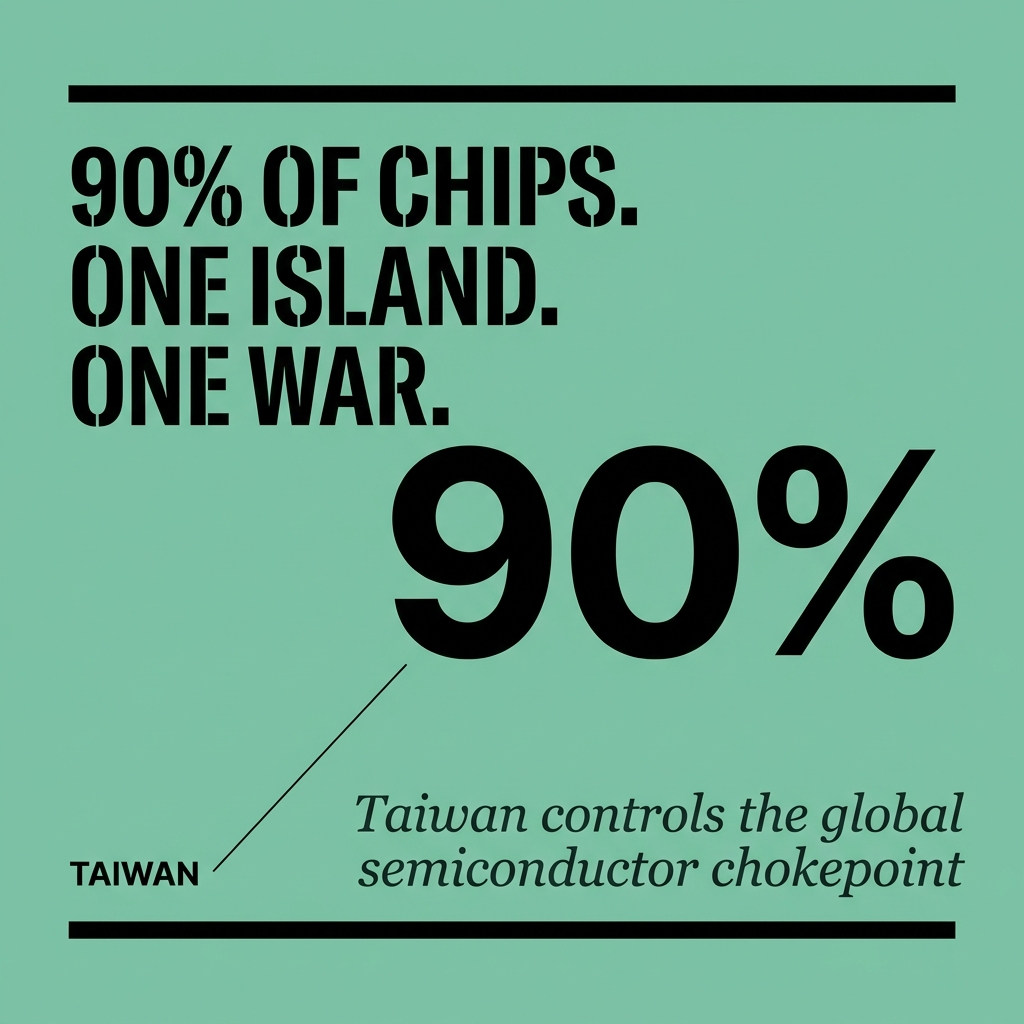
Taiwan controls the global semiconductor chokepoint. TSMC alone accounts for over 60% of global foundry revenue and more than 90% of leading-edge chip manufacturing. The company’s market cap hit $2.087 trillion as of April 2026, making it the world’s 6th most valuable company.
If China takes Taiwan, they would control approximately 90% of the world’s semiconductor production. They would control the world economy and set the standard. That’s a superpower move.
U.S. Treasury Secretary Scott Bessent wasn’t exaggerating when he warned that the concentration of 97% of high-end chip production in Taiwan represents the single biggest threat to the world economy. Any disruption risks what he called an “economic apocalypse.”
The numbers back that up. A full-scale conflict over Taiwan could result in a $10 trillion loss to the global economy. Even a blockade scenario would carry a global cost of $2.7 trillion.
The Chip Restrictions Nobody Talked About
Biden’s chip restrictions in 2022 were essentially war positioning.
He restricted the tooling and, most importantly, the American experts. They all had to leave China and take their software and equipment with them. It effectively kneecapped Chinese semiconductor production overnight.
They were stuck with the parts they had perfected but not the newest stuff with the US controls. He set them back several years with that move, but it was the best thing to do to defend American interests.
This is where the cold war framing becomes useful. The last cold war was marked by the atomic bomb and a new power that could end civilization. This time, the weapon in play is something we all have in our homes and in our pockets.
AI is also a frontier. So are drones. The strategic competition looks different, but the underlying logic is the same.
Everything Connects to China
Once you see the cold war framework, everything Trump has done starts to make sense.
Ending fentanyl precursors coming into the country. Cuba. Venezuela. The Panama Canal. Iran. All of it is essentially fighting China.
There’s an analogous situation with what FDR did in the 1930s against Japan. US involvement in WWII started as a trade war. FDR banned scrap exports to Japan at one point. Oil, I think. A few other things.
Japan did the same thing with seizing islands to expand their Pacific empire. They attacked Hawaii because it was as far as their ships could get, but it was the next logical place to seize except for the Philippines, which they seized as soon as the war started.
China has pursued a similar strategy, but this time China has been a big exporter to the US. The position is somewhat reversed in that way, but it’s playing out similarly with fights over trade that eventually fall over the edge into armed conflict.
The pre-WWII world was a pre-nuclear world, so the calculus is different. But there are parallels.
Iran and the Energy Control Game
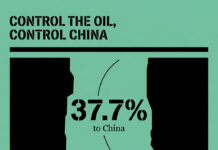
The Iran strikes weren’t really about Iran. They were a demonstration of American power mostly for a Chinese audience. It all has to do with oil. China has very little oil. They import most of it, and most of it comes from Iran and the Middle East. By controlling the flow of oil from Iran, the US essentially cuts China off or at least positions Tehran away from Beijing.
That demonstration was expensive. We’ve expended half of our armaments on Iran. But here we are. One aspect that should give Beijing pause: despite the bombings of bases in the Gulf states, American operations haven’t stopped. Every mission still went off. That’s resilience on a level that matters.
The Strait of Hormuz is the critical chokepoint here. About 20% of the world’s oil passes through that strait to reach markets in Asia and Europe. We’ve already lost 20% of the world’s oil supply. There’s already an energy crisis in Asia, and it will hit everything because everything runs on oil. Gas in my area is already $4.01, and we still have a month to go before it really starts to hit.
But here’s the strategic endgame: if we control Venezuela and the Strait of Hormuz, we essentially control the flow of energy globally. The US becomes a leading oil exporter and energy producer. We set the price and we control who gets it. That’s power.
Venezuela, Cuba, and Securing the Hemisphere
Venezuela has oil and lots of it. Taking out Maduro, running the country, and getting rid of the Chinese keeps them from securing the oil for themselves.
We’re pushing China out of North and South America basically. That’s so we can secure our own hemisphere. It all starts to add up when you think about it as a cold war against China.
Cuba is a loose end from the last cold war. But let’s face it, Cuba is poor and needs help. China could show up with a lot of help, and that would put China 90 miles from Key West and about 150 miles from Miami. There’s no way that’s going to be allowed. We learned our lesson from the Cuban Missile Crisis.
The Russia Question
Moscow and Beijing aren’t exactly friends, but China will simply get oil from Russia, and Russia will be happy to sell it to them because they need the money.
There’s a distance there. They weren’t allied during the last Cold War because Mao was not a Leninist. He had his own ideas and very much desired to be the face of global communism. Maoism was supposed to be the default communist philosophy. Two things could happen: either China finds another way to get energy by playing ball for a while, or they become friendlier with Russia. I think the Trump administration is counting on the former.
The Pattern Putin Learned
Putin annexed Georgia in 2008 by nearly half. He just put up a fence, and that was that. Most of Georgia is Russian-speaking, and they had been part of the Soviet Union, so it probably wasn’t much of a change for most people. He found out that the world didn’t really care. They let him get away with it, just like Crimea.
Ukraine was the next logical step. It’s no surprise that started because he had been planning it for a long time. Now some kind of peace is going to be negotiated at some point, and he’s not going to get Ukraine, but that’s okay.
Putin won’t live to see it, but maybe the next guy will try again. Or Putin will do what he did in Chechnya and wait for them to collapse. No clue if he will live long enough for that to work.
How I Connect the Dots
I have a degree in this stuff to start with, but I try to maintain context. I remember. I research and try to connect the dots in an easy way. Remember: The world is hard. This is not. It’s my slogan for a reason. Most coverage treats these events as separate stories. China tensions over here. Russia-Ukraine over there. Iran strikes in another section. Energy markets somewhere else.
But they’re all connected through the logic of great power competition and the transition happening right now in the global order.
What Politically Homeless Professionals Need to Understand
We are going through a tremendous change right now.
The stability that we’ve been used to was an anomaly, and those don’t last very long. Global chaos is historically normal. We are transitioning from a world where we had two superpowers down to one hegemony and now into a multipolar world the US wants to run on its own terms. It is going to be chaotic, dangerous, and volatile compared to what we are used to. I would say to reset your priors.
The news isn’t confusing because you don’t understand it. The news is confusing because most outlets aren’t showing you the connective tissue between events. They’re giving you isolated incidents without the strategic context that makes them make sense.
Taiwan isn’t just about democracy or historical claims. It’s about chips. It’s about energy. It’s about positioning for a century-long competition between the United States and China.Once you see that, everything else clicks into place.
The Delta Between Narrative and Reality
In any given issue, there is a delta between the reality of the situation and how we talk about it or the narrative around it. I try to talk about things in that space between the narrative and the reality.
The narrative says Taiwan is about democracy versus authoritarianism. The reality is that Taiwan is about semiconductors, energy control, and strategic positioning in a new cold war. The narrative says these are isolated conflicts. The reality is that they’re all connected through the logic of great power competition. The narrative says we’re in a stable post-Cold War order. The reality is that we’re transitioning into something more volatile and historically normal. Understanding the gap between those two things is where the actual insight lives.
That’s what I’ve been trying to promote for over 10 years now. An alternative, less outrage-based view that helps you understand the bigger picture and the context of how we got here and where we might be going next.
In a sober way.
Because you deserve to feel like you have a handle on the world without being overwhelmed, angry, or talked down to.
Discover more from The Cameron Journal
Subscribe to get the latest posts sent to your email.