
Supported by growing international trade and the digital economy, Uzbekistan is strengthening its ties with the global banking system, while Octobank is deepening its dialogue with international financial institutions
Central Asia has for many years appeared on the international financial agenda primarily as a story of remittances, commodity markets and regional trade. Gradually, that picture is changing.
At Sibos Miami 2026, Octobank, a third-time participant in one of the world’s largest financial industry forums, presented a broader agenda: Central Asia is becoming an increasingly developed and technology-driven financial market, and the region’s continued growth requires local banks to integrate more closely with global banking and payment infrastructure.
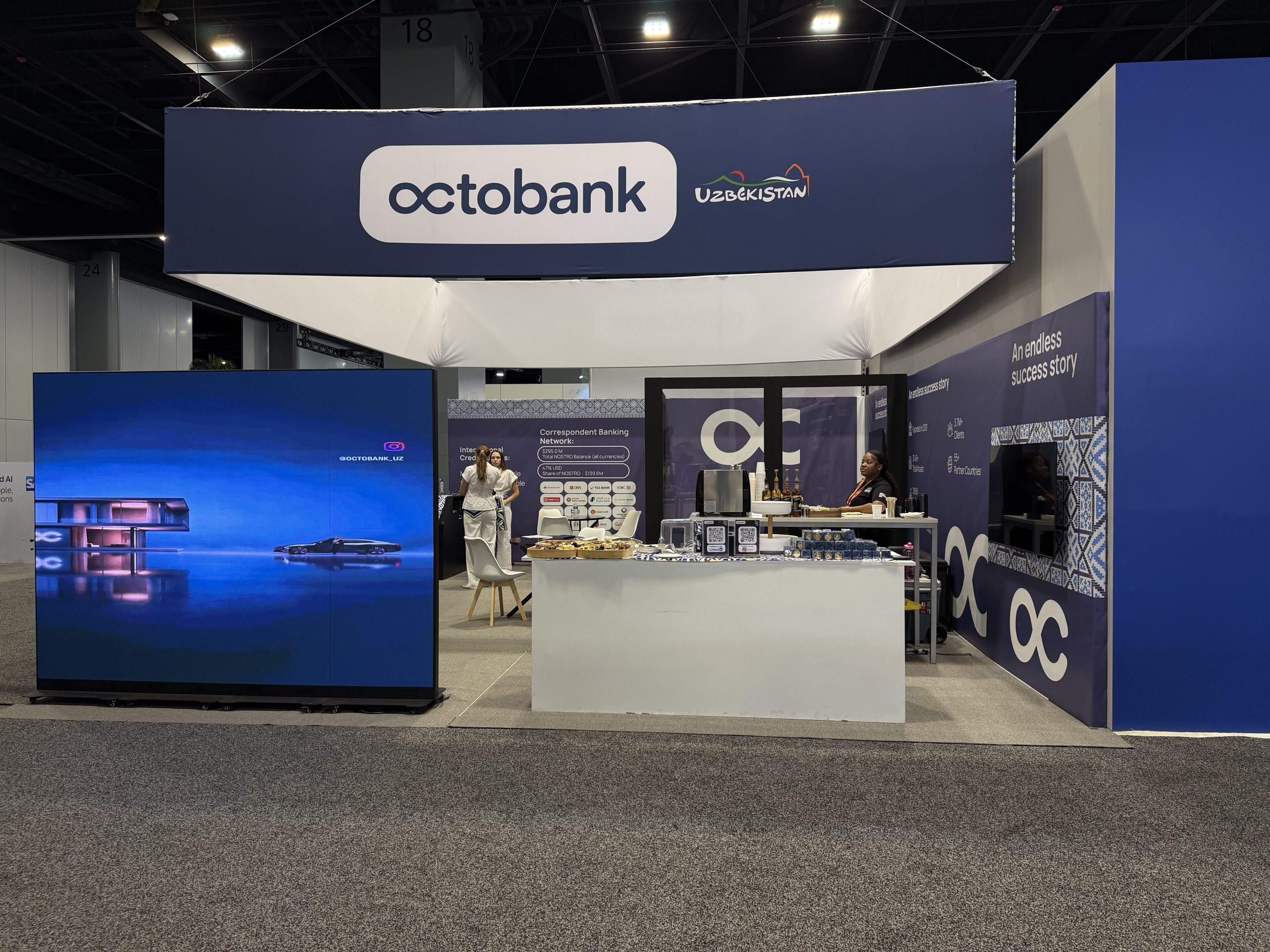
In Miami, Octobank occupied its own 48 sq. m stand, combining exhibition and meeting zones for meetings with international financial institutions, payment companies and technology partners.
However, the key part of the bank’s participation was not the stand itself or its design, but the business dialogue that developed around it.
Shifting from Remittances to Modern Financial Infrastructure
The areas at the center of Octobank’s Sibos agenda were those that form the foundation of international banking cooperation: correspondent banking, cross-border payments, clearing, foreign exchange operations, liquidity management and financial services for companies doing business in international markets.
The bank also signaled its interest in developing new payment routes and widening cooperation with foreign financial institutions.
This agenda reflects the deeper changes taking place in Uzbekistan’s economy.
As international trade, e-commerce and cross-border business activity increase, local companies need wider access to international settlements, multiple currencies, global payment systems and banking partners capable of supporting operations across several jurisdictions at once.
International banks, in turn, increasingly regard Uzbekistan as an interesting market that is still relatively underrepresented on the global financial agenda, notwithstanding its strategic position between the major economic centers of Asia, the Middle East and Europe.
Octobank sees this gap as an opportunity to develop further.
“Uzbekistan is becoming an increasingly visible part of international trade, and banking infrastructure must match this level of integration. For Octobank, it is important not simply to be present on the global financial agenda, but to build concrete connections with international banks and payment companies that help businesses operate faster, more reliably and more efficiently in foreign markets,” said Hamid Jumaev, First Deputy Chairman of the Management Board of Octobank.
Growth That Follows the Market
Octobank’s international strategy is grounded in a growing domestic business. According to the bank’s data as of September 2026, Octobank’s assets amount to about USD 1.66 billion, its client base exceeds 4.9 million people, and the bank maintains relationships with 19 correspondent banks and cooperates with more than 30 financial institutions. Further developing correspondent and settlement infrastructure in the main global currencies, particularly US dollars, euros and Chinese yuan, is one of the bank’s international priorities. These figures are important beyond simply characterizing the bank’s scale. They show that Octobank’s international development is connected not to an image presence abroad, but to the real needs of businesses and its client base. For a bank serving millions of clients and a growing corporate segment, a more developed network of international financial connections directly influences the speed of payments, transaction costs, access to currencies and the opportunities for Uzbek companies to operate in foreign markets.
Why Central Asia Is Becoming a Bigger Factor in Global Finance
Several factors are shaping the region’s importance at once. Trade routes are changing. E-commerce is growing. Central Asian companies are more and more active beyond their national markets. Financial technologies are diminishing the importance of geographic distance. At the same time, banks need the ability to connect markets that have historically been linked through longer and more complex chains of intermediaries. Consequently, the old image of Central Asia as predominantly a remittance market is gradually becoming outdated.
The next stage of development is financial connectivity. In practice, this means direct interbank relationships, broader access to clearing, faster cross-border settlements, and the development of foreign exchange infrastructure, treasury services and payment technologies for businesses and retail clients. For international financial institutions, a different question emerges. Not only: “How big is the Central Asian market today?” But also: “Which financial institutions will provide the infrastructure as new trade and payment flows grow?”
When the Silk Road Becomes Financial
Octobank’s participation in Sibos was based on the idea: “Uzbekistan — the New Silk Road of Digital Finance.” The historical analogy was deliberate.
For centuries, the Silk Road connected economies, moving goods, capital and information between markets. Today, a large part of these connections is becoming digital. A modern trade corridor can no longer be seen only as a network of roads, railway routes and logistics hubs. It also relies on the ability to move money between countries quickly and efficiently. That requires banks. It requires settlement infrastructure. It requires financial control and compliance systems. It requires international payment networks. And, importantly, it requires relationships of trust between financial institutions from different countries. For Uzbekistan, developing such relationships is becoming part of the country’s broader integration into the global economy. Octobank is working to become one of the financial institutions that enable this process.
More Than an Exhibition Presence
At Sibos, Octobank aimed to connect the international banking agenda with the broader story of today’s Uzbekistan. National elements were used in the stand’s design, visitors were offered traditional Uzbek sweets, and the business program was complemented by a chance to get to know the country’s culture.
At first glance, this may look like a regular exhibition element.
For international positioning, however, it has a deeper significance.
Many representatives of the global banking community still have no direct experience of working with Uzbekistan.
For this reason, Octobank’s task is not just to present the bank itself.
It also needs to present international audiences with the market that stands behind it.
What Sibos Leads To
The real value of any major international banking forum is defined not by how many meetings take place during the event, but by what happens after it has ended.
For Octobank, the outcome of Sibos will depend on how far the negotiations in Miami can develop into long-term relationships with international banks, financial institutions, payment companies and technology partners.
Continued dialogue could cover areas such as correspondent banking, clearing, payment infrastructure, foreign exchange operations, liquidity management and fintech cooperation. The bank itself emphasizes that its international strategy is about more than raising awareness.
The aim is for the dialogue started at Sibos to be continued in practical form. This distinction is fundamentally important. Because the larger story is not that an Uzbek bank took part in a major international event. It is that financial institutions from markets such as Uzbekistan are gradually starting to play a more direct role in global financial infrastructure.
As Central Asia integrates further into international trade and the digital economy, this process will become increasingly visible. The historical Silk Road connected economies through trade. Its modern counterpart is increasingly being shaped by payments, clearing, technology, data and direct banking relationships.
About Octobank
Octobank is a private commercial bank headquartered in Tashkent, Uzbekistan.
Founded in 2001 and rebranded as Octobank in 2023, the bank today develops digital banking, payment infrastructure, corporate services and international financial operations.
According to the bank’s data as of September 2026, Octobank’s assets amount to about USD 1.66 billion, its client base exceeds 4.9 million people, and the bank maintains relationships with 19 correspondent banks and cooperates with more than 30 financial institutions.
Octobank’s international strategy includes the development of correspondent banking, cross-border payments, foreign exchange operations, clearing, liquidity management and other areas of cooperation with financial institutions.
Discover more from The Cameron Journal
Subscribe to get the latest posts sent to your email.