Welcome to the next installment of my “What the Hell is Going On?” collection drawn from my first book and various new essays that I have been sitting on and am now ready to publish. You can read the whole collection.
Introduction
When I first wrote this essay, my goal was to ask a simple question, “Is Climate Change Real?” At the time, I was not convinced of catastrophic and global climate change. I thought the evidence was lacking, and the research simply wasn’t available to tell us if the climate was changing and if mankind was responsible for it. However, in the intervening period, events have brought the nature of our changing climate into sharp focus. Oceans are acidifying, which kills fish and coral reefs. Even without climate change, the death of fish means billions may starve. After grain and rice, fish is the most commonly eaten food.
I am going to do my best to present both sides of the debate. Those who are firm in their conviction about climate change will criticize me for presenting the opinions and evidence of “climate deniers” and those who aren’t convinced about climate change. However, I specialize in context. In order to be intelligent and have intelligent discussions about climate change, both perspectives must be clearly understood. Each side shouting at each other without listening first and addressing concerns will not help the situation, and it appears the situation could get quite dire in a relatively short period of time.
The Climate is Changing?
It all seems rather confusing, doesn’t it? Our changing planet has become one of the most contentious issues today. World Leaders met in Paris in 2015 to find out how to tackle the problem of increased carbon emissions and our warming planet and agreed together to create and implement solutions to stop this globally pressing problem. There isn’t anything more of a hot-button issue, especially in American politics, with Democrats looking like the enlightened ones while Republicans look like they are stuck in the dark ages. It has all the classical signs of an old-fashioned American debate.
There are deep economic consequences depending on how things move forward, and the most telling detail of the entire debate is how important it is to both sides. Both sides of the debate are convinced that they are right and that the very existence of civilization depends on them being right. On the one hand, those who are convinced we are killing the planet are convinced that we have to stop the way we exploit and destroy the environment in order to maintain any existence. Those that oppose it are convinced
that we have to keep the current system going because if we don’t, then what would we do? What would people do without jobs? How would we survive without the modern economy? How would we feed ourselves or look after our health problems.
Those for climate change usually are in favor of a more holistic kind of living that often includes less use of fossil-fuel-burning transportation, unsustainable foods, and, at the most extreme, any parts of modern society that aren’t considered “natural” or “of the earth.” I think the most surprising thing I’ve observed is the very real emotional response that some people have toward parts of civilization that we all take for granted.
I rented from a lovely couple in England for several months. The lady of the house took a trip from the small town she lived in and went to the larger city of Bath. She swore she would never go again because there were “car parks” (parking lots) and “people just buying things in stores and rabidly consuming.” To the bulk of people, the prospect of a future with no products, services, and veganism just doesn’t appeal.
Indeed, Climate Change is a question of our very existence. The answer is not within either side of this equation. As humans, we get very touchy when our existence (Regardless of how you define that) is threatened and that can lead to the kind of vitriolic debate that we currently find ourselves engaged. We have several problems, none the least of which are a matter of religious-like faith and belief, which comprise one-half of the argument. The question I put to myself and my research was, “Is Climate Change real?”
What is Climate Change?
For those that don’t know, global warming/climate change is the result of increased CO2 production and the fact that those gases keep more of the sun’s rays in our atmosphere than before. The more gas, the more rays get stuck, and the warmer the surface of the planet gets. In the years following the Industrial Revolution, when we began burning massive amounts of coal and oil, the result of that burning was Carbon monoxide (1 carbon and 2 oxygen molecules) and that gas has gathered on the planet. Newspapers reported on the potential damage from excess atmospheric carbon at least as early as 1911 when the first story in a small newspaper reported, in just two and a half column inches, that by the end of the 20th century, there could be adverse impacts to the weather if the release of carbon continued.
The climate change scientists and others would like us all to believe that this carbon gas release has irreparably caused warming and has resulted in climate change that manifests itself in a variety of ways. That includes increased sea levels as the result of melting ice, the death of a variety of animal species, and an increase in dramatic weather events like hurricanes, wildfires, and winter storms.
When it comes to the so-called climate change deniers the media does a fairly good job of invalidating their objections and the poor presentation doesn’t help. However, there are some commentators that present what I think is a compelling case to at least question the discussion we have around climate.
Climate Change Evidence
There is a variety of evidence for climate change. Often, people around the globe are already feeling the effects of climate change. From Al Gore’s popular film to a variety of government agencies, inter-government agencies, and popular nature films, the evidence of climate change is pervasive.
An Inconvenient Truth
Even before he was Vice-President and lost to George W. Bush in 2000, Al Gore has been ringing the alarm bells for climate change. His 2006 film, An Inconvenient Truth, discussed the potential of climate change. Al Gore had been giving the same slideshow presentation since the 1970s to pretty much anyone who would listen to him.
In the film, he looks at a NASA graph that shows global CO2 levels over the past 800,000 years. They go up and down, however, in 1950, we exceeded the normal range for CO2 concentration in the atmosphere and the graphs shows a dramatic increase to 400 ppm (parts per million) in the atmosphere. He points to our modern industrialized society as the cause. Since the invention of the steam engine and the economic progress that fossil fuels have created, mankind has been burning carbon in the form of coal and oil to create energy. The result of this burning of these fuels is that these gases are released into the atmosphere at a greater amount than the planet can remove from the atmosphere. When sunlight strikes the atmosphere, these gases retain some of that heat from the sun in various forms like UV and other rays. Rather than letting this heat go back out into the cold of space to dissipate, that heat is staying here on the planet and causing warming. Al Gore’s solution? A phase-out of fossil fuels and an increase in more sustainable forms of energy production, including solar, wind, and geothermal.
The planet is already approaching 1.5 to 2 celsius of warming. That amount of warming could be reached in the next several decades if drastic reductions are not taken by every nation. To put that in fahrenheit terms: 34.7 degrees to 35.6 degrees. This means that since pre-industrial times the planet has warmed up quite a bit.
Al Gore had never found a large audience until his 2006 film. He was a senator from Tennessee and then vice president, but he always knew that fossil fuels were damaging the planet. However, in 2006, he sparked a global conversation about global warming and climate change that has never died down. His sequel film, An Inconvenient Sequel: Truth to Power, culminates in his important work around the Paris Climate Accords, which almost every nation on earth signed at the time. Under President Trump, the United States later withdrew, although individual states like Colorado, Washington, and California are committed to abiding by the treaty, which even sparked a visit from Angela Merkel, Chancellor of Germany, early in 2017.
The Science
One of the biggest questions is the science behind climate change. Climate change science is difficult because you cannot reproduce planetary-sized experiments in a lab. We can’t build another Earth with the same conditions and then inject a bunch of carbon and see what happens. So, scientists rely on our natural laboratory for answers. Most
of the measurements that make the case for climate change come from temperature records that extend to the 19th century, followed by tree ring and ice core data. Using this data, scientists can tell which years were wet, causing more ice and thicker trees, and which years were dry, causing thinner trees and less ice.
Ice also holds atmospheric data in the form of little bubbles. The gases from these tiny bubbles are used to analyze what the air was like when the ice was formed. This allows scientists to look at the planet as it was. In recent years, photographs have been fairly stark as well. Arctic exploration began in the late 19th century and by that time, photography had been invented. From these historic photos, we can see what those explorers in the early 20th century saw. In many cases, they confronted mountains of pure ice, ice that now is no longer there.
By almost every measure, the planet is changing, warming is happening, and the warming is tied to the emission of CO2 and other gases. This warming is even starting to become recursive with the current warming causing more warming.

Effects of Climate Change
The effects of climate change will be extreme if carbon emissions are not reduced to net zero by 2050. These include a warmer planet, sea level rise, catastrophic ecological changes, and weather changes that would threaten all life on earth.
Warming Planet
To stop catastrophic warming that would end almost all human life on earth, the doomsday date is sometime in 2040-2050. If carbon output is not reduced by then, then there is no going back. The planet will begin to warm to a level above 3 degrees Celsius, which would cause sea level rise due to melting ice caps and increasingly unpredictable weather. Many coastal cities would soon be underwater. Fresh water would evaporate more, putting more water vapor in the air and causing more heating. That increase in water vapor would also increase the frequency and severity of storms around the globe. That gives humanity roughly 25 years to halt these climate problems and reduce the amount of carbon output to nearly zero.
According to Professor Anis H. Bajrektarevic, writing in the Asia Sentinel, “In order to make the necessary changes happen to stop catastrophic warming, $2.4 trillion dollars (about the annual US federal budget) would need to be invested in clean energy.” He also claims that we would need to link research and environmental policy together to look at new products and services and how those interact with the environment. In order to make a change, we have to rethink everything, and there is good reason to do so. The effects are extreme.
Sea Level Rise
Sea level Rise has the potential to radically affect billions of people. Most of humanity lives near a coastline. Most major cities, with only a few exceptions, are on a coast line. According to Richard Alley in Rolling Stone, “if fossil fuel burning isn’t cut significantly soon (within a decade), we could see a 15-20 foot rise in sea levels. This kind of sea level rise would see most of Florida underwater. New York, London, Tokyo, Los Angeles, Seattle, Mumbai, Beijing, Jakarta, and other major cities would be underwater as well. There is no current number to calculate the economic loss that this would cause in both productivity and real estate.”
Cities below sea level, like New Orleans, Florence, Venice, and parts of the Netherlands, would need taller sea walls to remain habitable. Small islands in Oceania (the area around Australia) will be completely wiped out by sea level rise. In some places, like the Maldives and Micronesia, sea level rise is already happening, forcing inhabitants to move.
These small nations whose land is right at sea level or just above have already had to evacuate some people from certain islands that are simply disappearing into the sea. The loss of life would be catastrophic, as well as, the losses suffered by the world economy. When storms did come, the storm surge would be higher as well. Areas that used to be safe from storm surge and flooding would have walls of water innudating them causing untold amounts of damage.
Sea level rise can come from the loss of ice at the poles and especially the loss of ice in West Antarctica and in Greenland. This is melting due to the fact that the oceans are getting warmer and that warm water is eroding the massive ice sheets from beneath which means that the ice will melt faster, break away from the main ice sheet and be surrounded by warmer water, causing more melting.
For example, think of a tray of ice cubes that were overfilled and all stuck together. Pouring some warm or hot water on top will break them away from the rest f the cubes. Then, when the ice in put in the warmer liquid in the glass, it slowly disappears, increasing the volume of liquid in the glass. This is the same principle on a global scale.
Ecological
Many of the ecological impacts are already beginning to be evident. Currently, there are more species of natural creatures dying than in any other time in human history. Large mammals are already being decimated and insects are even suffering from the effects of climate change. This has caused some insects to move into more northerly latitudes to seek out temperatures they are more accustomed to existing and thriving in.
According to the Copenhagen Climate Diagnosis, a major report preceding the 2009 Copenhagen climate talks, the report stated that physical changes would be dramatic, including the only good thing about the changes: the Sahara may become a lush forest due to increased water vapor and rain that would turn the desert into the world’s largest forest.
However, the situation is much worse for the rest of the planet. In India, the change of the monsoon could exacerbate the water crisis. In Canada, there could be major deforestation. In Brazil, the Amazon could die back and practically kill off the forest which has been described as “the lungs of the planet.” In Russia, there could be a
massive loss of tundra and permafrost. At the poles, a significant loss of ice would occur and the Greenland ice sheet would all but disappear. This would affect animal populations that rely on these climates and would have dire effects on human life as well. The additional heat could also make some parts of the planet nearly uninhabitable. Increased heat waves in India and China would make working outside nearly impossible. Even parts of the American southeast would experience heat waves that would make the outdoors completely inaccessible during the day. Air conditioning is not an easy fix. Energy consumption increases up to 20% on hot days, and parts of the electrical grid, like above-ground transformers, would overheat and explode from the strain.
The story isn’t just about atmospheric carbon either. It isn’t even just about the loss or gain of forests or the rise of sea levels. Climate Change is also about eco-systems. Recently, the New York Times Magazine reported on the onset of the insect apocalypse. Those brave souls who do the tedious work of counting insects, collecting them, and studying them often need decades to do their work. Even now, in shorter terms, they are discovering that we have fewer insects. Some people over 30 or 35 have even begun to notice this change. The article starts out with a Danish man who noticed that when he was riding his bike as a child, he would end up swallowing insects. However, his son, in the present, didn’t have that worry. His observation started a study where people drove around the country with insect collection devices strapped to the tops of their cars to replicate insects striking their windshields. They found that in all that driving, they weren’t collecting very many insects. This has a huge effect on the entire food chain. Birds rely on insects to eat. Studies have shown that in Europe, the number of farm birds is declining due to a lack of insects. When there are fewer birds that means higher food chain creatures don’t have a food source either. This even extends to oceans. If there are fewer dying whales, nutrient-poor areas of the ocean have no food, which means there are fewer fish, which means there are fewer whales. This is due to the loss of plankton, which means fewer whales to die, which means fewer things can eat the whales to create nutrients that keep that ecology strong.
We are just beginning to understand how warming might be affecting insects but the largest force that is affecting them is humanity. Humanity uses pesticides for agriculture in great numbers. That means farmers are killing off insects and it may have reached a tipping point where pesticides have done such a good job killing insects that the entire ecology of the planet is beginning to feel the changes. Increased temperatures and a lack of water are also factors that could be causing this insect apocalypse.
But What If It’s Not True?

It seems like a done deal, the evidence seems to be all around. Greenland is melting, the poles have less ice coverage and there are pictures of skinny polar bears unable to find food. Everyone, in their day to day lives seems to be able to tell some story about weather just not being the same. There are all kinds of storms, from super snow storms to hurricanes, that seem to be buffeting us all about. Looking at the global picture, things are even more grim with desertification (expansion of deserts) drought (and the resulting starvation) and flooding.
In 2017, Boston spent months digging out of the biggest snowstorm in history while California was wondering if their state was going to be able to flush a toilet for much longer. Cape Town, South Africa, was the first city to completely run out of water. India is deep in a water crisis. Hurricanes have gotten more powerful and caused more damage. There is observable evidence that something is going on with the planet. Science points the finger at global warming and the cause of that warming being greenhouse gases and the creature who is emitting all those gases: humans.
Wacky weather has been the narrative for a while, and no news story has suffered more in terms of narrative journalism than climate change. Every time something “odd” happens in the weather around the nation, the first question is if it is yet another sign of climate change and global warming. Usually, the friendly and well-meaning broadcast meteorologist nods their head affirmatively. Even in the evidence that is presented, there are some problems.
Here are some of the problems:
- Scientists only have ice sheet data since 1979 because that’s when they started tracking it with satellites. Before then, scientists have ice core data; there is no long-term data about the cycles of ice sheets.
- Temperature data, especially over time, can vary, not wildly, but it is difficult to rely on.
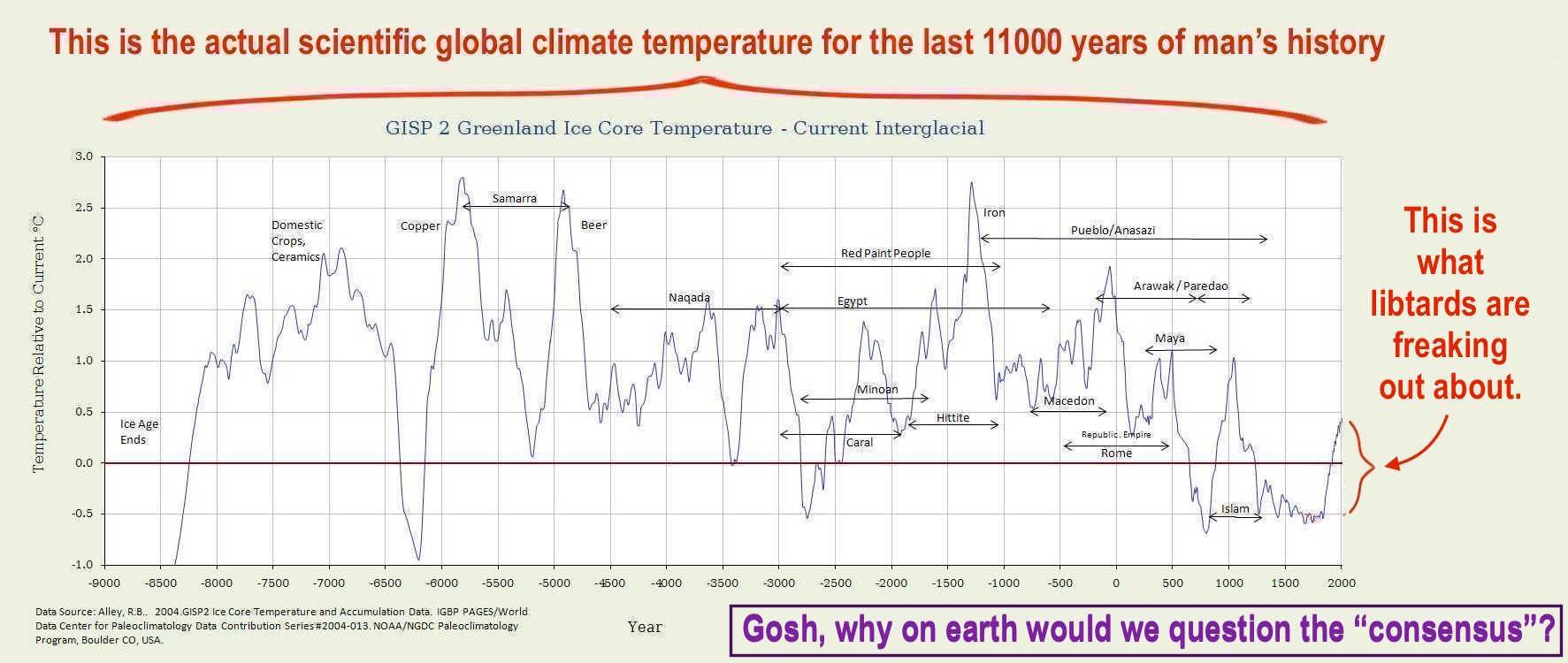
- Even with the temperature data issues, the planet goes through natural warming and cooling cycles. Even in Al Gore’s chart, the planet has warmed and cooled several times
- Despite the hype, CO2 is a very important to life as it powers plants that provide food and oxygen. Scientists, like Jay Lohr, point out that the increase in CO2 is good for crops and is causing reforestation.
- The Earth goes through ice ages and periods of glacial expansion and retreat.
- The planet has not warmed at the rate it was supposed to warm in the past 15 years.
- Climategate revealed there may be some problems with how data was handled.
- Although 2000-2009 was a warm decade, in 2014 and 2015, polar ice sheets expanded.
- Atlantic hurricanes have decreased in number over the past 15 years. The data predicted they should have increased in number and intensity.
- The predicted increase in allergies and lyme disease did not materialize.
- Many of the arguments for climate change tend to be economic not scientific.
- Humans are just beginning to be able to accurately measure how the planet is changing, and we don’t know if humans are to blame or not.
- This exists on such a time scale that we cannot begin to understand it to draw conclusions from it.
The simple fact is this: there is no smoking gun for climate change. There is data that the planet has already warmed 1 degree Celcius since 1950, and there are climate anecdotes from all over the globe. Lots of people talk about how times have changed when it comes to the weather. I spent the end of 2015 in Somerset, England, and the residents I talked to were people who commented that it “used to snow here.” Meanwhile, when I stopped in Iceland for a layover of 2 days, one of my taxi drivers commented on how it didn’t used to be as cold in Reykjavik and that he hated the cold and was tired of how cold it was outside. Apparently, even in Iceland, winters weren’t as harsh in recent memory. But all of this has not centered on a singular crisis. The signs of climate change are scattered around the planet, in isolated things that seem disconnected, but all have something in common: the planet is changing.
In the absence of overwhelming evidence and a smoking gun, the media has done a great job of using indicators, images, and dour-faced experts to create the perception that climate change is a real thing and that with every puff of smoke from a smoke stack, humans are slowly but surely killing the planet. It seems like the very fabric of modern civilization is simply tearing the planet apart and the natural system on which we have depended since the end of the last ice age is just falling apart at the seams and humanity is the only culprit.
The Environmentalist Movement
One of the first people one might describe as an environmentalist as John James Audubon. He founded the famous Audubon Society that specializes in researching, cataloging, and studying nature as well as running a few small parks. Audubon was doing his study of nature around the same time as John Muir was creating his stunning photos of Yellowstone and other natural features around the United States.
Teddy Roosevelt, after exploring the vastness of the American west, thought that instead of merely exploiting the land and its natural features, some of it should be preserved. As President, he went on to create the national parks system which was revolutionary at the time and used the power of the federal government to specifically restrict the use of land for its preservation in its natural state. Both of these men were the early pioneers of what would later be called the environmental movement.
Caring for and preserving the environment wouldn’t be a high priority after the progressive period of the early 20th century until the 1960s. Much of the modern environmental movement was a cultural reaction to the consumerist culture of the 1950s as well as a strong desire to identify with nature and the natural world as opposed to the “ticky tacky” world of suburbia. This was with good reason. The United States was an industrial powerhouse following World War II; however, environmental regulations were virtually non-existent. Manufacturing processes created air and water pollution. Industrial cities like Chicago and Pittsburgh would be choked with air pollution from steel mills and factories. One of the cultural changes coming over the horizon would be the defense of the natural world of animals against the encroachment of mankind.
In the 1970s, Americans lived in environmental conditions that most would now consider barbaric. Cleveland is the classic example. Before the Clean Air and Water Act, the Cuyahoga River was filled with so much foul material that it was flammable. On July 22, 1969, it burst into flames. Oil and other debris littered the surface, and it simply burned.
This river passes through populated areas and feeds into one of the largest freshwater reserves on the planet: Lake Erie. The river was so polluted that the local papers referred to it as “oozing.” If there were a major American river flowing through a populated area today that was filled with that much waste, there would be outrage, and there are most likely some places where some outrage is called for due to this very problem.
Thanks to the environmentalist movement, the times have changed, and now the picture looks much better. Although environmental accidents and degradation still occur, they are not simply tolerated; they are fixed and cleaned up, and our rivers, streams, and coastal areas are better for them. Humanity is a part of the environment, and the way people think about human involvement in ecology reflects that view. The current climate change narrative suggests that if humanity doesn’t go back to living in mud huts and dying off at 35 years of age, not enough is being done to protect and keep the planet in a perfect and pristine state. Some of the arguments sound like the only way to solve this problem is for humanity to disappear and quit existing. The EU was one of the first organizations to recognize that to meet its own 2030 targets, significant lifestyle changes have to occur. Climate Change narratives focus on changing every aspect of modern life.
A Greenpeace?
Patrick Moore of Greenpeace fame very famously came out against Greenpeace and the modern environmental movement, calling them “eco-fascists.” He founded Greenpeace to stop a nuclear test off the coast of Alaska in 1971, not only as part of the nuclear non-proliferation movement but also for the environmental disaster that the release of radiation would cause in ocean eco-systems. Greenpeace, through its direct actions, brought the environmental movement into the public discourse and brought harmful practices, like whaling and clubbing seals for their fur, right into the living rooms of people all over the world. However, he ended up leaving the organization after financial problems and the realization that it was being dominated by those “eco- fascists.”
In a popular presentation in front of a conference speaking out against the climate change narrative, Dr. Moore points out that, in the same place where the IPCC claims that it is “extremely likely that human influence has been the dominant cause of the observed warming of the planet since the mid-20th century,” they also claim that it is a judgment. It’s an opinion based on the observation. He made that statement 12 years ago in 2007. Meanwhile, he presents a quote from the Global Warming Petition Project signed by 31,000 scientists and professionals in just the United States “There is no convincing scientific evidence that human release of carbon monoxide and dioxide will, in the foreseeable future, cause catastrophic heating of the Earth’s atmosphere and disruption of Earth’s climate.”
He also claims, like others, that an increase in CO2 is a good thing. Plants will thrive, and agricultural production will increase. He also points to data showing that we are warming because we are actually leaving an Ice Age. According to his data, the average global temperature over the last several million years has been about 22C. We’re only at 14.5C. This could mean that the planet is getting back to normal. Yes, the planet may be warming, but that is because the planet is getting back to its “normal” non-Ice Age temperature. Dr. Moore also goes on to point out that even the IPCC agrees good forests are a great way to help the planet and serve human needs as well. He argues that trees are a sustainable resource and should be planted widely and used for products like homes and furniture.
Dr. Moore presents the idea that climate change has more to do with private people being against the way we conduct civilization than reporting fairly on what is going on with the planet. He cites Greenpeace’s opposition to chlorine in the 1980s. Chlorine is an important element, but once it was branded as “bad,” many people decided to come out against it even though it is a vital compound for safe drinking water and other uses. This is the problem with climate change: rather than create a narrative around science and actionable ways to change the way humanity conducts itself on the planet, the climate change narrative often focuses more on things that do not matter (chlorine) and less on serious matters like agricultural chemicals or plastic.

The Planet is Changing
Unfortunately for the narrative, the planet did not agree with the warming idea. There were isolated incidences of warming, but the overall picture was changed and stable. There could be a political angle as well. As the environmental movement floundered in the late 1970s, unable to get people to change their lifestyles to meaningfully reduce waste, pollution, and other outputs and reduce industry, a massive, destructive, man-made event sounded like it was a good way to get people’s attention. Climate alarmism began as early as 1980. After much media attention, the idea worked. The debate has moved from a question of if the planet is changing to whether mankind is having an adverse effect on the global climate system on which we are all dependent.
One thing is clear: the planet is changing, and for the first time, we’ve had the technology to quantify those changes and understand them in new ways that were unknown to people in the past. Even as late as early discoveries of North America, Greenland, and Iceland, those early explorers recorded a very different landscape in those places than we know today. The planet is constantly changing, and our ability to understand those changes is in its infancy, which makes it a difficult task to convince everyone that we have to remake the global economy in order to stop or at least mitigate these changes.
The Failed Narrative

The whole scientific narrative around the nature of our changing planet is difficult to understand and harder to accept. There is a now infamous National Geographic story from July 1980, where the magazine announced that the science was in, and we were headed for another ice age. For northern latitudes, this was a real problem. Much of Canada, northern parts of the United States, and Europe were under ice during the last ice age. The Canadian Shield in Nova Scotia is the remainder of that glacial expansion. The Great Lakes along the border between the United States and Canada are there because the glaciers dug out these future lake beds and melted during the retreat. However, just 10 years later, the narrative had changed again. No need to fear another ice age, instead the planet was doing the exact opposite. This is where the narrative around this science has been a failure.
Climate change advocates have sold the problem all wrong. The goal is to stop another 1 degree of temperature rise over the next 100 years. Even the babies of today will be in their 80s and 90s by the time 2100 comes around, and this degree of temperature rise comes to pass. Most people don’t want to sacrifice their jobs today to stop the warming of the planet in 80 years. The simple fact of the matter is that we have been affecting his planet since we left the caves and began the expansion of civilization at the end of the last ice age when the planet warmed dramatically.
Early farmers were busy warming up the planet and stopping the ice ages that had happened periodically in pre-historic days. We’ve eliminated whole species from our planet via over-hunting. Human impact on this planet has been constant since the early days of civilization when began to organize into villages and hunting bands and exploit the planet for human needs. The planet makes all sorts of interesting changes on a nearly constant basis, both because change is constant on a living organism like Earth and due to the changing ecological profile of different areas. The climate and the planet were not perfect and pristine in the centuries before the Industrial Revolution. From rivers filled with raw sewage and dead bodies to awful deforestation in Europe, humans have had an impact on the planet for thousands of years. Humanity has been burning fuels and pumping the results into the atmosphere for thousands of years. And yet, the climate change narrative holds that, thanks to the industrial revolution accelerating this process, mankind has been able, in 200 short years, to radically change the planet.
If the climate change advocates want to change the way people live, they have to address things that people can see results from in their lifetimes. There is no shortage of problems worthy of address. Sea level rise is certainly going to affect billions, as coastal cities flood and eventually succumb to the ocean. Places that are cold and unpleasant now, by mid-century, may become the new sunbelt of moderate temperatures, and more desert locations simply become unbearable due to the heat.
Deforestation is a massive problem that affects the temperature and the atmosphere. Positive forestry and managed forests can create a sustainable material (wood) and also work as an important part of the ecology. Saving oceans from being choked in plastic and other waste is as important as cleaning up the Cuyahoga River. All of these things can be adapted to and solved in ways that will both serve the climate change narrative and also move the needle on how we treat the planet. New methods can create ways of moving cities or mitigating flooding along coasts. Cleaning the ocean and creating new waste systems that don’t just dump the problem into the ocean would be a positive benefit for everyone and preserve a significant food source. In order to solve these problems, the narrative must move from “Your lifestyle is wrong” to “Here’s how to help the planet and create positive change for the future survival of everyone.”
Even in the face of all that is being done and all that can be done, to some greater or lesser degree, humanity cannot stop the way the planet is changing. The best thing to do is adapt to it. Creating barriers for cities along coastlines is an important project to begin, and in many cases, those cities may need to be abandoned and moved elsewhere. Humanity can mitigate carbon emissions and other chemicals in the system. Agriculture can be made more sustainable in a way that uses less land and fewer chemicals and do it in a way that works with the ecology of the planet. Complementary planting, organic farming practices, and GMOs all hold promises for a new kind of food production that would benefit everyone and the planet. Countries can rethink energy in new ways, but those new ways have to be reliable. Natural gas holds some of that promise, as does nuclear power. Nuclear power plants can even use the waste that we’ve already created. Old nuclear waste is an energy commodity. Managing waste and products and packaging at the end of their lives is vital to the planet. We can work toward a zero-waste society. Receptacles for compost, recyclable materials, and other waste is important. By creating packaging that rots and go away, we can reduce the actual waste to a footprint so small that it can be stored, incinerated, or otherwise disposed of in a way that is not damaging to the ecology. It starts with industry and ends with the consumer. It seems like a bother, and it seems like it will be a waste of time and energy, but this sort of thing is what will actually save the planet, and the best part is that the results are immediate. Humanity will see results from these practices within 5–10 years.
More than a Belief
Any time, you have to talk about something in terms of belief, I think you lose something in the debate. In learned circles, you will hear the following, “I believe in climate change” or “I believe in global warming.” If science cannot produce such evidence that makes it so that we can say, “I know that global warming is true” or “I know about climate change,” then there is a problem. When something so important as the state of the planet is reduced to mere belief and faith, massive policy decisions cannot be based upon that. The same people who proudly proclaim the belief in this cause would no sooner ascribe that same idea to any other area of their lives. There are people in this world who believe that the world is a flat disc bound by two walls of ice. Their belief is nice, and they are welcome to it, but we can definitively say that we know the Earth is a sphere, and we have overwhelming evidence to that idea.
To some greater or lesser degree, it seems to be that human civilization in its industrial form is the root of the problem. In all things, there are actions and reactions, this is a basic law and climatology is no different. I do not see a way in which we can all live and do so in a way that has no impact. Our very existence as reasonable human beings who are engaged together in villages, towns, cities, and nations is impactful. Animals impact their environment; they just do it in a way that is more harmonious to the greater wholeness than the way we have lived for the past 10,000 years. We are all part and parcel of the planet.
How Do Humans Adapt?
Climate Change is already coming. It’s already happening and if steps aren’t taken, it may be too late before the warming of the planet can be halted or even reversed. The best course of action for climate may be adaptation to the new climate reality that the planet is offering. This will mean radical changes to entire way people live all over the globe.
Transportation
One of the biggest outputs of carbon comes in the form of transportation. Cars, buses, planes, ships, and trains all rely on carbon in some form. Either through electric generation or through direct output. In order to stop further warm of the planet, all of these would need to be phased out by 2050. Professor Bajrektarevic argues that air travel as we know should be all but phased out in places like Europe where trains are faster, safer, and more environmentally friendly. In a climate adapted future, we could see air routes restricted to just crossing the oceans and transcontinental air travel possibly cease as apart of adaptation.
Governments have forced cars, trucks, and buses to get more efficient as a matter of public health (no one wants to breathe in those gases). Airplanes, trains, and ships do not have the same regulations. Jet engines have gotten more efficient at the behest of cost-cutting airlines, but they still inject massive amounts of carbon directly into the upper atmosphere, where some scientists say it has a greater effect because it does not come down out of the atmosphere and just stays in the higher atmosphere helping to keep in more sunlight. Trains and ships are only just beginning to come into any sort of regulation in regards to their carbon output.
The advances in autos have been great. Electric cars are finally coming online. Manufacturers have embraced hybrids that use much less gas than before, and startups are trying to disrupt the automotive industry. Companies like Tesla and Rivian are rethinking personal transportation. Matched with green alternatives to energy, these vehicles could reduce one of the biggest sources of carbon output in our economy. There still lies the problem of how energy is produced. Electric cars merely transfer the output of carbon from the tailpipe to the smoke stack, but this can be overcome with green and renewable energy.
Geoengineering
One of the biggest ways we could help mitigate many of the changes would be through geoengineering. One of the ways to cool the planet would be to inject particles into the atmosphere and reduce the amount of sunlight that reaches the surface. This would cool the planet. There are also new, large-scale air filters being tested that would remove carbon from the air, which would reduce the effect of greenhouse gases. There are also other ways in which the climate can be changed to slow these effects and maintain the planet that we have known.
Lifestyle
Now the debate has centered on what kind of changes are to be made in order to halt the change of our climate. From vehicle emissions, to cleaner extraction practices, and renewable energy, billions of dollars have been spent working on finding ways to move our economy toward a new future that is not dependent on putting millions of tons to carbon into the atmosphere. However, the solution to our problem is not that simple.
While the changes made are fairly positive, the fact of the matter is that, in real terms, these changes just aren’t moving the needle that much. More fuel-efficient cars are great, but these processes still pump carbon into the atmosphere for transportation. Even the vaunted Tesla, with its electric motor, still needs electricity, which we create through the release of carbon. Solar panels are nice, but they depend on rare earth metals and carbon-based transportation, and they are marginally effective on cloudy days. Wind power is dependent on the wind, which means that on a windy day, we can function normally, but once the winds die down, something else has to fill in the gap for homes and businesses. Windmills also have a habit of killing birds who crash into them. If that is not enough, the human cost of extracting the metals and hydrocarbons from the earth is also to be considered. Twenty-one people a year die in coal extraction (it was 233 in the 1930s). That is a very high cost of human life for the privilege of pumping that in the air for the convenience of electricity. Even so-called renewable resources aren’t that renewable when you look at the total picture. Solar and wind are nice to have but are unreliable and deadly to winged members of our ecology. Few people want to adopt nuclear power, as France did in the 1970s with a standardized design, and so that leaves us in a difficult place. Our long lives, plentiful food, and modern conveniences are dependent on energy and extraction. It seems like no matter where we go or what we do, there is no perfect solution.
Climate Change advocates seem to think that technology is going to save us. Most people do not realize that technology is dependent on extraction and exploitation and that even our most clever solutions will involve extraction and exploitation. The planet will be changing whether we like it or not.
I think many of the people who are dead set on climate change are simply unhappy with civilization at large and the ways humans live. We have become far less exploitative of natural resources in recent decades but that is often a luxury reserved for developed countries and one denied to undeveloped countries. Journalists, working to reinforce this narrative, are quick to write stories about towns that must be vacated due to lead poisoning (Picher, Oklahoma) or places where the population was poisoned by the creation of C8s, the chemicals that make Teflon (Parkersburg, West Virginia and surrounding areas). Even in places like Libby, Montana, where the town was contaminated with asbestos from its vermiculite mines, the groups around the environmentalist movement have been quick to trumpet the naturally destructive and lethal nature of humanity and to expose the shadow side of civilization.
One of the overlooked items is that individual changes are unlikely to make a big difference in the climate conversation. While not having plastic straws and reducing the use of plastic certainly does a good job of reducing waste, industry is the primary emitter of carbon. This means that the way we create products and services will need to change. Others even admit that in order to make big changes, we might have to abandon the automobile altogether and dramatically restrict the number of children that people have to gradually reduce the population much as China did with the one-child policy that was only recently rescinded. The whole of humanity needs to make changes that are more sustainable and work with and in concert with the ecology. Blowing up civilization is not the solution. We don’t have to kill billions to stop climate change. We can be more adaptive, collaborative, and renewable in ways that actually help the planet and humanity together.
So Is it Real…or Isn’t it?
The reality is that the planet is changing in ways that we have just begun to notice and measure. There are some problems with climate change science, and there are some problems with the common arguments. The climate change narrative also overlooks actionable things that could be done now, like waste reduction and the reduction of pesticides, which would really make a difference to the environment right away. The economic issues are huge. Ever since the arrival of oil, humans made the transition from using animal power to using mechanical power, as powered by oil, gas, and coal. Changing the economy takes money, commitment, and an acknowledgment of the reality that changing the global economy is not going to be an easy thing. To really get people ready for these changes, there needs to be clearer research and something viable and important to prove that climate change is real and that human life will be adversely impacted.
The recent Intergovernmental Panel on Climate Change (IPCC) report is filled with important caveats about the climate situation. Different numbers and calculations are notated with how confident they are in the science behind climate change through planet-warming due to the exposure of greenhouse gases (which includes methane). IPCC reports that confidence remains high that the changes observed are on track with the projected warming and that we are reaching an important tipping point where climate change may become irreversible.
We know from history that drastic changes in climate have an effect on human life. For example, the explosion of Krakatoa, a volcano in Indonesia, emitted so much carbon that global temperatures were cooled for several years causing crop failure in France and being a very indirect cause of the French Revolution.
If humanity continues on as it has, policymakers need to realize that cleaning up lakes, rivers, streams, oceans, and land means that we’re going to have to find better and smarter ways of dealing with these byproducts and producing them in the first place. Efforts need to be made to find ways of disposing of these wastes or simply not make those products. It also means changing what it means to consume products and how much consumption should occur. This challenge is even bigger when the entire world economy and the way we survive within that economy is based on some kind of consumption.
If one accepts the science as presented, the case for global warming seems clear. However, one must also acknowledge that the same set of data can yield different results. The planet is a large place with complex systems that we’re only now beginning to understand clearly. Dr. Moore used the same ice core data as the IPCC and pointed out the problems.
Is the planet changing? Yes. Should we attribute it all to mankind’s contributions? That is for the reader to decide. However, it is clear that climate change is a narrative. It is a perspective that posits one thing, and that narrative has some problems. It is important in these discussions to be circumspect about the data, the science, and what is going on. When other science is presented, it is important to also present how the science might tell a different story. But it is unlikely that you will see the other side of the story presented in the mainstream media or by major climate organizations. This is not to say adaptation to a changing planet or finding more sustainable ways to continue civilization as we know it should not be a major goal for all nations. However, it is disingenuous to say that the climate science is in, scientists know what is going on, and what must be done. That isn’t fair to the data or science as a principle of discovery and observation.
http://www.theclimatemobilization.org/
https://sports.vice.com/en_us/video/the-lost-winter-vice-sports-climate-change-special
http://www3.epa.gov/climatechange/
http://www.nature.com/news/climate-change-the-case-of-the-missing-heat-1.14525
http://www.theatlantic.com/magazine/archive/2014/09/how-to-talk-about-climate-change-so-people-will-listen/375067/
https://www.theguardian.com/science/scienceofclimatechange
http://www.takepart.com/flashcards/what-is-climate-change
http://www.eea.europa.eu/themes/climate
http://www.climatechange.gc.ca/default.asp?lang=En&n=E18C8F2D-1
http://www.ipcc.ch/
http://topics.nytimes.com/top/news/science/topics/globalwarming/index.html
http://www.theatlantic.com/magazine/archive/2007/04/global-warming-who-loses-and-who-wins/305698/
http://www.slate.com/blogs/bad_astronomy/2011/10/21/new_independent_climate_study_confirms_global_warming_is_real.html
http://time.com/3921976/cuyahoga-fire/http://climate.nasa.gov/causes/
http://www.theatlantic.com/science/archive/2015/12/what-old-weather-reports-dont-reveal-about-climate-change/419850/
http://www.vox.com/2015/12/21/10629172/climate-change-target-zerohttp:// www.theatlantic.com/science/archive/2015/12/iceland-storm-melt-north-pole-climate-change/422166/?utm_source=SFFB
http://www.aei.org/publication/shut-up-she-explained-my-request-for-climate-evidence/
https://www.newscientist.com/article/mg19926721-600-the-ice-age-that-never-was
https://sports.vice.com/en_us/video/the-lost-winter-vice-sports-climate-change-special
https://www.rollingstone.com/politics/politics-news/climate-change-sea-level-rise-737012
https://slate.com/news-and-politics/2018/10/un-climate-report-2040-coral-davenport-interview.html
https://www.asiasentinel.com/society/scientists-2040-doomsday
https://www.gq.com/story/billionaires-climate-change
https://www.nature.com/articles/464141a
https://www.theguardian.com/world/2018/oct/30/canada-glaciers-yukon-shrinking
https://www.globalcitizen.org/en/content/india-climate-change-uninhabitable
https://www.skepticalscience.com/argument.php
https://www.investors.com/politics/global-warming-hoax-climate-change-facts
https://www.nature.com/articles/468345a
https://www.nationalgeographic.com/environment/global-warming/global-warming-real
https://www.theguardian.com/theguardian/2002/nov/02/weekend7.weekend2
https://www.theguardian.com/world/2018/oct/30/canada-glaciers-yukon-shrinking
http://polluterwatch.com/blog/man-who-defrauded-epa-calls-epa-fraudulent-fox
https://www.telegraph.co.uk/comment/columnists/christopherbooker/6679082/ Climate-change-this-is-the-worst-scientific-scandal-of-our-generation.html
https://www.youtube.com/watch?time_continue=500&v=tL7CMqf3RLcWhat the Hell is Going On? 221

https://climate.nasa.gov/evidence
http://theconversation.com/an-inconvenient-truth-about-an-inconvenient-truth-81799
https://www.climaterealityproject.org/blog/inconvenient-truth-then-and-now
https://www.desmogblog.com/jay-h-lehr
https://www.theguardian.com/commentisfree/2016/nov/08/cars-choke-communities-pollution-diesel
http://www.global-warming-and-the-climate.com/greenhouse-warming-argument. html
https://www.theguardian.com/commentisfree/2016/nov/08/cars-choke-communities-pollution-diesel
https://www.desmogblog.com/jay-h-lehr
https://www.telegraph.co.uk/comment/columnists/christopherbooker/6679082/ Climate-change-this-is-the-worst-scientific-scandal-of-our-generation.html
https://www.theguardian.com/environment/2012/jul/18/police-hacked-climate-science-emails
https://www.wsj.com/articles/SB10001424052970204452104577059830626002226
https://nypost.com/2012/11/02/dont-blame-sandy-on-global-warming
http://climateguide.nl/2019/03/09/non-survivable-humid-heat-for-over-500-million-people/
http://hockeyschtick.blogspot.com/2010/08/why-greenhouse-gases-wont-heat-oceans.html
https://www.brookings.edu/bpea-articles/on-the-economics-of-a-carbon-tax-for-the-united-states
Discover more from The Cameron Journal
Subscribe to get the latest posts sent to your email.