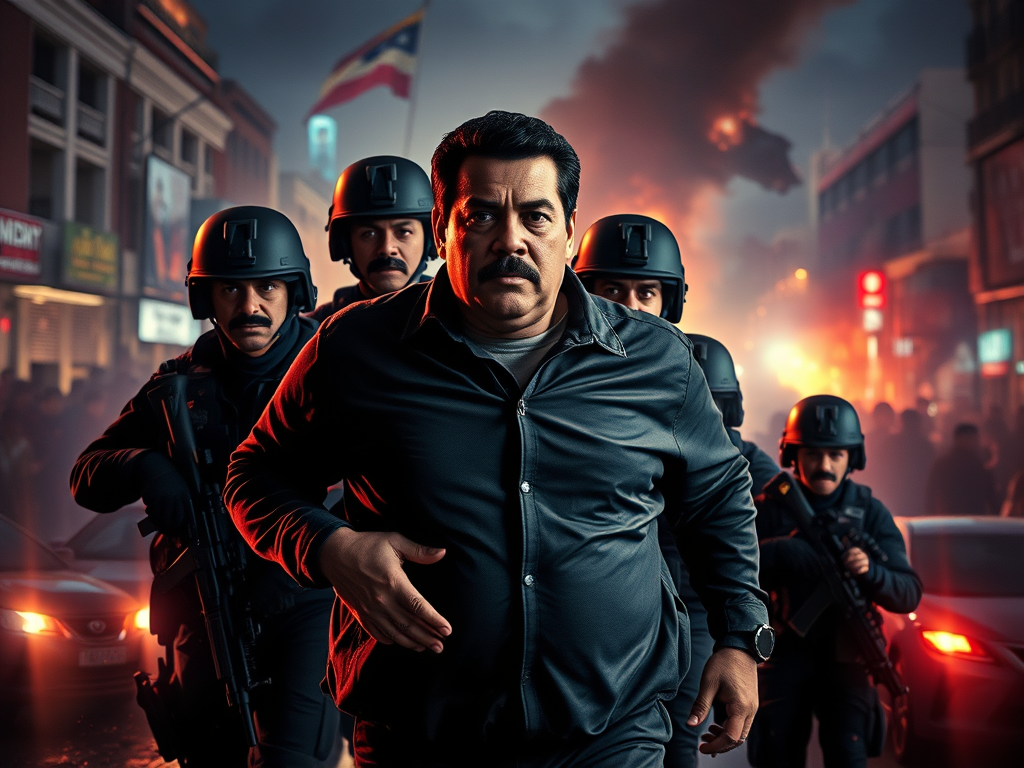
The dawn raid in Caracas made for compelling television. U.S. forces captured Venezuelan President Nicolás Maduro, whisked him to New York, and presented the world with a fait accompli wrapped in drug and weapons charges.
The spectacle obscured something more fundamental.
This wasn’t about Venezuela. This was about announcing that the post-1945 international order is over, and the United States plans to manage its collapse on its own terms.
The Theater of Consensus Is Dead
The Panama playbook from 1989 offered a template. Invade, capture the strongman, frame it as law enforcement, and move on. The UN General Assembly condemned it. The Organization of American States condemned it. The European Parliament condemned it.
None of it mattered.
516 Panamanians died during Operation Just Cause—314 soldiers, 202 civilians. About 20,000 people lost their homes. The legal justification? A 1989 DOJ memo by then-Assistant Attorney General Bill Barr concluded the President has inherent constitutional authority to use the FBI for extraterritorial arrests, even when those arrests violate international law.
The courts agreed. Under the Ker-Frisbie doctrine, the manner in which you capture someone has no bearing on jurisdiction. Federal courts refused to consider the legality of the invasion itself.
But here’s what changed: In 1989, the administration at least performed the ritual of building consensus. They briefed Congress. They coordinated with allies. They sold the operation to the American public.
This time? Nothing.
No congressional notification. No allied coordination. No public preparation.
The administration didn’t bother with the theater because they no longer feel obligated to perform it. When you’re dismantling an international order, you don’t ask permission from institutions created by that order.
Securing the Pole
From 1898 to 1994, the U.S. government intervened successfully to change governments in Latin America at least 41 times. That’s once every 28 months for an entire century.
The pattern reveals something important: The United States never faced a significant military threat from Latin America. The interventions weren’t defensive. They were about maintaining exclusive influence over the hemisphere.
Trump’s statement that the U.S. would “run” Venezuela until a safe transition made the quiet part loud. He talked openly about tapping Venezuela’s vast oil reserves, fixing the country’s oil infrastructure, and selling “large amounts” of oil to other countries.
This isn’t regime change as democracy promotion. This is regime change as resource management.
The strategy becomes clearer when you understand the broader pattern. Venezuela is the opening move. Iran is next. The objective isn’t to spread American values or defend American security.
The objective is to secure the Western Hemisphere as America’s exclusive sphere of influence before the world fully fractures into competing poles.
China gets Asia. Europe handles Europe. America controls this continent.
It’s American foreign policy before World War I, when spheres of influence were openly acknowledged rather than dressed up in the language of universal values and international law.
The Multipolarity No One Wanted to Admit
The liberal international order erected after the Cold War was only possible in unipolarity. When one power dominates, it can enforce rules that benefit everyone—or at least claim to.
That world ended with the 2008 Global Financial Crisis.
We moved from Cold War bipolarity (1945-1989) to American unipolarity (1989-2008) to what scholars now call “complex multipolarity.” Multiple powers with competing interests, no single arbiter, and declining faith in international institutions.
The Maduro operation signals that the United States has stopped pretending otherwise. China and Russia haven’t condemned the action. They’ve stayed silent.
Why? Because they understand the new rules.
If America can seize a head of state in its hemisphere without international backlash, China can do the same in Asia. Russia can do the same in its near abroad. The mutual silence isn’t approval—it’s acknowledgment of the new reality.
We’re watching the great powers negotiate the terms of multipolarity through action rather than treaty.
The Rodríguez Decision
The choice to elevate Delcy Rodríguez—Maduro’s own vice president—over opposition leader María Corina Machado revealed the actual priorities.
Machado represents the democratic opposition. She has popular support. She embodies the narrative that removing Maduro would restore democracy to Venezuela.
But she didn’t get the job.
The stated reason? Trump believes Machado “stole” his Nobel Peace Prize nomination. Personal grievance masquerading as geopolitical strategy.
The deeper reason? Rodríguez is manageable. She’s embedded in the existing power structure. She knows how the institutions work. She has relationships with the Chavista hardliners who still control Venezuela’s security apparatus.
Machado would have demanded actual democratic reforms. She would have tried to dismantle the system rather than manage it. She would have been harder to control.
The U.S. chose stability over legitimacy because legitimacy requires messy democratic processes that might not produce favorable outcomes.
Democracy played a rhetorical role in both Panama and Venezuela. The invasion of Panama was presented as a response to canceled elections. The Maduro operation invoked democratic illegitimacy.
But international law doesn’t permit military action to restore or impose democracy. States can’t determine the legitimacy of other governments unilaterally.
The gap between the democratic rhetoric and the authoritarian choice of Rodríguez reveals the performance. You don’t restore democracy by empowering the autocrat’s deputy.
When Everything Becomes Personal
Leaders in the Middle East figured out years ago that Trump operates on personal relationships. Hence the private jet from Qatar. Hence the flattery, the gifts, the tributes.
The Machado decision demonstrates how personal grievance now shapes foreign policy at the highest level. A Nobel Prize slight determines who runs Venezuela.
This creates a new calculus for international relations: If you flatter the king and pay tribute, you might avoid intervention. Emphasis on “might.”
The unpredictability becomes the point. When allies can’t rely on institutional processes or shared values, they have to cultivate personal relationships with the decision-maker. This centralizes power and reduces the constraining influence of bureaucracy, Congress, or international norms.
It also makes foreign policy less predictable and more transactional. Countries that master the art of personal diplomacy—understanding Trump’s grievances, offering the right incentives, avoiding perceived slights—gain advantages over countries that rely on traditional diplomatic channels.
The Institutional Vacuum
Removing a strongman while leaving the power structure intact creates a predictable problem. The Chavista hardliners who benefited from Maduro’s rule remain embedded in Venezuela’s institutions.
They control the military. They run the security services. They manage the patronage networks that keep the system functioning.
Rodríguez can’t govern without them. She can’t reform without their cooperation. She can’t deliver the stability the U.S. wants without maintaining the system that created the instability in the first place.
This is the regime change paradox: The operation succeeds tactically but fails strategically because it doesn’t address the underlying institutional rot.
Panama offers a cautionary example. The final civilian casualty count from Operation Just Cause remains unknown—estimates range from 300 to 3,000. A Human Rights Watch report found that American forces violated the rule of proportionality, risking harm to civilians that outweighed military objectives.
The operation removed Noriega. It didn’t fix Panama’s institutions. It didn’t create sustainable democracy. It demonstrated that military force can capture individuals but can’t build legitimate governance.
What Success Looks Like When There’s No Endgame
The metrics for judging this operation remain unclear. Is success defined by Maduro’s conviction in U.S. courts? By stability in Venezuela? By increased oil production? By preventing Chinese or Russian influence in the hemisphere?
The administration hasn’t articulated clear objectives beyond the immediate tactical goal of capturing Maduro and the vague strategic goal of “running” Venezuela temporarily.
“Mission accomplished” moments rarely age well. The banner on the aircraft carrier in 2003 became a symbol of premature victory declaration. The intervention in Libya removed Gaddafi but created a failed state.
Regime change operations generate compelling headlines but rarely deliver sustainable outcomes because they treat symptoms rather than causes.
The drug and weapons charges against Maduro frame the operation as law enforcement rather than regime change. This legal fiction allows the administration to bypass constitutional constraints on the use of military force.
War powers, foreign relations, and criminal law enforcement collapse into a single executive decision. Congress isn’t consulted. Often it isn’t even notified until after the operation concludes.
This blurring of categories—turning invasions into arrests, framing regime change as law enforcement—creates constitutional problems that courts have consistently refused to address. They defer to the executive branch and decline to treat alleged violations of international law as creating individual defenses.
The World That Comes Next
Multiple ambassadors criticized the U.S. intervention during an emergency UN Security Council meeting. Venezuela’s representative called it an “illegitimate armed attack lacking any legal justification” and the “kidnapping” of Maduro as being “of particular seriousness.”
The criticism will continue. The UN will pass resolutions. International law scholars will write articles.
None of it will matter because the institutions that would enforce those norms no longer have the power to constrain great power behavior.
The new multipolar world will feature three orders: a thin international order that facilitates basic cooperation, and multiple bounded orders—one dominated by China, another by the United States, potentially others by regional powers—each enforcing their own rules within their spheres.
The Maduro operation doesn’t violate this emerging order. It demonstrates it.
The United States is showing that it may be down but not out when it comes to projecting power wherever it chooses. China and Russia can’t match this capability, which is why they’ve remained silent. Their silence isn’t weakness—it’s recognition that they’ll exercise similar prerogatives in their own spheres.
The post-1945 order promised universal rules applied equally to all nations. That promise was always more aspirational than real, but at least the aspiration constrained behavior at the margins.
The new order dispenses with the aspiration. Power determines rules. Spheres of influence are openly acknowledged. Intervention requires no international justification, only the capability to act and the will to accept consequences.
We’re not watching the end of American power. We’re watching the end of the illusion that American power operates within a rules-based international system.
The spectacle of the dawn raid in Caracas will fade. The legal proceedings in New York will drag on. Rodríguez will struggle to govern Venezuela while managing competing interests from Washington, Caracas, Beijing, and Moscow.
The real story isn’t what happened in Venezuela. It’s what the operation reveals about how great powers will behave in the multipolar world we’re entering.
The theater of consensus is over. The performance of international law continues, but everyone understands it’s just that—a performance.
What comes next depends on whether other powers accept this new reality or push back against it. China’s actions in Asia, Russia’s moves in its near abroad, and regional powers’ responses to American intervention in their neighborhoods will determine whether we’re entering a period of managed multipolarity or chaotic competition.
The Maduro operation suggests the United States has chosen its path: secure the hemisphere first, manage the transition to multipolarity from a position of regional dominance, and let other powers sort out their own spheres.
Whether this strategy succeeds depends less on what happens in Venezuela and more on whether the rest of the world accepts the new rules—or writes their own.
Discover more from The Cameron Journal
Subscribe to get the latest posts sent to your email.