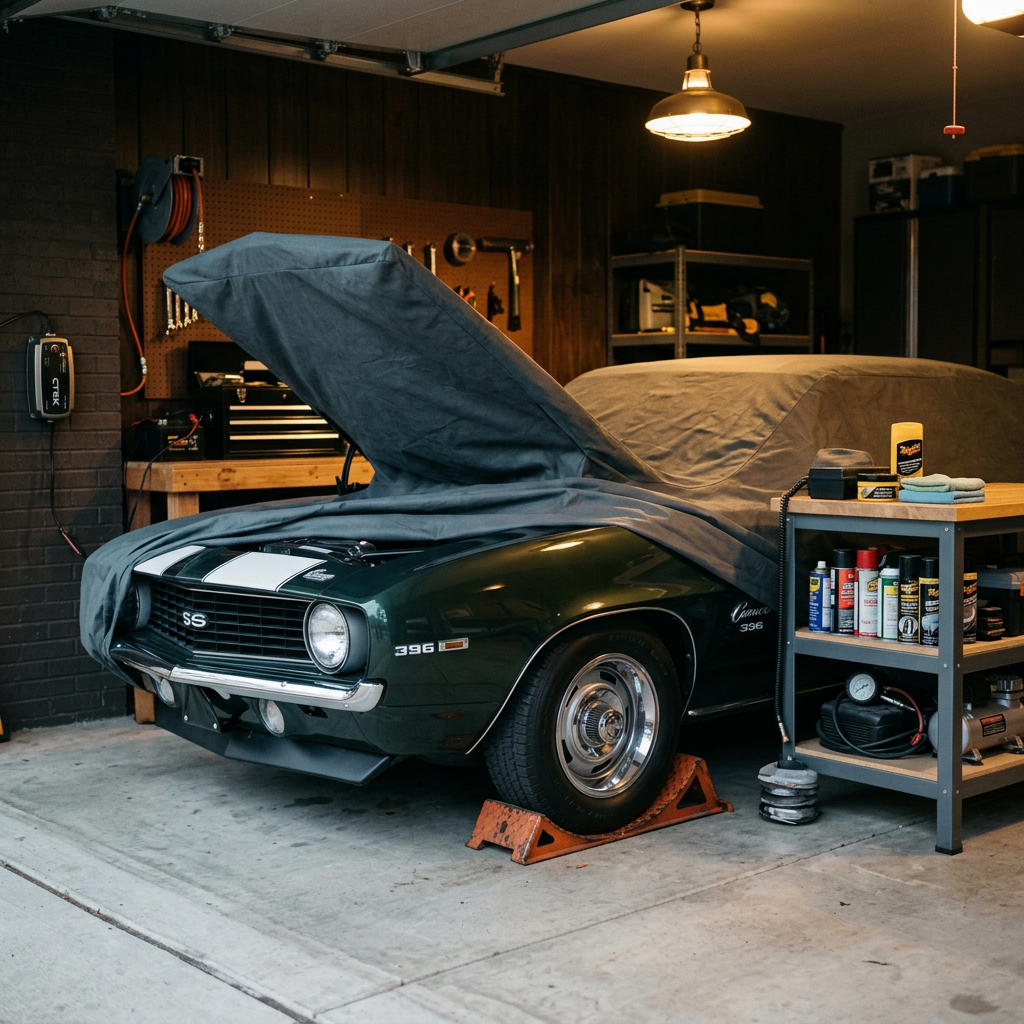
The vast majority of classic cars never die from rust or old age. They meet their end through good intentions. What seems like “taking good care of the car” over the off-season may well be doing more damage: starting the car every few weeks, pulling the parking brake on hard and then just walking away, throwing a tarp over it after a spirited wet drive. Storage isn’t about doing lots of things. It’s about doing the right things once, in the right order, and then leaving the car be.
The oil change timing everyone gets backwards
Many owners change their oil at the start of the season and think that’s enough to get them through storage, but it’s not. Old oil holds acidic combustion byproducts and moisture that settle out when the engine sits dormant for months. Sitting in that oil for months gives those acids time to work on bearings, cam lobes, and cylinder walls.
The fix is simple: change the oil right before the car goes into storage, not weeks before. Fresh oil coats internal components in a clean protective film with none of the corrosive baggage. If you’re storing a car with a flat-tappet cam or an engine that’s particularly sensitive to the zinc additive in oil, this is also the moment to make sure you’re running the right formulation. It’s a 5-minute job that pays off in April.
While you’re under the hood, this is also the point to fog the cylinders if you’re storing for more than a couple of months. Spraying fogging oil through the spark plug holes coats the combustion chambers and prevents rust rings from forming on the cylinder walls – a problem that shows up as a rough, smoky startup months later and sometimes never fully goes away.
Fuel is a ticking clock, not a static resource
Ethanol-blended gasoline doesn’t age gracefully. Roughly within 90 days of sitting, E10 fuel starts to decay and phase-separate into dark and light components (per AAA). The lighter component is the ethanol, and it gets that way because it has absorbed enough atmospheric moisture to break away from the gasoline. What’s left behind can gum up injectors, corrode fuel lines, and lay waste to your hope of an easy spring start.
Top off the tank. The less air in the tank, the less water vapor that’s able to condense in it. Add the correct dose of fuel stabilizer to the tank, then run the engine for five to 10 minutes so the treated fuel enters the injectors or carburetor. Most people skip this step and simply think, “Oh, the stabilizer will get mixed in when I drive the car next.” This is the most common half-done approach we see, and it completely defeats the purpose of adding stabilizer.
The battery problem nobody thinks about until it’s dead
Batteries tend to lose their charge even when everything’s switched off. This is often due to small parasitic drains from devices such as clocks, alarms, and other electronic systems which can lead to the gradual discharging of the battery over a few weeks. A battery that remains at low charge for several months is highly likely not to function again.
Here are some tips to ensure your battery remains functioning. Clean the battery terminals, fully charge the battery, and use a smart trickle charger (battery tender) instead of a regular one. If you leave a regular charger connected for the entire season, the battery will eventually overcharge and be damaged. If there is no power source near your car’s location, remove the battery and store it in a place with a stable temperature.
Tires, suspension, and the danger of bare concrete
Tires that support the same weight in the same position for months on end form flat spots. Sometimes those flat spots shake out after a few miles of driving. Sometimes, particularly with older rubber, they don’t.
Overinflate tires slightly before storage, or better yet, get the car up on frame-rail jack stands so the tires and suspension bushings aren’t in compression. This also spares the suspension itself. Bushings and rubber components can take a permanent set if they’re compressed in one position for an entire season, altering the vehicle’s handling characteristics for the worse come spring.
One simple step that gets overlooked constantly: never leave tires on bare concrete for long periods. Concrete sucks the moisture right out of the rubber, and that moisture loss speeds up cracking and dry rot. A sheet of plywood or a set of tire cradles under each wheel fixes the issue for about fifteen bucks.
Where and how the car gets there matters as much as how it sits
If car storage equals car transport – to a warehouse, another residence, a buddy’s outbuilding – chances are the car could be in more jeopardy even before the engine is switched off. Often, more harm can be done in a twenty-minute drive than standing dormant for several months, especially if a flatbed turns up with generic tie-down points and an oblivious driver who’s not used to coaxing low-clearance bodies, irreplaceable trim, or seventy-year-old springs and dampers carefully onto a tilting deck.
This is the exact kind of scenario that dedicated vintage car transport is designed to avoid, relying on tie-down methods and loading equipment that’s made for the specific needs of the car rather than what’s conveniently quick or generic daily driver ‘enough’. Think of the drive over as part of the preparation regime and not a separate chore. Topping up the oil, stabilizing the fuel, and setting the correct tire pressures mean nothing if the car gets mushed, pulled, and chafed during the journey.
The parking brake habit that seizes brakes solid
Leaving the parking brake engaged feels responsible. It isn’t. Brake pads and shoes left in contact with rotors or drums for months can corrode and weld themselves in place. Owners have opened up storage buildings in spring to find a car that physically won’t roll because the brake has fused to the disc.
Parking brake off. Wheel chocks on. It looks less secured. But it’s the version that actually protects the brake system.
Sealing the car against moisture and pests
Small animals like rodents seek shelter in the warm and cozy engine bay of your car during the winter months. They can cause extensive damage making nests in the engine compartment and chewing up the wiring harness. To prevent this, a recommended preventive measure is to stuff some steel wool in the exhaust tip and place mousetraps around it. You can also use rodent repellent sprays in the engine bay and in the car at various places to deter rodents and minimize the damage they can cause.
Another common problem not only for long-term storage but for vehicle storage in general is moisture. Moisture can cause rusting, peeling of paint, fungus on leather and carpets, and also bad odors. Toss interior desiccants such as silica gel packs onto the seats and floor to keep mildew and mold from taking hold. Cover the car with a breathable cotton or layered cover, never a plastic tarp. Plastic traps condensation against the paint and can actually abrade the finish as the car settles and the tarp shifts against it over weeks of contact.
Thoroughly wash your car before storage and wax it. The waxed surface will protect the paint from damage and also won’t let moisture settle on the surface of the paint. Road salt, brake dust, tree sap, and general grime stay chemically active on paint even while the car is parked. A clean, waxed surface gives the cover something smooth to rest against instead of grinding contaminants into the clear coat every time the fabric shifts.
Why monthly startups do more harm than good
Among the habits that classic car owners have, this is the one that most are proud of, and it’s usually the wrong call. Starting it up for five or ten minutes once a month doesn’t get the car to full operating temperature. It burns a little fuel, gets the oil somewhat hotter, and then shuts down again before any of the water and condensation has a chance to boil off.
What you’re left with, then, is contaminated oil sitting in the engine with the water until the next “maintenance” startup. Where the cycle repeats. If you can’t get the car properly warm and keep it there long enough to boil off the water in the oil, you’re better off just leaving the car completely alone. A well-prepped, undisturbed car will sit in a much more stable condition than one that’s been woken up and put back to sleep every few weeks.
Coolant, washer fluid, and the expensive surprises
Coolant that’s too diluted won’t protect against a hard freeze, and a cracked block or split heater core from freeze damage is one of the costliest repairs a stored classic can come home to. Test the coolant mix before storage to confirm it’s holding at the correct freeze point for your climate, and top off washer fluid with a freeze-rated formula while you’re at it.
Insurance, documentation, and the cycle you’re actually managing
Many classic car insurance policies include stipulations about storage. They might demand indoor storage, or simply require that you seasonally “store” the vehicle to access the cheaper premium. Failure to do so doesn’t just write off some savings, though. It can void your coverage in the event something happens to the vehicle while it’s parked, making the cheapest phase of a classic’s year of ownership potentially the riskiest.
Photograph the car before you put it away, ensure you’ve documented the mileage, and keep a log of what you did to get it ready to sit. That way you’re covered with your insurer, and you have a good, clear baseline to check against when it’s time to wake the classic back up.
The fluids, tires, and brakes you protect getting your classic car ready for storage are the same ones you check when the season ends and spring comes around again. In other words, the prep you do before you lay a classic up for a few months is equally as important as what you do when you know you’re about to jump back into it. If you don’t, what should be a quick switch getting back into driving becomes a tire-kicking exercise in noticing what fell apart over winter.
Discover more from The Cameron Journal
Subscribe to get the latest posts sent to your email.