
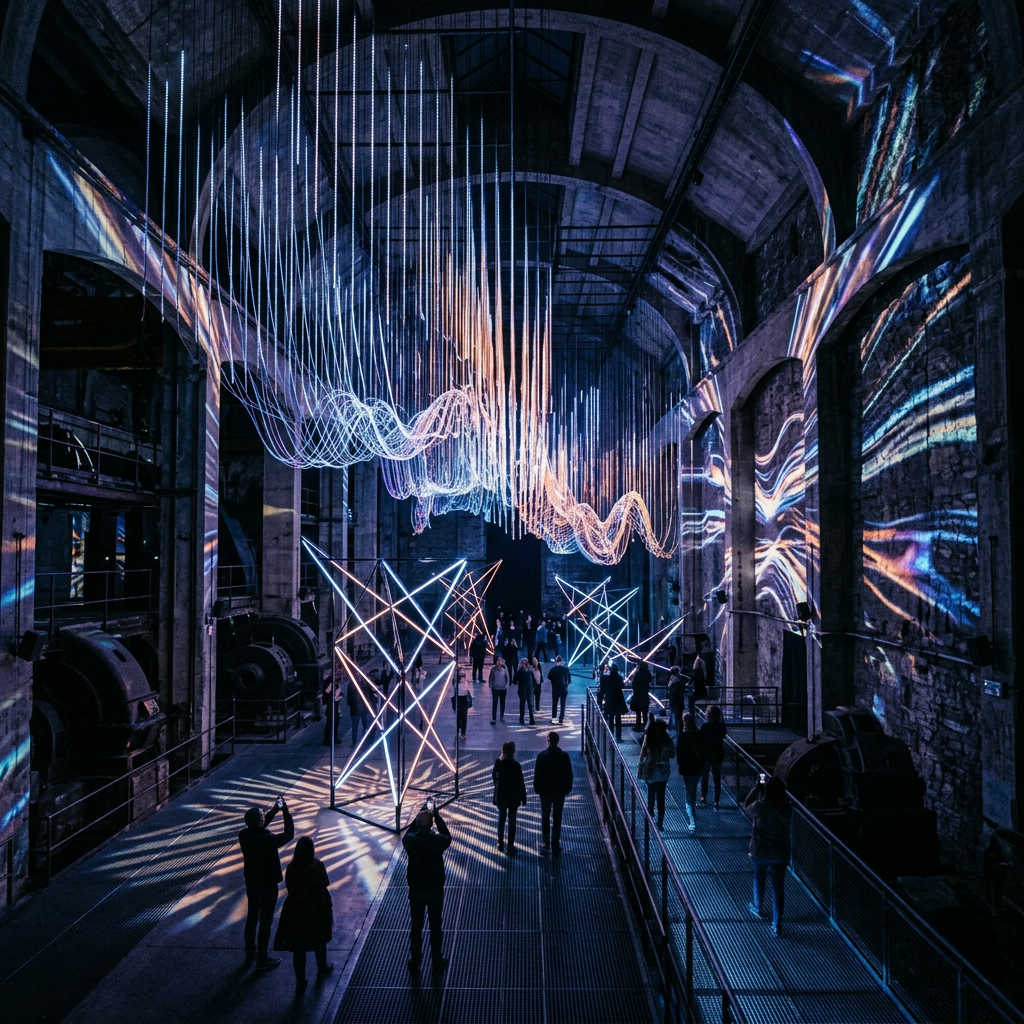
You cannot force an event to be shareable after it has already taken place. This concept needs to be integrated into the overall experience from the very beginning, starting with the initial design choices.
Events that go viral on social media are not necessarily the most expensive ones, but rather the ones where people experienced something truly captivating and wanted to share it with others. This feeling cannot be replicated by simply asking people to use a specific hashtag.
From passive audience to active participant
The old model of an event – chairs and a stage, a speaker – doesn’t create social content. It’s for delivering information to a captive audience. This model absolutely still has its place, but it’s not a model that naturally generates shareable moments because it’s not a model that asks anything of the attendee except to sit there and pay attention.
When you have an attendee co-creating an experience with you; when they’re contributing to a live activation by voting on what happens next; when they’re contributing to an art installation by drawing something; when they’re contributing to content by unlocking an NFA embedded in the physical space – when the attendee is not just watching, but creating, or participating in the creation of something, they’re not just watching something any more. They’re actively participating and engaging in something. And people share the things they make.
The logic of multi-sensory design
The sense of smell is the greatest trigger of memory and emotion, yet it receives the lowest budget allocation. This makes no sense. The right scent (no, not the smell of cookies baking) subtly and subconsciously impacts how people feel about a space and more importantly, how they feel emotionally in that space. What’s more, by backgrounding or buffering unstoppables (strong scents always get a reaction) your guests may not have even known they disliked the chair fabric or hated your choice of cleaning product until you eliminate them from the experience altogether.
Designing for social currency
People aren’t sharing on social to be helpful. They’re doing it because it makes them look good. Social currency is the psychological driver at play – the low-key status message of “I was at this, and it says something positive about me.”
So it’s not about “how do we get people to post?” It’s about “what will make them feel privileged to post?” Exclusivity is one answer. An invite-only room, an event that only unearths itself for a set number of guests, or content that disappears at the end of the night creates urgency that this is worth recording. Intellectual or aesthetic sophistication is another. When something is genuinely clever or beautiful, posting about it suggests good taste. A generic photo booth with ring lights suggests nothing except attendance at a corporate event.
The activations that produce the most organic UGC are not the ones that ask outright for it. They’re the ones that make people feel like they discovered something, understood something, or felt something that not everybody else got to do.
Hero installations over Instagram traps
The term “Instagram moment” is used negatively when designing an event. It is used to describe a colorful wall, a neon sign containing a somewhat inspirational phrase, and a designated area on the floor where people can stand and take pictures. Attendees take photos of these elements and then immediately forget about them. The photos look like those taken at any other event over the past 5 years.
Creating a “hero installation” is a different concept. These are large, visually impactful installations that are unique to the brand and the event. They are specific. They tell a story. They feel organic to the space rather than plopped in. The longer you look, the more you see.
The test is whether an attendee could swap it into a different brand’s event and have it not feel out of place. If yes, it’s decoration. If no – if it feels like it could only be here, with this brand, at this moment – then you’re onto something that people might actually want to photograph for its own sake.
Venue character does half the work
You can’t cover up a characterless place with fancy decorations. For example, you may have to spend a fortune on set decorations just to make a blank conference suite look decent – and even then, hardly anyone will share how fantastic their time at this neutral location was.
Halls with distinct architecture or rich history, such as grand industrial spaces, striking contemporary buildings, or splendid traditional venues, simply deserve to be mentioned in social media even when empty. They have character and feel already, and all you have to do is to equip this character with your brand attributes. This is why selecting an iconic event venue London planners have used for high-production brand experiences – like Tobacco Dock, with its Georgian dock architecture and layered spaces – gives the design team a running start. The space has presence before anything is added to it. Attendees photograph the venue itself, which means every piece of UGC they post carries the brand’s chosen backdrop.
The venue choice is a creative decision, not just a logistical one. Treating it as primarily a capacity and catering question misses most of its value.
Bridging the physical and digital experience
An event that can’t be sent through the screen is wasting most of its reach. Those who come in the door are never the entire audience – they are the distribution channel for everyone who couldn’t make it.
Designing the physical-to-digital journey is about deliberately building those connections. AR filters calibrated to the physical space are how audience members can easily create content they want to share that’s obviously situated in your venue. QR codes included in that environment are how fans can discover and share officially created videos that make their experience even more special. And RFID is how that experience you deliver to each attendee is something unique to them that they then take home as a memory.
Friction in sharing is the enemy. Ever seen a QR code and had to unlock your phone, find the app, scan the code, and then get a push notification to watch a video you weren’t that interested in anyway? The experience to capture and the impulse to share should be instantaneous.
Gamification that doesn’t feel like homework
The term “gamification” is often used loosely today to imply that a leaderboard was introduced. When implemented poorly, this concept substitutes fun with obligations. Conversely, when it is applied correctly, it can help transform excitement into true enjoyment.
The main differentiator is whether participation feels like an obligation or a choice. For example, a digital scavenger hunt where you must complete various tasks to win a prize feels like an obligation. The same scavenger hunt, presented as if you are uncovering hidden details of a storyline that the conference has been woven into over the course of the day, feels more like a privileged insider.
Cooperative physical experiences work great in this regard. For example, an art wall that is gradually added to by attendees and that is also designed to become a visually complete masterpiece by the end of the day works as a reward to latecomers who can admire the final result, and early contributors who can proudly say they were the first to add their mark.
Micro-moments of unexpected delight
The spontaneous, real social media content that people create is not usually from the big, obvious things. It’s from the small, unexpected things that delight guests.
A F&B station with little name cards that reference some obscure part of the brand’s history. A corridor with reactive lighting that flickers as people walk by. An unmarked room that’s only discovered by noticing the latch in the wall. Notes in the gift bags that mention something personal to the recipient.
These micro-moments work because they’re not a photo-op. They’re a surprise. The photo just happens to be what people use to remember and share that experience. The first instinct is to capture it in a photo because it’s not something they’ve seen before. That’s the definition of a new, memorable experience.
Of course, they’re really hard to design (and explain to clients), so they often get pushed down the list as ‘not essential’ during budgeting. But they can often drive way more genuine UGC than anything you designed explicitly to be shared.
Measuring what actually happened
Reach and impressions indicate how widely the content got. But they don’t offer insight into whether the experience resonated.
For that, you need to measure both quantitative signals – like the volume of UGC, frequency of branded hashtag use, or RFID tech dwell times that indicate which activations were most popular – and qualitative sentiment analysis of the actual content people created and shared during or after the event. Dwell time data also reveals the success of experiential storytelling. It shows the zones visitors found most captivating and engaging and which they passed through with little interest.
Surveys are useful, especially in drilling down with specific questions about the impact of this or that new product or sponsor. But generally, people are inclined to be nice when asked directly “did you have a good time?” And in an age of the rising “experience economy,” they are far more likely to share the best moments – or, paradoxically, the worst – in their own digital lives.
Discover more from The Cameron Journal
Subscribe to get the latest posts sent to your email.




