It’s been nearly 50 years since the riot at Attica prison in upstate New York. The most shocking part about the book is how little has changed about the prison system in the intervening decades. From police corruption to a government cover-up, all the familiar elements from today’s issues with law enforcement were very much present in 1973 when a small fight in the A block tunnel turned into a riot and partial occupation that would make the state prison famous.
Prison riots and disturbances had already been happening before Attica. The summer before had already featured some problems. Two other prisons in NY State had rioted, along with some famous riots in California. Much of this had to do with how the state of New York was moving prisoners around its system. Down in New York City, they had been arresting many black people, but especially black men. Rather than try to house them in overcrowded jails in Brooklyn, they exported the men to upstate New York.
Location
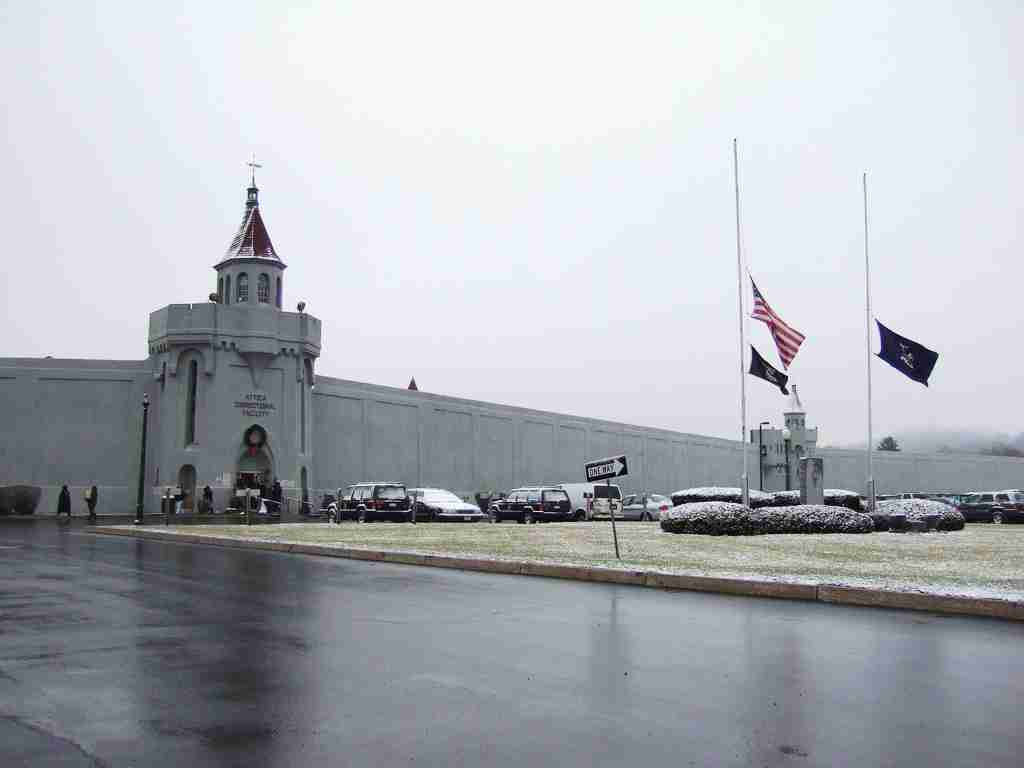
The prison was built in a four-square style and looked like an old European fortress complete with walls, parapet, and turrets looking down on the open recreation areas that joined the arms of the prison. Long tunnels connected the central control area, called Times Square, to the other tunnels and the buildings where the men lived and worked. There were four blocks: A, B, C, and D. All of these locations would become essentially war zones as the riot progressed.
Attica was located in a small town in upstate New York. It was staffed by locals. Like many small towns today, the prison was one of the best paying jobs in the small town of Attica. The families of the corrections officers would take center stage as the country watched and waited for word of their safety during the riot. It goes without saying that the majority, but not all, of the prisoners were black, and the guards were all white.
Conditions at the Prison
The riot at Attica began, not just because of the fight in A Block tunnel, but because of the poor conditions of the prisoners within its medieval walls. The guards would take the men out of their cells and to the mess hall and to their jobs at set times. The men were only allowed to shower once a week. Bear in mind, that in summer, this would quickly create a terrible stench as the prison did not have air conditioning and the prisoners would perspire constantly. There was very little airflow as well. In the winter, the reverse problem occurred with the place being rather cold although heat, however ineffective, was available. Toiletries and other necessities were often only available for purchase or not available at all. The men also did not have access to library books, and all reading material coming from the outside was censored by the prison staff.
Medical care was available, but basically pointless. This would become a major point during the riots. Although the prison employed two doctors for the prison of nearly one thousand men, they did very little actual doctoring. Prisons could arrive to the infirmary and be given an aspirin, or simply sent away and told that their complaints were not serious. Prisoners with chronic diseases were often left to suffer or were given minimal medical care.
Like most prisons, the prison employed the prisoners to do a variety of tasks around the prison. It also ran a machine shop where the men worked. Much like prisoners of today, the pay was embarrassingly low. A job in the machine shop or the laundry was a privilege. Other less glamorous jobs abounded, and for new prisoners they were shunted to jobs cleaning and making repairs. This labor also contributed to the need for showering.
The food at the prison was also terrible, and no accommodations for religious dietary requirements were allowed. Men who were muslim and could not eat pork were not given any substitutes and often had to go hungry for their religious beliefs. Not much has changed in prison conditions in the intervening years, but this was the state of Attica in 1973 when the riot broke out.
In the days leading up to the prisoner outbreak, the guards said the place was a tinderbox of issues just waiting to happen. Both the prisoners and their guards were on edge.
The Riot
The guards were taking the prisoners from A Block to the mess hall when a fracas broke out in the A block tunnel heading toward Times Square and moving toward the mess hall. It is not clear as to how the fight started, but fighting broke out in the A block and that’s how the riot started. The prisoners soon took over Times Square, killing the guard inside. They moved out to the yard and were soon followed by prisoners from B and C block once they were able to open the doors from the central control in Times Square. The prisoners from D block were never allowed out of their block and remained inside during the entire riot. The prisoners took the guards hostage, 23 in total, and put them in a circle.
The demands of the prisoners were not terribly exotic except for the evacuation to Cuba, most of the demands were what would be considered basic human rights. Prison is a place where human rights really disappear. The bulk of the demands included things like stopping the censorship of reading material, mail inspection, regular showers, soap, access to the library, access to better legal defense, and basic medical care.
Once the prisoners had taken over the yard and taken the remainder of the guards prisoner, they set up an adhoc council and government. Security was kept tight and the hostages were guarded 24/7 by the security team. Prison commissioner Russell G. Oswald, who had been appointed by Governor Nelson Rockefeller just a few years before, immediately drove to the prison to negotiate with the prisoners. Oswald had a more progressive of incarceration, and he had tried to bring some reform to the prison system. It is clear, though not overtly so, that the government of New York was not eager to negotiate with prisoners, much less black men.
Governor Rockefeller was frustrated by the ongoing negotiations that Oswald was engaged in. This frustration grew as firebrands like Bobby Seale and William Kunstler arrived to negotiate and observe the proceedings. All-in-all, there were a dozen observers during the tense negotiations. Various proposals were offered to the prisoners. Oswald only offered half measures to any of their demands. As the days dragged on, the prisoners set up lean-tos and other adhoc shelter in the yard to protect themselves from the rain.
Rumors about the hostages abounded. Their deaths and repeated rumors of castration filtered out of the prison to worried families waiting outside. Families of prisoners arrived as well, and soon the entire facility was surrounded by a throng of worried people waiting for any word on their loved ones. This attracted media attention and although it existed before the 24-hour news cycle, it was a regular feature on evening news programs and made national news.
Deaths all around
On September 12, 1971, the New York State Police lined up outside armed to the teeth, ready to re-take the prison. They had been standing out there for 72 hrs waiting for the word to go in. They had several days to get angry about the situation and once the order was given, complete with a helicopter flying overhead, a bloodbath ensued. Hostages were shot, prisoners were shot on the catwalks and left to bleed out. The police didn’t give any mind to who they were shooting, and the pictures from above showed their wanton lack of care.
After the prison had been secured, men with open wounds were not taken to medical care, they were locked back in available cells to bleed. Anyone still standing, was stripped naked and paraded across the open yard. The photos are harrowing. The police put the unwounded men back in their cells and kept everyone on lockdown for days after.
Once the Attica prison riot was over, Oswald soon resigned. Nelson Rockefeller was given a verbal pat-on-the-back by President Nixon for taking the initiative and ending the riot. However, for the prisoners and the families of the dead prison guards, their story wasn’t even over.
Settlement
In the aftermath, 62 inmates were charged in 42 indictments with 1,289 separate counts for incidents connected with the riot. One state trooper was charged with endangerment. There were two separate investigations but because they were handled by the New York Bureau of Investigation very little accountability for the actions of the police was taken. Much of the Meyer report was redacted from public view until 2005. Families of killed prison guards were just as bereft of answers as the families of prisoners who were killed during the re-taking of the prison.
The final settlements for the Attica prison riot weren’t paid out until 2012. It took almost 50 years of legal wrangling with the state of New York to get a settlement and get it paid out. Elizabeth Fink and Bobby Smith worked together within the Friends of Attica and various other organizations to get the settlement. Elizabeth Fink started as a young lawyer who went to the prison to help and ended up spending most of her life trying to get justice for the prisoners, especially those who been shot the police for no other reason than they were standing in the yard unarmed.
Attica! Attica!
In the years after the prison riot, the chant of Attica! Attica! was a familiar refrain at civil rights protests. For civil rights leaders, it was a demonstration of the state’s intractability on dealing with prisoners fairly or offering them decent conditions. Faced with any pushback, the state resorts to violence rather than improving material conditions.
One of the things I noticed in my reading of this book was how little as changed in the intervening years. Prisoners are now allowed to access legal resources in prison, as affirmed by the Supreme Court. Prisoners cannot be kept from their lawyers. Prison libraries are still censored and mail is still inspected. Policies on showers and what-not varies by prison.
One of the obvious things about the Attica prison riot is the blatant racism on behalf of anyone in charge. The idea that black men would be reasonable and decent and should be treated as such is anathema to the very thinking of either Oswald and especially Governor Rockefeller.
If you want to read more about the various details of the crisis, I highly recommend reading Blood in the Water.
Discover more from The Cameron Journal
Subscribe to get the latest posts sent to your email.