
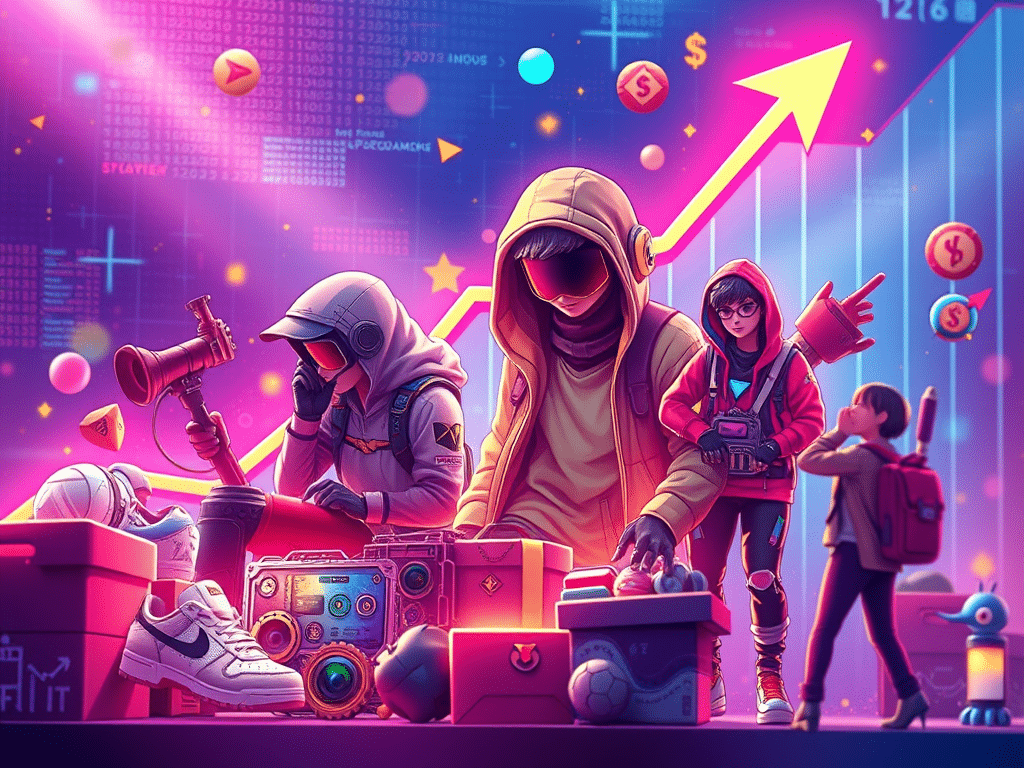
Spending on virtual goods isn’t slowing down; it’s exploding. By 2025, the market is projected to grow from $33 billion worldwide to over $80 billion by 2034, with some forecasts predicting a higher value of around $150 billion. From in-game spaceships and cosmetic skins to NFT art and digital fashion, these purchases are no longer side notes in the entertainment industry. They’re a growing part of the global economy.
But what exactly makes people pour real money into items they can’t physically hold? For some, it’s about status and self-expression. For others, it’s about efficiency, ownership, or even the hope of long-term value. Whatever the reason, investing in virtual goods has become one of the most fascinating shifts in consumer behavior over the past decade.
So let’s break down the different types of virtual goods, why people are buying them, and what this trend means for the future of digital culture.

In-Game Assets
The first and most familiar category of virtual goods comes from gaming. For years, players have spent money on cosmetic skins, weapons, and character upgrades. Titles like Fortnite and League of Legends built entire economies around outfits and cosmetic bundles, while long-running franchises such as World of Warcraft have had gold farming and item trading since the early 2000s.
Today, those purchases go far beyond cosmetics. In Star Citizen, for example, ships are high-value digital assets. Some are priced in the hundreds of dollars. What makes them even more attractive is the option to buy versions with Lifetime Insurance, meaning that if your ship is destroyed in the game, it can always be replaced. That insurance transforms a virtual item into something that feels like a lasting investment.
Because of this, many players now use backup options for in-game investments, such as trusted marketplaces like Space-Vendor. These platforms allow gamers to purchase ships and upgrades quickly and securely, without waiting months or grinding endlessly to unlock them. For players who see their time as valuable as their money, this kind of access has become an appealing way to shape their gaming experience.

NFTs as Digital Collectibles
In-game assets were the first step towards valuing the digital; NFTs took it to the next level. An NFT (or non-fungible token) is a unique digital asset recorded on the blockchain that proves ownership. Unlike a skin tied to a single game, an NFT can exist on its own, be traded across platforms, and often resold for real money.
The art world was one of the first to adopt. In 2021, digital artist Beeple sold an NFT at Christie’s for $69 million, and the world took notice that pixels could be worth as much as paint. Musicians follow with NFT albums and concert tickets, while independent artists use the tech to sell directly to fans and collect royalties every time their work is resold.
For collectors, it’s about scarcity. Just like owning a limited edition print, an NFT is exclusive.
For creators, it’s about independence and control over their work. But NFTs also come with risks: volatile prices, scams, and projects that collapse after the hype dies down. Still, they’ve become one of the most talked about parts of the virtual goods economy.
Virtual Fashion and Identity
Another corner of the virtual goods world is fashion: Digital clothing, skins, and accessories that shape how people present themselves online. Virtual fashion comes in two forms.
The first is the in-game variety, where outfits and skins are tied to specific platforms. Fortnite is famous for its constant rotation of cosmetic skins, ranging from superheroes to luxury brand collaborations. Roblox has its own catalog of outfits and accessories that players use to customize avatars. These items aren’t NFTs; they stay locked within the game ecosystem.
The second form is blockchain-based NFT fashion. Luxury houses like Gucci and Dolce & Gabbana have released NFT sneakers and couture pieces that can be collected, traded, or even worn in certain metaverse environments. Unlike a game skin, these digital items can be owned and resold like physical designer goods, blurring the line between fashion and investment. Some brands have even considered rewarding NFT item holders with physical items for free.
The Risk–Reward Balance
As with any investment, buying virtual goods comes with both upsides and downsides. On the reward side, digital assets offer something tangible in the online world: ownership, uniqueness, and in some cases, the ability to resell for profit. For gamers, spending money on a rare ship or skin means skipping countless hours of grinding and getting right to the experience they want. For collectors, owning a limited NFT can feel like holding a piece of internet history.
But there are real risks too. Market volatility is the most obvious. There’s also the issue of platform dependency: if a game shuts down its servers, those purchases may disappear. Scams and fraudulent projects remain a threat as well, especially in the NFT space where oversight is limited.
At the same time, there’s a trade-off between time and money. Some players take pride in earning every item through gameplay, while others see buying virtual goods as a more efficient path. That balance is personal, but it underscores a key truth: virtual goods are no longer trivial purchases. They’re decisions about value, identity, and how people choose to spend both their hours and their dollars.
The Role of Regulation
The growth of virtual goods hasn’t gone unnoticed by policymakers. In early 2025, the Trump administration took a significant step by reclassifying NFTs and meme coins as collectibles rather than securities. That might sound technical, but the effect is clear: less oversight from the SEC and a friendlier environment for creators, marketplaces, and investors.
For artists and developers, this shift means more freedom to experiment without worrying about whether their work will be tied up in lawsuits. For buyers, it reduces some barriers to entry, but it also comes with fewer consumer protections. Without stricter regulation, scams and market manipulation are still possible, and anyone investing in NFTs or other digital assets needs to be cautious.
Still, this kind of policy move signals something important: virtual goods are now part of the economic conversation at the highest levels. Governments are starting to treat them as real assets, and that recognition alone could help normalize digital ownership as a legitimate part of modern life. In other words, regulation is also about validation, and that validation could shape the future of how we value digital property, whether NFT or not.
Discover more from The Cameron Journal
Subscribe to get the latest posts sent to your email.




