
I had a conversation recently with Marc Defant, a volcanologist who approaches social issues the way he approaches rocks and lava: with hard numbers and scientific rigor. When we got to feminism and the gender pay gap, he had a simple position. The numbers don’t add up. He’s right. And he’s wrong. And that’s exactly why this issue generates so much heat. The gender pay gap debate is a perfect example of what happens when two different groups look at two different sets of data and declare victory. Both sides are technically correct. Both sides are missing something important. Let’s get into this.
The Two Numbers Everyone Is Fighting About
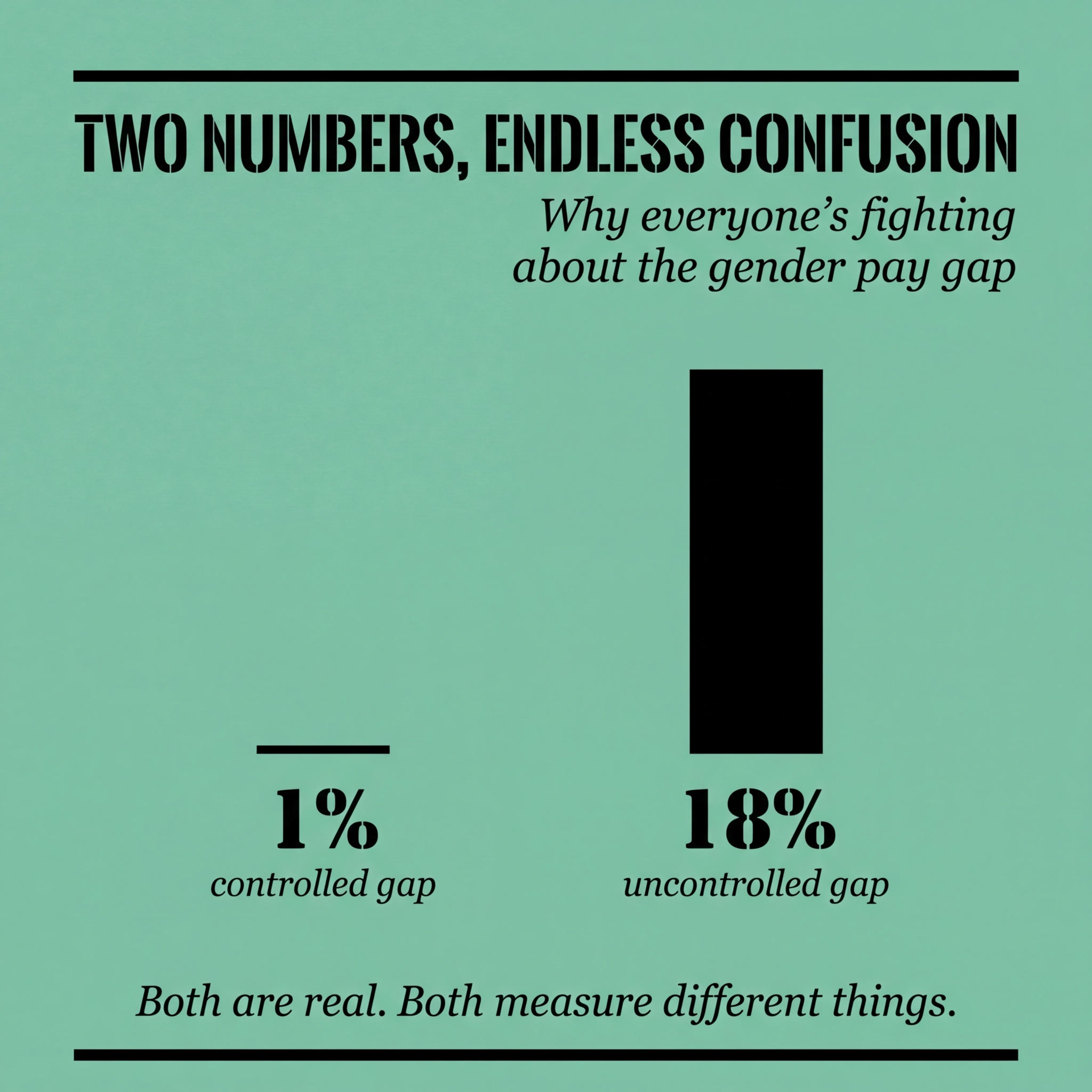
There are actually two different gender pay gaps, and most people don’t realize they’re talking past each other. The controlled gap measures equal pay for equal work. Same job, same qualifications, same experience.
According to PayScale data, women in these situations earn 99 cents for every dollar men earn. That’s a 1% difference. When someone says “the gender pay gap doesn’t exist,” this is usually what they mean. And by this measure, they have a point. We’ve essentially solved the problem of employers paying women less for doing the exact same work. The uncontrolled gap measures median earnings across all workers, regardless of job type or industry. Here, women earn 82 cents for every dollar men earn. And much of this has to do with the value of work produced. That’s an 18% difference. When advocates talk about the gender pay gap, they cite this number. And they’re not wrong either. Both numbers are real. They just measure different things.
The Data Actually Got Worse
Here’s something that surprised me when I looked into this. The uncontrolled gender pay gap grew in 2026. Women now earn 82 cents per dollar earned by men, down from 83 cents last year. According to HR Dive, this marks the second consecutive year the gap has widened. That hasn’t happened since the 1960s. Over a 40-year career, that 18% gap translates to roughly $1 million in lost earnings. Even the tiny 1% controlled gap compounds significantly over time. So while we’ve made progress on equal pay for equal work, something else is happening that’s pushing women’s overall earnings down relative to men’s.
The “Choice” Explanation Has Problems
The standard explanation goes like this: women choose lower-paying professions. They go into teaching and social work instead of underwater welding or power line work. They prioritize flexibility over earnings. They take time off for children. I’ve made this argument myself. It has been illegal to pay women less for the same job since the 1970s. The gap isn’t about pay discrimination. It’s about how society values work done predominantly by women. But here’s where it gets complicated. New research from Berkeley shows that professional women now negotiate their salaries more often than men. 64% of women reported trying to negotiate for promotions or better compensation compared to 59% of men. The difference? Women get turned down more often. 7% of women reported unsuccessful negotiation attempts compared to 4% of men. The “women don’t ask” narrative is outdated.
The Gap Widens With Seniority
Here’s another data point that doesn’t fit neatly into either narrative. Women aged 45 and older earn 71 cents for every dollar men earn. Women executives earn 69 cents. Women earn 88% of what men make after finishing their MBA, but only 63% of what men make 10 years later. The gap isn’t static. It grows as careers progress, particularly after parenthood. If this were purely about career choice, you’d expect the gap to remain constant or even shrink as women proved their value over time. That’s not what happens.
Why This Generates So Much Heat
Nearly half of men in the U.S. (46%) now believe the pay gap is “made up to serve a political purpose.” Only 43% accept that the pay gap is a legitimate issue. The debate is intensely polarized along gender and political lines. Conservatives insist the pay gap is a myth because it’s largely explained by occupation and parenting choices. Progressives insist it’s proof of systemic discrimination. Both sides have data to support their position. But both sides are also talking past each other. The truth lives in the messy middle between narrative and reality and that’s where The Cameron Journal Lives
What The Numbers Actually Tell Us
Research shows that about 80% of the total pay gap is attributable to differences in how men and women pursue their career paths. Educational choices, occupational segregation, work experience, time off for caregiving. That’s the part conservatives focus on. But that still leaves 20% unexplained. And even the “explained” portion raises questions about why we value certain types of work so differently. Why does a social worker with a master’s degree earn less than a power line technician with a high school diploma? Both jobs require skill. Both serve essential functions. One involves caring for vulnerable people. The other involves working with electrical infrastructure. We’ve decided as a society that one is worth more than the other.
The Problem With Hard Science Standards
When Marc Defant looks at feminism through his volcanologist lens, he’s looking for clear cause and effect. Measurable variables. Reproducible results. That’s not how social issues work. You can’t put “societal valuation of care work” into a graph. You can’t quantify the cumulative effect of being turned down for negotiations more often than men. You can’t measure the impact of being the only woman in a room full of executives who don’t take you seriously. These things matter. They just don’t fit neatly into spreadsheets. The numbers don’t tell the whole story. Much of this has to do with lived experience, values, and societal priorities. That’s what the humanities are about: talking to people. It can’t always fit in a graph. I didn’t convince Marc of this. But it was worth saying all the same.
Where We Actually Are
The gender pay gap exists. And it doesn’t exist. Both statements are true depending on what you’re measuring. We’ve mostly solved the problem of employers paying women less for doing identical work. That’s progress worth acknowledging. We haven’t solved the problem of women earning significantly less over their lifetimes. That gap is real, it’s growing, and it’s costing women roughly $1 million over a career. Some of that gap reflects choices. Some reflect how we value different types of work. Some reflect barriers that are harder to measure but no less real. The answer isn’t to pick a side and declare victory. The answer is to acknowledge that both the 1% number and the 18% number tell us something important about how our economy works and who it works for. Context matters. Understanding the bigger picture matters. And doing so without rage or condescension matters most of all.
That’s the gap between narrative and reality I try to work in.
Discover more from The Cameron Journal
Subscribe to get the latest posts sent to your email.