
I spent years in Seattle paying rent that made no sense.
The address sounded right. The city had the brand. When people asked where I lived, “Seattle” carried weight in a way that “Wilmington” never would.
But here’s what I was actually getting for that fashionable address: a closet that cost $5,000 a month and a growing suspicion that I was playing a game with rules written by someone else.
The math didn’t work. It hadn’t worked for a while. But I kept paying because that’s what you do when you’re running career decisions on outdated software.
The Data That Breaks the Story
A recent study from CoworkingCafe analyzed 298 cities across the country with populations under 250,000. They evaluated economic factors, workforce strength, and quality of life using a 100-point scale.
The results don’t match the story we tell ourselves about where opportunity lives.
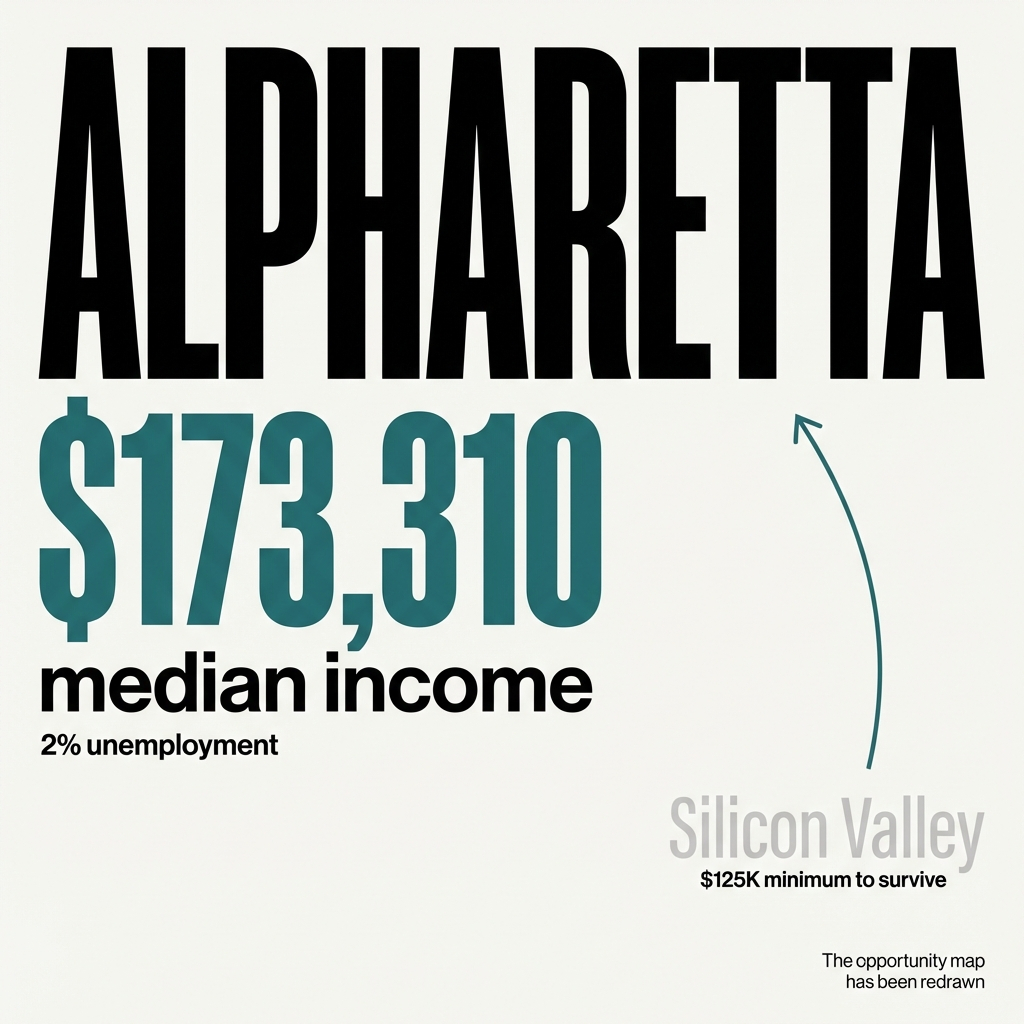
Alpharetta, Georgia tops the list with a median household income of $173,310 and unemployment around 2%. That’s not a typo. A city most professionals have never heard of is posting numbers that make Silicon Valley look like a bad deal.
South Jordan, Utah saw 72% wage growth. The median household income hit $126,974 in 2023, up from $75,433 in 2000.
Meanwhile, in the cities we’re supposed to want, the math runs backwards.
In Silicon Valley, 40% of renters and homeowners spend more than 30% of their income on housing. Nearly one-third of all households can’t meet basic needs without assistance, despite unemployment hovering around 4%.
You need an annual income of $125,280 just to afford a two-bedroom apartment in Santa Clara County.
The opportunity is there. The lifestyle isn’t.
Why We Choose Expensive Over Smart
I suffered from what I call “fashionable address disease.”
You know the symptoms. You want to live somewhere that sounds impressive when you say it out loud. Somewhere with cultural cachet. Somewhere that signals you’ve made it.
The disease doesn’t care about your bank account or your quality of life. It cares about status.
Here’s what I’ve learned: most people focus on big cities because that’s where the jobs are. But with remote work reshaping the landscape and housing costs eating 40% of your income, the equation has changed.
The question isn’t whether you can afford to leave the big metro anymore.
It’s whether you can afford to stay.
The Real Tradeoffs Nobody Mentions
I’m not selling you a fantasy where small cities solve everything.
There are legitimate tradeoffs. Amenities get thinner. School options narrow. The local event calendar won’t match what you had in Brooklyn or San Francisco.
And here’s the career risk that matters: fewer employers in your niche means less fallback if things go sideways.
This strategy works far better for mid to late-career professionals who already have networks that can land them a remote role if their current job changes. If you’re early in your career and still building connections, the smaller city might isolate you from the serendipity that happens in dense professional environments.
But there’s another angle most people miss.
The lower cost structure creates entrepreneurship runway. When you’re not spending $5,000 a month on a closet, you have room to take risks. Start something. Build something. Break out on your own.
What Changed for Me
Seattle was great when I was young. I got jobs, gained experience, built a foundation.
But as I got older, the cost stopped making sense.
Wilmington gave me proximity to New York without the brutal cost structure. I could still access the network and opportunities when I needed them, but I wasn’t hemorrhaging money just to exist.
The address didn’t sound as good. Nobody at a cocktail party gets excited when you say “Wilmington.”
But I could breathe. I could save. I could make decisions based on what I wanted to build rather than what I needed to afford.
The Invisible Mid-Sized Business Ecosystem
Here’s what most professionals don’t know: there are great mid-sized businesses in mid-sized cities.
They’re not on TechCrunch. They don’t have the brand recognition of Google or Meta. But they’re profitable, growing, and often desperate for talent that doesn’t want to live in San Francisco or New York.
These companies offer good money, lower cost of living, and real upside potential. The work is often more varied because smaller teams mean you wear more hats. The impact is more visible because you’re not one of 10,000 employees.
But they’re invisible to people who only look at the usual suspects.
The CoworkingCafe study found that coworking infrastructure grew 23% across the U.S., with cities like Gilbert, Arizona leading the charge. Eight new coworking spaces opened in Gilbert as remote workers more than doubled to nearly 33,000.
That’s not a fluke. That’s infrastructure following talent that decided the old map was wrong.
Your Optimal Geography Changes
What worked for me at 25 didn’t work at 35.
Seattle made sense when I needed access, experience, and the energy of being around people building things. It stopped making sense when I had the network and wanted the space to use it.
Geography isn’t a one-time decision. It shifts as your life shifts.
Early career, you might prioritize density and networking. Mid-career with a family, you start caring about schools and safety. Late career, you might optimize for cost and quality of life.
The mistake is treating your geography like a permanent identity rather than a tool you adjust based on what you’re trying to build.
The Vibe Check Matters
All the economic data in the world won’t help you if the city’s rhythm doesn’t match your nervous system.
This part is entirely intuitive. Voting patterns matter. The local scene matters. The pace of life matters.
Take a trip. Spend a few days there. See if the vibes are right.
You can have the perfect salary and cost-of-living ratio, but if you wake up every morning feeling like you’re in the wrong place, the math stops mattering.
What This Actually Means
We’ve been running career geography decisions on 20-year-old assumptions.
The map of American opportunity has been redrawn. Remote work, housing costs, and the maturation of mid-sized cities into legitimate economic hubs changed the game.
But most professionals are still navigating by the old map because the new one doesn’t come with the same status signals.
Alpharetta doesn’t sound as impressive as San Francisco. South Jordan doesn’t have the brand of Seattle. Gilbert, Arizona won’t get you the same nods at a conference.
But if you’re optimizing for actual outcomes rather than how your address sounds, the data tells a different story.
I’m not saying everyone should leave the major metros. Some people need to be there for their specific industry or life situation.
I’m saying the default assumption that big city equals best opportunity needs to be questioned.
Because right now, there are professionals in Alpharetta making $173K with 2% unemployment while their counterparts in Silicon Valley spend 40% of their income just to have a roof.
The opportunity didn’t disappear from the big cities.
It just stopped being worth what it costs.
Discover more from The Cameron Journal
Subscribe to get the latest posts sent to your email.