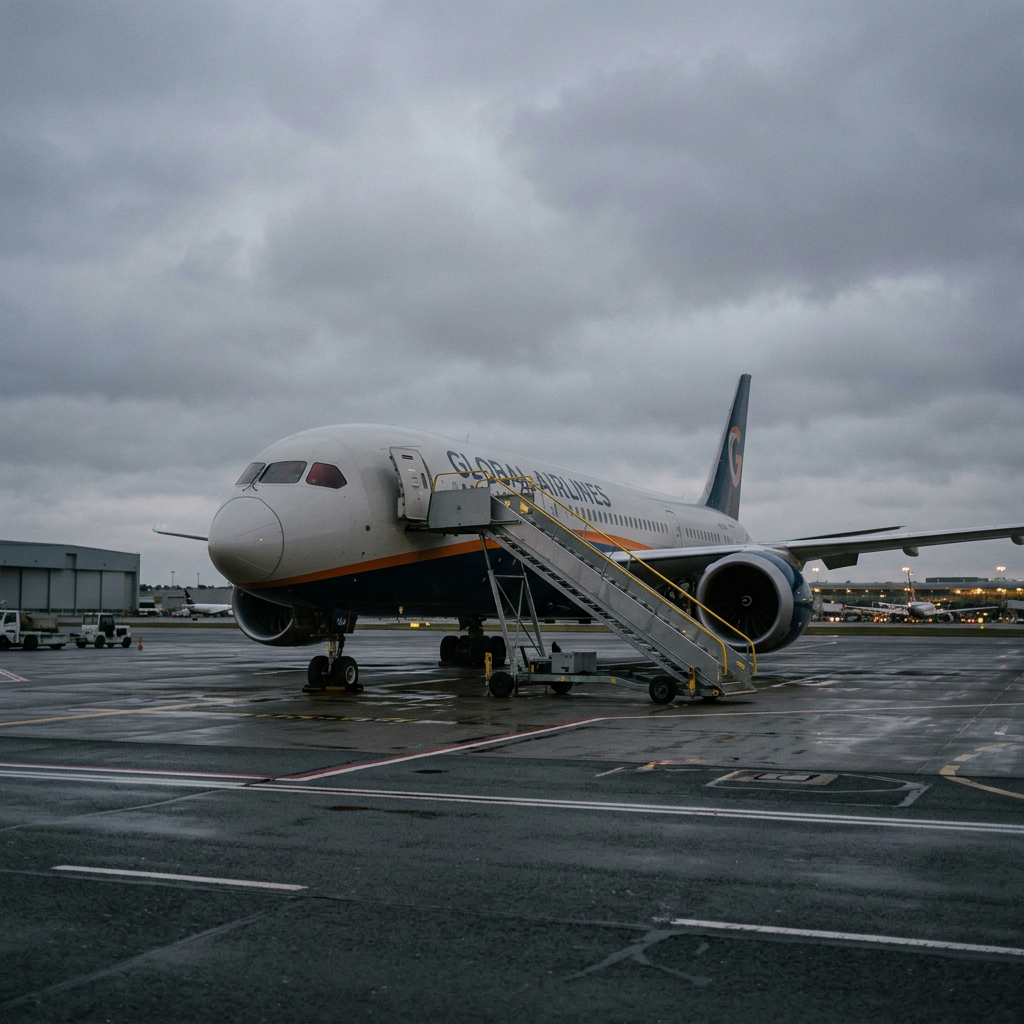
Spirit Airlines collapsed on 2 May with the sort of lurid theatricality that accompanies the death of institutions designed for people the ruling class regards as economically necessary and socially disposable in equal measure, and its 17,000 workers were stripped of wages, benefits, and severance without warning, but the significance of the collapse stretches far beyond any single bankruptcy filing because the airline had spent its existence as an airborne circulatory system for the American working and exhausted poor who balance impossible budgets against impossible inflation.
Spirit gave millions of Americans something the political class has spent fifty years pretending to care about and consistently refused to provide: affordable mobility, the freedom to cross the continent without incurring a debt that would take months to retire, the capacity to attend a funeral in another city or see a child graduate or take a family somewhere warm without the whole exercise becoming a financial calculation about whether the trip was worth the credit card bill that would follow it home, and the airline did so by operating on thin margins that required everything to go roughly as planned, margins that had no room whatsoever for a doubling of jet fuel prices triggered by a war in the Persian Gulf that the people boarding those planes had no hand in starting and no power to stop.
Jet fuel stood at roughly $80 per barrel in March and had risen to an average of $179 per barrel by the week ending 24 April, according to the International Air Transport Association, a price increase of such velocity and scale that Spirit’s business model ceased to be viable and the Trump administration refused to intervene, declaring with the breezy contempt of people who have never needed to count the cost of a plane ticket that the government lacked half a billion dollars lying around, a statement that deserves to be held alongside the $866 billion the same government allocates annually to the Pentagon, so that the arithmetic of which Americans are worth saving becomes unmistakably clear.
Spirit was the first casualty, and the serious money is on it being far from the last, with the Association of Value Airlines having penned a letter to the Transportation Secretary requesting $2.5 billion in federal assistance to bridge the gap between sky-high fuel prices and the lower projections on which carriers built their business plans, a request that covers Spirit, Frontier, Avelo, Sun Country, and Allegiant, representing effectively the entire low-cost carrier sector of the American aviation market, and the spectacle of an entire industry segment simultaneously seeking government rescue illuminates with unpleasant clarity how thoroughly the model depended upon the continuation of fuel conditions that the Strait of Hormuz crisis has now rendered historical.
JetBlue, which has recorded no full-year net profit since 2019, carries a debt-to-equity ratio of 6.31 and faces analyst projections of a $1.3 billion loss in 2026 if current fuel prices persist, a loss that would push its total debt toward $9 billion and raise annual interest costs from $600 million to approximately $800 million, with its founder having stated publicly that bankruptcy was a real possibility and that no acquirer would likely purchase the airline outside of Chapter 11 proceedings given the scale of the liabilities involved, while the airline’s credit rating has been downgraded to CCC+ by Fitch, and Frontier is already returning aircraft and deferring deliveries, the universal language of an industry preparing for a prolonged contraction rather than a temporary disruption.
The era of low-cost air travel as a mass working-class resource is ending, and the question of what replaces it as a mechanism for moving ordinary people across a country the size of a continent at prices they can actually afford is one that American politics is currently unable to answer, having spent the decisive decades of the twenty-first century making precisely the choices that guaranteed the question would arrive without an answer already prepared.
While the Strait of Hormuz crisis has provided the immediate trigger for the aviation industry’s unravelling, the vulnerability it exposed was assembled over decades of deliberate political choices, and chief among them was the decision, repeated across administration after administration from both parties, to allow the United States to fall further and further behind every comparable economy in the world in the construction of high-speed rail infrastructure, a failure whose scale becomes genuinely vertiginous when set against what was being built elsewhere during the same period and what it would have meant for the working-class Americans now watching their affordable air travel disappear.
China in 2023 alone expanded its high-speed rail network by 2,776 kilometres, an amount equal to the entire length of Japan’s high-speed rail system, bringing its total to 45,000 kilometres, approximately two-thirds of the global total, with trains running at up to 350 kilometres per hour and a next-generation system capable of 450 kilometres per hour expected to reduce the journey between Shanghai and Beijing to two and a half hours, and the Beijing-Shanghai corridor in 2024 carried more than 52 million rail passengers against only 8.6 million air passengers on the same route, generating $5.9 billion in revenue and $1.79 billion in net profit, while frequent weather disruptions and congested airspace continued plaguing the airline equivalent, so that taking the train had become the faster, cheaper, more reliable, and more profitable option simultaneously, which is the kind of outcome that tends to emerge when a state decides that infrastructure serves a public purpose rather than a quarterly earnings call.
The American experience over the same period reads like a chronicle of failure assembled with the care of a practised self-saboteur, beginning with the Obama administration’s 2009 stimulus investment of approximately $8 billion in what was advertised as high-speed rail but was mostly directed at incremental improvements to existing Amtrak routes shared with freight trains, including an embarrassing episode in which $287 million was spent on NextGen Acela trains that ended up running approximately ten minutes slower than the trains they replaced, as a result of a botched procurement effort that attempted to deploy the same rolling stock on both the Northeast Corridor, whose infrastructure dates in segments to the 1830s, and the still-unbuilt California system, a decision that wasted eighteen months, ignored manufacturer recommendations, and bought an overengineered train incapable of reaching its designed speed without tens of billions of dollars of track improvements that were never funded.
California’s high-speed rail project, the most ambitious attempt to build genuine bullet-train infrastructure in the United States, approved by voters in 2008 with an original price estimate that bore essentially no relationship to actual costs, has consumed billions of dollars over nearly two decades and as of 2026 has produced no operational trains, a collection of bridges and viaducts in the Central Valley that locals refer to as their own Stonehenge, a current cost estimate of approximately $126 billion for the full San Francisco to Los Angeles connection, a funding gap of roughly $90 billion, and a revised opening date that has slipped to 2038, with the Trump administration having cancelled $4 billion in federal grants in 2025, a decision consistent with the broader principle that whatever the federal government is able to find money for, it is reliably unable to find money for the mobility of ordinary people, and the project’s own Transportation Secretary having acknowledged that when construction began, the financing for completion was simply absent, which is a notable confession about the seriousness with which the political class approached what they told the public was a transformative infrastructure programme.
Biden’s promise of a second great railroad revolution produced an $80 billion Amtrak proposal and considerable rhetoric from a man who had genuinely ridden trains his entire career and understood what they could do, but the legislative reality produced incremental improvements and repair backlogs rather than the network investment that would have been required to build a rail system capable of replacing the cheap regional air travel now vanishing, and the Republican Congress that terminated the Obama-era high-speed rail programme the moment it gained the House ensured that whatever groundwork might have been laid for a genuinely competitive national passenger rail network was instead returned to pavement, leaving Morocco, where trains run at 200 miles per hour, and Japan, where the Shinkansen has operated since 1964, and France, where the TGV has connected cities at speed for four decades, in a position to offer their working classes a mobility option that America refused to build.
The proposition that mobility is a class privilege is presented by those who benefit from the arrangement as a natural law rather than a political choice, but the evidence from every corner of the world where serious political will has been applied to the question suggests that it is nothing of the kind, and that the barriers to working-class movement are constructed rather than inevitable, assembled through decades of funding decisions, infrastructure neglect, regulatory capture, and the preference of private profit over public utility.
Luxembourg became in March 2020 the first country on Earth to make all public transport, including buses, trams, and trains, free to every person within its borders regardless of residency, a policy that eliminated fares across the entire national network and demonstrated that the cost of doing so, in a country where fares had in any case only covered approximately 10% of operating costs, was considerably smaller than the political will required to enact it, and the policy has remained in place because the political class in Luxembourg grasped something that the American political class has consistently failed to grasp, which is that the cost of keeping people from moving is borne by the people who need to move and cannot afford to, rather than by the state that claims to serve them.
Tallinn, the capital of Estonia, made public transport free for residents through a public vote in 2013, a decision that increased ridership and demonstrated the appetite among ordinary people for a transit system that treats their movement as a public good rather than a profit center, while Dunkirk in France eliminated fares citywide in 2018 and saw bus ridership soar by 60% within a year, with nearly half of new riders having previously used private vehicles, and Hasselt in Belgium abolished fares in 1997 and watched ridership climb to thirteen times its previous level by 2006, with Belgrade becoming in 2025 the third European capital to offer free public transport, joining Tallinn and Luxembourg in a growing roster of cities that have decided the question of whether people can move around is too important to leave to the market.
In the United States, where the political conditions for such decisions are considerably less hospitable, the efforts have been smaller but the impulse has been the same: Kansas City became in 2019 the first large American city to eliminate bus fares entirely, a decision that came from the recognition that public transport should be considered a public good in the same category as schools and parks, and that the savings from eliminating fares could amount to hundreds of dollars in savings annually for working-class households. Boston’s Mayor Michelle Wu championed free bus pilots and argued that eliminating fares would speed up service, close racial disparities in transit access, and advance economic justice, with New York City testing free bus service on five routes; and advocates across the political spectrum from Denver to Olympia, Washington, have recognised that the 15% of household budgets Americans spend on average on transportation represents a tax levied most heavily on the people least able to pay it.
Socialist councillors in New York City have argued for free buses as part of a broader vision of working-class mobility as a public right, and the argument requires no great intellectual effort to make because it is simply true: a city in which the working class can move freely, without counting whether they have a MetroCard balance or calculating whether the cost of the fare is worth the trip, is a more productive, more equitable, and more humane city than one in which mobility is rationed by income, and the political resistance to such proposals comes primarily from people who ride nothing but private vehicles and have organised their conception of urban life around the assumption that public transit is a service for people unable to afford private transport rather than a civic infrastructure as fundamental as roads or pavements.
A high-speed rail network connecting major American cities, built during the first decade of the twenty-first century when the political will existed in at least fragmentary form and the borrowing costs were historically low and the unemployment rate was high enough that the labor to build it was available and looking for work, would have been the most consequential infrastructure investment in American life since the interstate highway system, but unlike the interstate highway system, which moved freight and automobiles in the service of a car-centric suburbanisation that itself served the interests of oil companies and real estate developers and automobile manufacturers, a high-speed rail network would have moved people, and specifically the kind of people who take Spirit Airlines, who cannot afford to drive because the distances involved are too great and the time cost too high,
The political forces that killed high-speed rail in the United States across three administrations were operating in the explicit service of freight railroad companies, airline industry lobbying, oil industry interests, and the ideological conviction that any investment in public infrastructure that might reduce car use and fossil fuel consumption was, by definition, a socialist conspiracy against the free market.
The deeper revelation emerging from the wreckage concerns the extraordinary arrogance of political and financial classes that spent decades insisting the market would resolve every contradiction through the mystical intelligence of price signals and logistics software, only to discover that civilisations are unable to survive indefinitely after converting every sphere of public life into a subsidiary department of speculative finance, with the global economy having spent three decades optimising for shareholder return while neglecting democratic accountability, domestic productive capacity, and the basic principle that people need to be able to move around without calculating whether they can afford the ticket, and the scale of the problem, encompassing the dismantling of the productive commons, the refusal to build public infrastructure capable of serving as an alternative to fuel-dependent private commercial aviation, and the wage suppression that renders working-class households perpetually one crisis away from immobility.
The ability of ordinary people to move through the society in which they live is not some luxurious consumer indulgence but one of the foundational conditions of democratic participation itself. A population unable to travel affordably becomes trapped economically, socially, culturally, and politically, cut off from opportunity, isolated from family, priced out of mobility, and transformed into a geographically immobile labor reserve whose entire existence becomes constrained by the radius of what they can afford to reach. The destruction of cheap air travel therefore threatens something larger than tourism or convenience because it narrows the physical horizons of working-class life itself, reducing mobility from a social expectation into a privilege increasingly reserved for those insulated from fuel shocks, inflation, and precarious wages.
A nationalised transportation system, properly understood, would not merely consist of trains replacing airplanes but of an integrated public mobility network organised around the principle that movement is a social good rather than a revenue stream. High-speed rail corridors connecting major metropolitan regions, conventional passenger rail binding smaller cities and rural communities into the network, municipally owned electric bus systems operating free at the point of use, publicly coordinated regional air travel for isolated areas where rail remains impractical, and infrastructure financed not according to quarterly profitability but according to social utility would together represent the single greatest expansion of working-class freedom in modern American history. Such a system would lower household costs, reduce dependence upon volatile fuel markets, weaken the monopolistic power of airlines and automobile manufacturers, dramatically cut emissions, increase labor mobility, reduce regional inequality, revitalise neglected cities, and reconnect millions of Americans to one another in material rather than rhetorical terms.
The extraordinary thing is that none of this is technically impossible, economically unthinkable, or historically unprecedented. The United States already spends vast sums subsidising transportation indirectly through highways, airports, fossil-fuel infrastructure, military protection of global shipping lanes, tax incentives, and endless emergency rescues for industries deemed too important to fail after decades of privatisation rendered them incapable of surviving disruption. The question was never whether the country could afford public transportation on a national scale; the question was always whether the political order was willing to subordinate private profit to public necessity long enough to build it. Every country that constructed successful high-speed rail, universal transit access, or heavily subsidised mobility infrastructure did so not because market forces spontaneously delivered it but because states made the deliberate political decision that the movement of ordinary people mattered more than the ideological sanctity of shareholder return.
And perhaps that is the final revelation contained within the smoking wreckage of the low-cost airline era: that the wealthiest society in human history systematically refused to guarantee one of the most basic conditions of social freedom because doing so would have required recognising the working-class not merely as consumers to be extracted from, disciplined, and discarded, but as citizens whose lives possessed inherent public value. The collapse now unfolding across aviation is therefore not simply logistical or economic but moral, exposing the accumulated consequences of a civilisation that spent half a century building systems optimised for profit extraction while neglecting resilience, solidarity, and the ordinary dignity of being able to go somewhere without fear of financial ruin.
The alternative remains visible nonetheless, waiting in the space where political imagination has been deliberately starved for decades: trains crossing the continent at high speed under public ownership, free electric buses in cities where movement is treated as a civic right, integrated ticketing systems that allow workers to move between regions without debt, publicly employed transportation workers with stable wages and pensions, rural towns reconnected to national economic life rather than abandoned to isolation, and a generation of Americans raised with the assumption that mobility belongs to everyone rather than only to those capable of enduring the market price of access. Such a society would not merely move people more efficiently. It would move them more humanely, more equally, and more freely, and in doing so would finally begin constructing an economy organised around the flourishing of life rather than the continuation of quarterly earnings reports.
Discover more from The Cameron Journal
Subscribe to get the latest posts sent to your email.