Pre-order America’s Lost Generation now!
When I was growing up, there was a simple equation put forward by schools, parents, and every career fair: work hard, play by the rules, and you’ll earn not just a living, but a sense of meaning, purpose, and, eventually, security. For Millennials, this story simply no longer holds water. The more I talk with readers, research policy trends, and reflect on my own tangled career, the more clear it becomes—work has become not the pathway to adulthood, but a grindstone that wears away at our sense of possibility.
Hard Work and Little Pay
Let’s start with the basics: Millennials are working harder for less. According to the Economic Policy Institute, productivity has risen by over 60% since the late 1970s, but wages have barely budged. The labor share of income has shrunk, while profits for corporations and the ultra-wealthy have soared. Yet for my generation, the old safety nets have disappeared. Early in my career, I cycled through jobs that promised experience, not pay—just as many of my peers did. The first “real job” was supposed to be a launchpad. In reality, it was a revolving door of internships, gigs, contracts, and side hustles, usually without benefits or any hope of advancement.
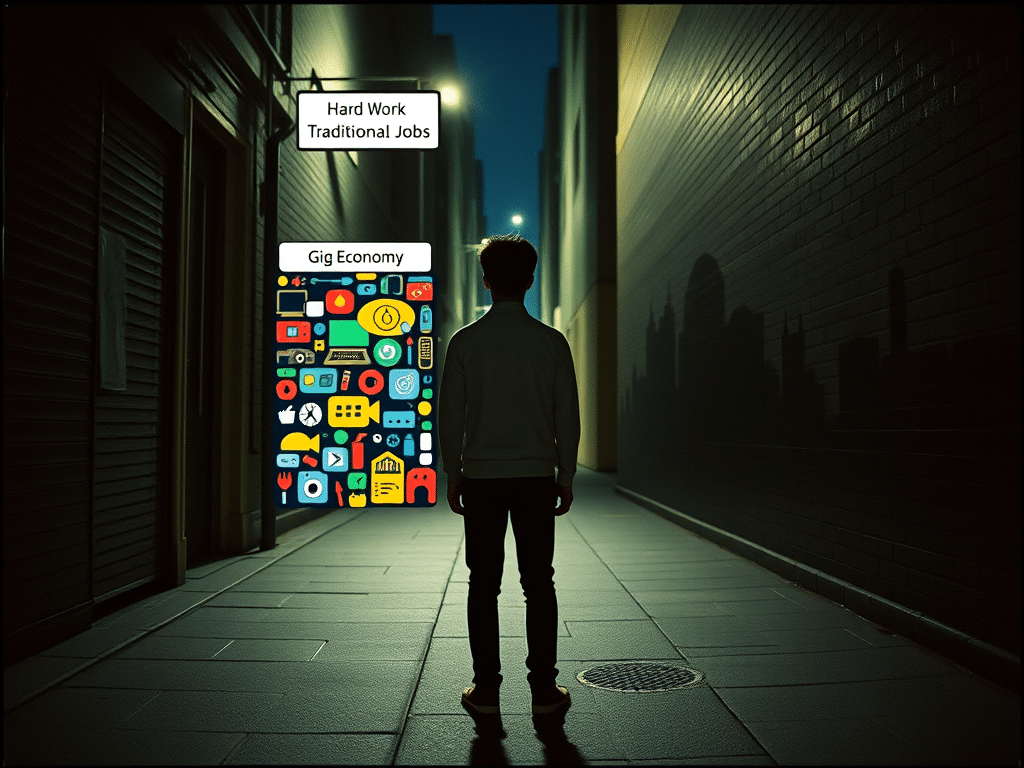
I’ve unpacked the “gig economy trap” at length on The Cameron Journal (“The Job Market is Broken,” “You Have to Be Everything”), and it shows up on every page of America’s Lost Generation. Millennials are more likely to hold multiple jobs at once, drive Uber after their 9-to-5, or freelance just to cobble together the illusion of stability. According to Upwork’s 2023 report, 36% of Millennial workers operate in freelance or short-term contract arrangements. There’s some flexibility and autonomy in that, but it usually comes at the cost of health insurance, retirement savings, and professional growth. The American workplace demands total commitment, but returns little loyalty.
Work Used to Mean Something
For Boomers, work was once a community—something that offered identity, retirement plans, and the idea that one good job could support a household. Today, that feels almost quaint. Millennials compete for what’s left of those old “good jobs,” and the rest of us become what I call “permaprecarious”—always hustling, always re-skilling, never sure which app or platform will even exist next year. As discussed in “OK Boomer: Jobs,” the ladder has been replaced by an obstacle course, with no guarantee any of it leads anywhere. Every economic downturn brings a new wave of layoffs; every market crash exposes the hollowness of “loyalty” on both sides.
If you’re wondering how meaning fits into this equation—the answer is: it doesn’t, for most. We were raised on the idea that a career should offer passion, impact, even self-actualization. Instead, we curate side projects and personal brands, searching for fulfillment in spaces that used to be filled by healthy workplaces and community. In “Why Your Untold Story Keeps You Trapped,” I write about how work, once a site of pride, has instead become a source of shame for those falling behind on bills or switching jobs yet again.
This is not just a matter of personal dissatisfaction. The mental health effects are profound and systemic, as discussed in my earlier essay in this series. The CDC and the World Health Organization have found that long-term job insecurity and economic volatility are as damaging to health as many chronic diseases. Burnout is ubiquitous, even as new technology promises to “solve” our problems with another productivity app or AI tool.
Across the globe, the comparison to Japan is instructive. Their “non-regular” workforce—what we now call gig or contract labor—never regained their footing after the lost decade, and now, the consequences are everywhere: delayed households, lifelong instability, and a fraying of the communal ties that come from stable work. America is on an almost identical path, heedless of the warning signs.
What’s Next?
But this bleak portrait isn’t the whole story. As I argue in America’s Lost Generation, Millennials are nothing if not resilient and innovative. We’re the generation inventing new paths, new networks, and new meanings. The future of work could be brighter—if we leverage our collective creativity and demand policies that bring security and meaning back together. That means universal healthcare untethered from employment, portable benefits, fair pay, and a return to valuing people over quarterly profits.
If work is to matter again, it has to be a site of dignity, not just survival. For those who want deeper analysis and practical advice, I invite you to explore more at The Cameron Journal, including “Maximizing Remote Work Efficiency” and “Why the Gig Economy Isn’t Sustainable.”
Millennials are already redefining what it means to labor, live, and dream of a better future. Now, let’s make those dreams something more than just after-hours pursuits.
Discover more from The Cameron Journal
Subscribe to get the latest posts sent to your email.