
I spent years in Seattle paying too much for what was essentially a closet with good coffee nearby.
The math never made sense. But I stayed anyway.
Because Seattle sounded right. It had the brand. The tech scene. The cultural cachet. When people asked where I lived, “Seattle” landed differently than “Wilmington” ever would.
That’s what I call fashionable address disease—and it cost me years of financial progress I’ll never get back.
Here’s what the data actually shows: corporate headquarters are flooding into cities you’ve barely heard of. Employment growth is happening in metros that don’t make anyone’s “cool cities” list. And only 8% of Americans moved in 2025—one of the lowest rates on record—which means most people are stuck running old software about where careers happen.
The gap between the narrative and the reality has never been wider.
The Five Paths Nobody’s Talking About
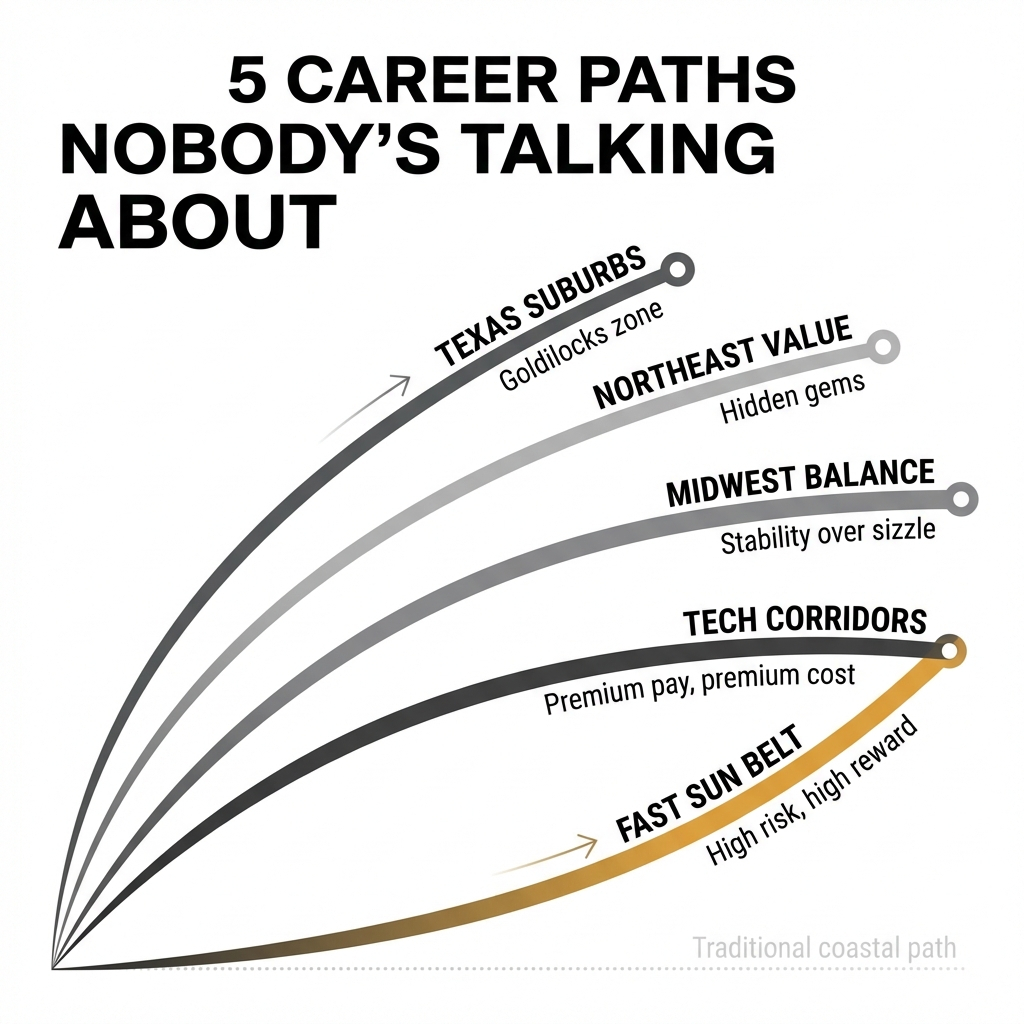
The research reveals something most career advice ignores: there are now five distinct paths to professional success, each with different risk profiles, cost structures, and lifestyle tradeoffs.
Not one path. Five.
And which one works for you depends entirely on your career stage, family situation, and how much financial volatility you can stomach.
Path 1: Fast-Growing Sun Belt Hubs (High Risk, High Reward)
The cities: Dallas-Fort Worth, Austin, Nashville, Phoenix, Houston
Between 2018 and 2023, these five metros captured the top spots for corporate headquarters relocations. Dallas employment alone has grown 11% since 2020. 52% of all millennials now live in the Sun Belt.
The opportunity is real. But so is the volatility.
Austin saw rents drop more than 5% in 2024 due to oversupply. Rapid growth means infrastructure struggles to keep up. You’re betting on momentum continuing—and if it doesn’t, you’re stuck in a city built for a boom that ended.
Best for: Early to mid-career professionals with high risk tolerance and no school-age kids yet. People who can move again in 3-5 years if the market shifts.
Worst for: Anyone who needs stability or can’t afford to ride out a correction.
Path 2: Established Tech Corridors (Premium Pay, Premium Cost)
The cities: Silicon Valley, Seattle, Boston, Baltimore/DC metro
Silicon Valley still posts the highest average tech salary at $131,332—even after a 7.3% decline. The Baltimore/Washington corridor averages $123,369 with a 5.8% increase.
But here’s the part nobody mentions in the salary surveys: a $180,000 salary in San Jose leaves you with less disposable income than $140,000 in Austin once you factor in housing, taxes, and cost of living.
You’re paying a premium for brand, network density, and the optionality that comes from being where deals happen in person.
Best for: People building elite networks, raising venture capital, or positioning for executive roles where proximity to power matters.
Worst for: Anyone trying to build wealth through savings rather than equity. The math doesn’t work unless you’re capturing significant upside beyond salary.
Path 3: Balanced Midwest Cities (Stability Over Sizzle)
The cities: Minneapolis, Madison, Des Moines, Pittsburgh
Madison leads all cities in work-life balance with a score of 83.6 and an unemployment rate of just 2.8%. Minneapolis earned the top spot as the best city for a career change, with unemployment at 3.5%—well below the national average.
These cities don’t generate headlines. They don’t have the explosive growth of Austin or the salary peaks of San Francisco.
What they have is predictability.
Des Moines is growing steadily in finance, insurance, and data services. Pittsburgh offers expanding healthcare and tech sectors with home prices that haven’t lost touch with reality. Minneapolis attracts young professionals and remote workers who want four seasons and functional infrastructure.
Best for: Mid to late-career professionals who value stability, families prioritizing schools and safety, anyone building a business who needs low overhead and high quality of life.
Worst for: People who need cutting-edge industry exposure or thrive on rapid change and cultural density.
Path 4: Affordable Northeast Gems (Hidden Value Plays)
The cities: Morristown NJ, Albany, Pittsburgh
Morristown is the most affordable city in the Northeast and second-most affordable nationwide. It’s also the only city on the list where incomes exceed the estimated cost of living. The median household income sits 41% above the national median.
Albany has become a hub for health tech, biotech, and IT talent. The proximity to major markets creates startup activity without major market pricing.
Pittsburgh shows up here too—growing healthcare and tech industries, home prices that still make sense, and Northeast stability without coastal pricing.
Best for: Remote workers who want access to NYC or Boston without the cost. People in healthcare, biotech, or information technology who want to own property before 40.
Worst for: Anyone in entertainment, fashion, or industries that require daily face time in major metros.
Path 5: Texas Suburban Powerhouses (The Goldilocks Zone)
The focus: Dallas-Fort Worth suburbs, specifically
DFW was recently ranked #1 for overall real estate prospects in 2025. The region’s economy spans tech, finance, defense, and transportation. Employment has grown 11% since 2020.
The median tech salary is $97,000—roughly aligned with a cost of living slightly below the national average. Thousands of new apartments have been delivered, yet occupancy remains solid.
This is the path for people who want Sun Belt growth without Austin-level volatility. Suburban infrastructure built for families. Corporate headquarters relocating by the dozen. And a cost structure that still allows you to save money.
Best for: Families in the wealth-building phase. Professionals in finance, tech, or defense. Anyone who wants growth exposure with lower downside risk.
Worst for: People who need walkable urban density or prioritize public transit. Anyone allergic to car culture.
The Real Risk Nobody Mentions
Here’s what the “move to a smaller city” cheerleaders won’t tell you:
Fewer employers in your niche means fewer options when things go wrong.
If you’re early career and your company tanks, you might not have another employer in your field within 100 miles. If you’re in a specialized role, you could be the only person doing that job in the entire metro.
This strategy works far better for mid to late-career professionals who have networks that can land them remote roles if their job situation changes. People who’ve built enough expertise and connections that geography becomes less binding.
The lower cost structure also creates entrepreneurship runway. If you’re paying $2,000 a month in housing instead of $4,500, you can afford to take a swing at building something. That’s real optionality.
But if you’re 25 and still building your network, choosing a smaller city could limit your growth trajectory in ways that take years to recognize.
Why Your Brain Lies to You About This
I suffered from fashionable address disease for years before I admitted it.
There’s something deeply human about wanting to live somewhere that sounds impressive. Somewhere people recognize. Somewhere that signals you’ve “made it” in some tribal, status-driven way.
The reality is that Seattle was great when I was young. I got jobs, experience, connections. But as I got older, the cost stopped making sense. I was paying a premium for brand when what I actually needed was financial breathing room.
Wilmington gave me proximity to NYC without spending $5,000 a month on a closet.
The math shifted. My needs changed. But my brain kept running old software about where successful people live.
That’s the trap: we make geography decisions based on narrative rather than numbers.
How to Actually Choose
The data gives you the paths. But the decision is entirely personal.
Here’s what matters:
Voting patterns matter. If you’re liberal but not woke (like me), some cities will exhaust you. If you’re moderate and politically homeless, you need a place where you’re not constantly defending your existence to true believers on either end.
Local scene matters. Can you find your people? Are there cultural amenities you actually care about, or are you paying for opera tickets you’ll never use?
Vibes matter. Take a trip. Spend a week. See if the rhythm of the place matches your nervous system. Some cities move fast. Some move slow. Some feel dense and urgent. Some feel spacious and calm.
You can’t optimize this on a spreadsheet.
But you also can’t ignore the spreadsheet entirely.
The Bigger Picture
Only 8% of Americans moved in 2025. That’s one of the lowest rates on record.
But flexible work, automation, and evolving skill demands have prompted many people to reassess their financial goals—and in some cases, their location.
For some professionals, relocating to a city with stronger job prospects and higher real wages isn’t just a smart move. It’s a necessary one.
The gap between where people think careers happen and where they actually happen now is enormous.
Dallas is booming. Morristown has higher incomes than most coastal cities. Madison offers better work-life balance than anywhere in California.
But most people will never consider them because the narrative hasn’t caught up to the reality.
That’s the opportunity.
If you can deal with living in a place people can’t find on a map, there are great opportunities waiting.
You just have to be willing to let go of the fashionable address.
Discover more from The Cameron Journal
Subscribe to get the latest posts sent to your email.