
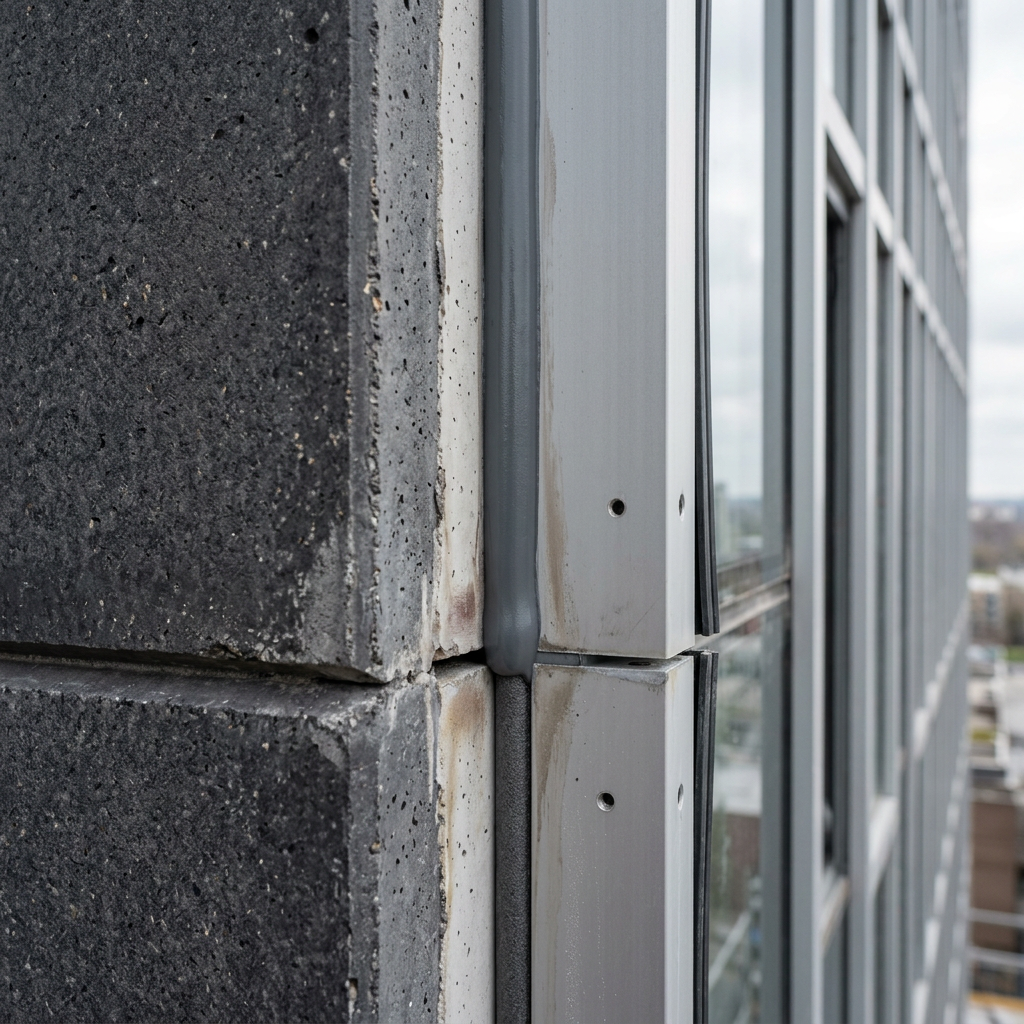
Sealant is bought by the cartridge and judged by the metre. A product that costs a little less per tube looks like a saving until the joint reopens, the bead is cut out and the work is repeated with scaffold, labour and access costs that dwarf the sealant bill. On projects where access is expensive, the right comparison is not unit price. It is the cost per year of service for the joint.
Start With the Joint, Not the Product
Four questions about the joint narrow the choice more reliably than any brochure.
How much will it move? Facade panels, cladding and long runs of metal expand and contract daily. High-movement joints need a sealant with a high stated movement capability, not one chosen for its ease of use.
What is it bonding to? Mixed substrates are the norm: concrete, aluminium, steel, glass, coated panels, timber. The sealant has to be compatible with every one of them, and some chemistries attack coatings or stain porous stone.
Is the surface dry? In humid climates, the joint face is often not fully dry when work has to proceed. Some hybrid sealants are formulated to cure and bond on slightly damp surfaces; many other products are not.
Will it be painted? If the joint sits inside a painted finish, paintability is a requirement. Many silicones fail it.
Where Hybrid Chemistry Fits
Modified hybrid sealants sit between silicone and polyurethane. They tend to be paintable, tolerate slightly damp surfaces, bond to a wide range of substrates without a primer in many cases, and typically carry good UV resistance. Those attributes make them a common choice for high-rise, cladding and mixed-substrate work.
They are not the answer to every joint. Pure silicone is still the default for wet rooms and structural glazing where its particular properties are specified, and acrylics remain sensible for low-movement interior joints that will be painted. Selection should follow the joint conditions, not a habit.
Reading the Claims
Manufacturers publish figures for movement capability, temperature range, UV performance and certification. The numbers are useful, but two cautions apply. A stated service life, such as a decade of UV resistance, is a manufacturer’s claim under defined conditions, not a guarantee for every site. And certification marks are worth reading for what they cover: a listing against a recognised sealant standard is meaningful, but only for the properties the standard tests.
Shelf life deserves attention too. Stated shelf life varies by product and sometimes by chemistry (the MS-1000 below lists 12 months, against 24 months for the acrylic grades in the same range), so stock should be dated and rotated, particularly on long projects where cartridges sit in a store for months.
Cost Per Year of Service
Consider two sealants on a facade joint. One costs less per cartridge but needs replacement a few years earlier. The other costs more and lasts longer. Once the cost of access, masking, removal of failed material and labour is included, the cheaper tube is almost always the more expensive joint. Material is a small share of a re-seal job; access and labour are most of it.
This also argues for doing the preparation properly. A premium sealant on a poorly prepared joint fails as quickly as a cheap one.
A Short Selection Routine
List the joint types on the project. For each, record the movement, the substrates, the exposure and the finish. Match a product to each group rather than one product to all. Check each against its data sheet for the properties that matter and confirm shelf life and storage conditions before ordering.
Practical Takeaways
- Choose by joint movement, substrates, moisture and finish, not by unit price
- Hybrid sealants suit mixed-substrate, paintable and slightly damp conditions
- Manufacturer service-life figures apply under defined test conditions only
- Check shelf life and rotate stock on long projects
- Compare cost per year of service, including access and labour
Where to Start
For mixed-substrate and high-rise work, a hybrid such as First Sealant MS-1000 is a reasonable benchmark to compare against. The manufacturer lists it as paintable and mould-resistant, suitable for interior and exterior use, applicable on damp surfaces, with a stated operating range of -50°C to 100°C, a stated UV life of 10 years, and certification to TUV, PSB, ASTM C920 and ASTM C719, with a 12-month storage life.
For advice on matching a product to a specific joint, their team can be reached at 096-818-9168, 097-959-5111, or 097-959-1222, Monday through Saturday, 08:30-17:30.
Technical specifications referenced above are drawn from the manufacturer’s published product information. Confirm suitability for your application directly with the supplier.
Discover more from The Cameron Journal
Subscribe to get the latest posts sent to your email.




