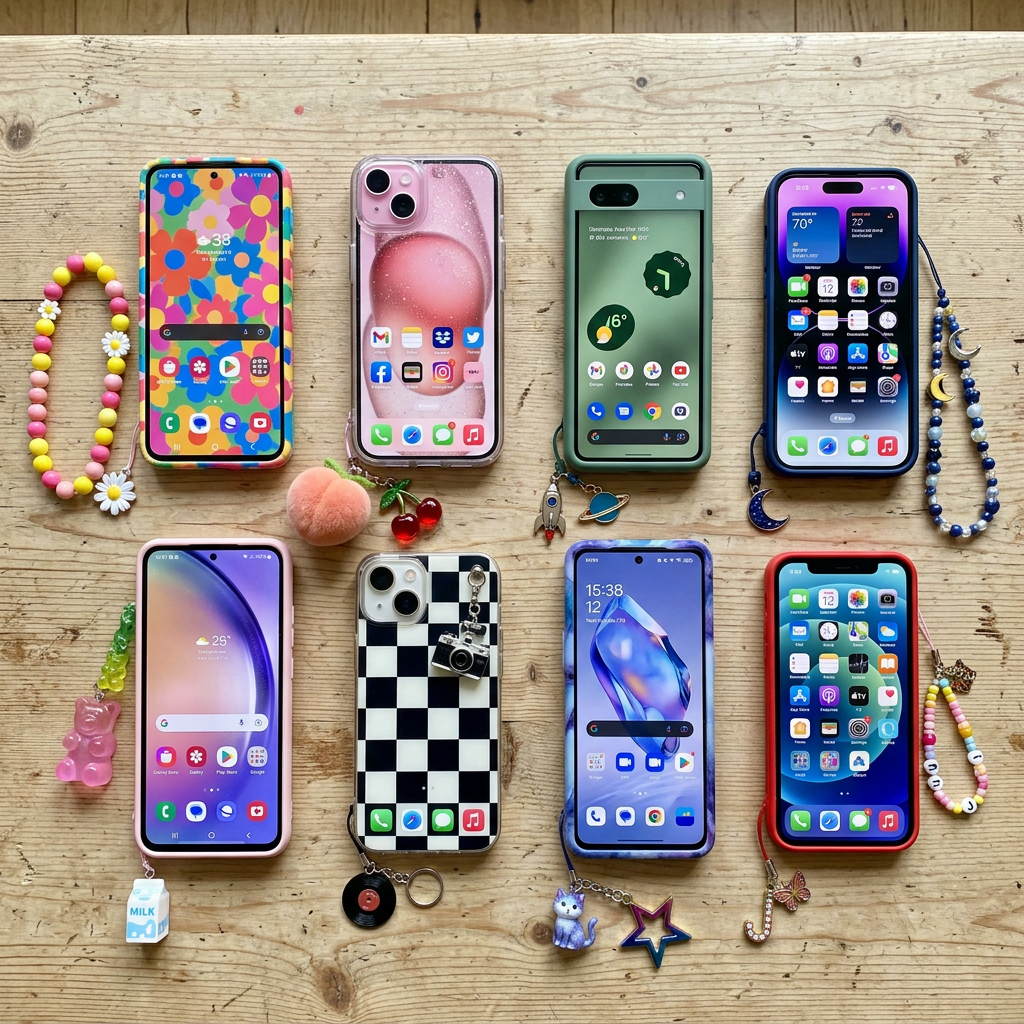
Many individuals don’t perceive their smartphone as a fashion statement. In fact, they should. This gadget is on your table, in every picture, and you touch it numerous times in the morning. Its appearance, and how you’ve customized it, sends a message, even if you don’t realize it.
The Hardware Problem Nobody Talks About
If you look at comparisons of top smartphones from recent years, you will see that they are all identical. They all have a glass front, glass back, metal frame, and three camera lenses in a square. The design is truly remarkable, but the uniqueness is almost non-existent.
These top-of-the-line smartphones are essentially all the same because they selected the same design, and it’s not because that design reflects something about the user. The lack of diversity in design is exactly what has transformed physical accessories from something optional to a necessity.
Mobile covers are not only for protecting your phone now. It’s the only element of the phone that manufacturers haven’t completely monopolized.
How Social Media Made the Back of Your Phone Visible
Mirror selfies had an impact. Once that format became popular, suddenly the back of your phone appeared in the picture. People noticed. Suddenly, the phone case you used was not invisible, it was part of the image, the outfit, the aesthetic.
Gen Z and Millennials picked this up fast. Both groups grew up treating tech as identity rather than utility, and the phone case became a natural extension of that. Regional style trends started bleeding into tech fashion, which is why finding cool phone cases UK suppliers offer has become a real search behavior, not just impulse buying. People want something specific to their taste, not the generic mass-produced plastic that ships free from discount marketplaces.
Phone charms and grips followed the same arc, what started as ergonomic accessories became style choices with their own aesthetic categories.
Your Phone is an Everyday Carry Item, Not a Tool
According to statistics from Reviews.org (2023), an average person checks their mobile 144 times a day. That’s 144 triggers, 144 moments of your screen shining up at you, 144 instances where your phone case could be working for you in the background. The sensory experience of that object, whether it’s cold glass, soft matte TPU, or textured silicone, shapes your mood in ways that are small individually and significant over time.
This is where dopamine dressing crosses into tech. The principle that color and design choices influence psychological state doesn’t stop at clothing. A case in a color you actually love, with a finish that feels satisfying to hold, does something to how you relate to your day. It sounds minor. Over thousands of daily interactions, it isn’t.
Customization at this level is a form of micro-expression, not a grand statement, but a consistent, quiet signal to yourself about who you are and what you care about.
Protection and Style Aren’t Actually in Conflict
A more traditional approach to this dialog might have cautioned you against trading safety for style. But times have changed.
There are now cases built for drops that also look engaging in their own right. Your best bet is to make sure you buy a case that clearly states its level of drop protection, promises wireless charging will still work, and provides enough protection for the camera bump. After those checks, you’re free to choose based on your personal taste.
The more interesting dilemma is not really looks vs. protection, but rather chasing the hype and newness of it all vs. something built to last. If you love changing your case as you would your outfit, there’s no problem. Just make sure you’re not simply following the same logic as with fast fashion when buying protection for an item that costs hundreds of pounds (or dollars).
Ultimately, style and function should complement each other.
Making Your Physical and Digital Customization Match
The most underrated part about customization is to consider your phone as a singular visual system, not two separate things, a case, and a default wallpaper.
Tech aesthetics work best with some coherence. If your case has a muted, earthy color palette; a high-contrast neon lock screen fights it. If you’ve gone bold with a printed pattern, a minimal widget layout on a neutral background can balance it out.
Android users have a significant advantage here with custom launchers and icon packs. iOS has closed the gap with widget support. Either way, spending twenty minutes matching your internal layout to your case creates a visual consistency that makes the device feel intentional rather than assembled by accident.
That coherence isn’t just aesthetic. It’s a form of personal branding in the most ordinary sense, not for other people’s benefit, but for your own. The things you carry every day say something. When they’re chosen deliberately, they say it clearly.
Your phone will look like everyone else’s or it won’t. That’s actually a choice you get to make.
Discover more from The Cameron Journal
Subscribe to get the latest posts sent to your email.