Series Introduction:
In an era marked by increasing skepticism toward institutions, the interplay of leadership, integrity, and moral accountability takes center stage. Thinkers like Plato and Jordan Peterson have wrestled with these themes across history and literature, offering timeless insights into governance challenges, societal cohesion, and human tendencies toward corruption. Wade Fransson, author, and speaker, joins this intellectual tradition with a unique perspective shaped by his spiritual and professional journey.
This series examines how Fransson’s life and ideas resonate with—and diverge from—the insights of Plato and Peterson. Fransson’s trilogy explores the vulnerabilities of institutions and leaders to greed, ignorance, and ambition, shedding light on how principles like transparency, consultation, and humility can safeguard against decay. By weaving together Fransson’s experiences with the philosophical depth of Plato and the psychological narratives of Peterson, this series provides a multifaceted exploration of what it means to build and sustain just institutions.
Each article will delve into critical topics such as the influence of economic and political interests, the role of whistleblowers, and practical steps for fostering accountability. These discussions illuminate a path toward institutional reform grounded in wisdom, ethical leadership, and a commitment to the common good.
- Discussion Points:
- The role of confirmation bias in shaping expert opinions
- The impact of economic incentives on scientific research
- The importance of questioning authority and seeking multiple perspectives
- Strategies for evaluating the credibility of experts and their claims
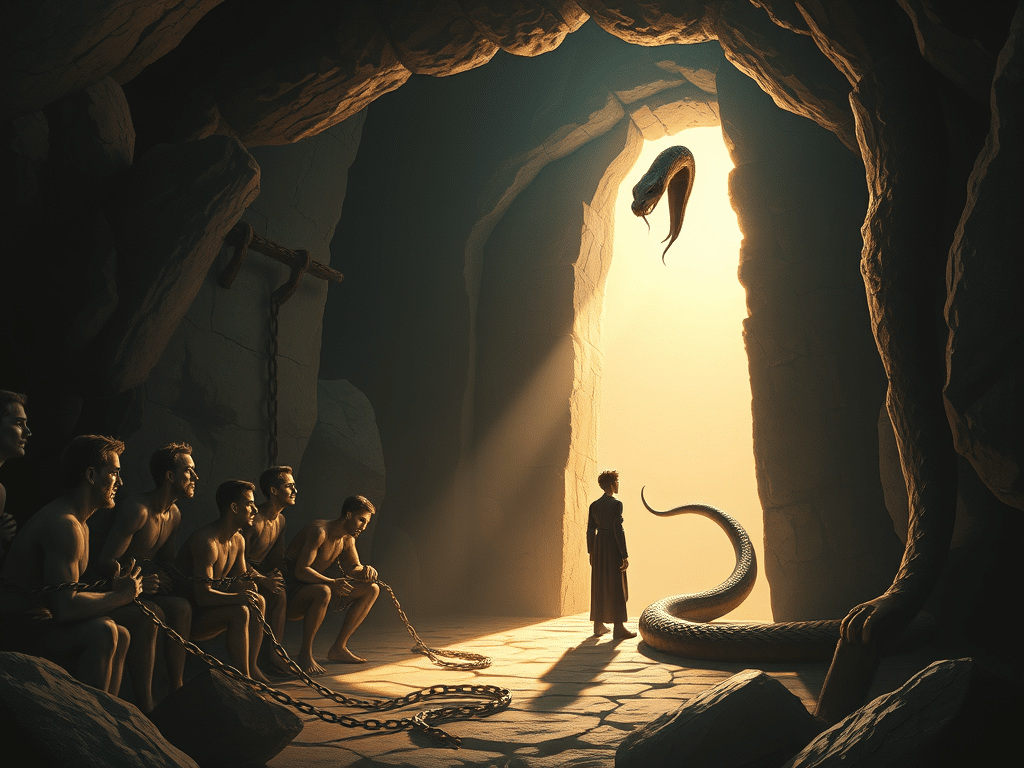
For Fransson, the allegory of the cave is not merely an intellectual exercise but a profound spiritual reality. Having once stood at the pulpit of the Worldwide Church of God, he understands firsthand the danger of mistaking institutional dogma for ultimate truth. This echoes Plato’s chained prisoners, who perceive only shadows of the true Forms. As Fransson has recounted, his transition from Christianity to the Bahá’í Faith came through the painful realization that even those with spiritual authority can be blinded by their own biases. Peterson, too, underscores this dynamic, particularly in his exploration of Adam and Eve. Their fall, marked by the serpent’s cunning deception, symbolizes the human propensity to cling to comforting illusions rather than confront the harsh realities of existence.
Peterson’s serpent and Plato’s shadows also illuminate the role of pride in sustaining ignorance. In Genesis, the serpent entices Eve with the promise of godlike knowledge, a temptation rooted in pride and the refusal to acknowledge a higher moral order. Fransson relates this to the intellectual pride he encountered within evangelical theology, where the interpretation of scripture often became an exercise in confirmation bias. Similarly, Peterson observes that pride prevents Cain from offering a proper sacrifice, leading him to murder his brother Abel in a fit of resentment. This pattern mirrors Plato’s insight that the soul, when disordered by passions, cannot perceive the Good.
The influence of economic and institutional structures further complicates the search for truth. Fransson’s critique of the modern reliance on experts resonates with Peterson’s discussion of Babel, where human ambition and pride lead to understanding fragmentation. Just as the builders of the tower sought to ascend to heaven through their own efforts, modern institutions often fall prey to the illusion that knowledge can be bought or engineered without regard for higher principles. For Fransson, this is a lesson drawn from scripture and his career in the corporate world, where financial incentives can distort decision-making as readily as they can scientific research.
Yet both Plato and Peterson offer hope. Though arduous, Plato’s cave is not a prison without escape; the journey toward the light is possible. Likewise, Peterson finds redemption in the stories of Abraham, Noah, and Moses, whose faith and courage transform them into agents of divine order. Fransson’s own journey echoes these narratives. His embrace of the Bahá’í principle of the independent investigation of truth underscores the necessity of questioning authority and seeking knowledge from multiple perspectives. For Fransson, the search for truth is not a solitary endeavor but a communal one, requiring humility, dialogue, and the willingness to sacrifice personal certainty for the greater good.

In Genesis, God’s covenant with Noah reaffirms the possibility of renewal after chaos. Peterson frames this as a call to prepare for the inevitable storms of life, a call that resonates with Plato’s philosopher-king, who must return to the cave to guide others toward the light. Fransson, too, emphasizes the importance of preparation—not through dogmatic adherence to tradition, but through a disciplined engagement with reality. His work as a publisher and community leader reflects this commitment to fostering dialogue and understanding in a fragmented world.
The interplay between Plato’s cave, Peterson’s serpent, and Wade Fransson’s spiritual insights reveals a timeless truth: freedom requires courage. Whether stepping into the blinding light of the Forms, wrestling with the chaos of the serpent, or embracing the sacred imperative to investigate reality independently, the path to enlightenment is fraught with struggle. Yet through this struggle, we move beyond ignorance, beyond deception, and into the transformative light of truth.
Plato’s allegory of the cave illustrates the profound challenge of discerning reality from illusion. Just as the cave’s prisoners mistake shadows for truth, modern society often relies on experts whose views may be shaped by unseen forces, such as confirmation bias and economic incentives. Jordan Peterson’s exploration of religious archetypes adds depth to this conversation, particularly in his analysis of the serpent as a symbol of deceit and the human proclivity to avoid uncomfortable truths. Wade Fransson’s reflections, informed by his spiritual and professional journey, bring these abstract ideas into practical focus.
Confirmation bias is one of the most insidious barriers to truth, a cognitive inclination that even the most well-meaning experts are not immune to. Plato’s chained prisoners represent this bias in a metaphorical sense; they cannot conceive of a reality beyond the shadows they have always known. In his analysis of Cain and Abel, Peterson illustrates how Cain’s resentment blinds him to the moral failings in his sacrifice, instead externalizing blame onto his brother. Fransson observes that confirmation bias is especially prevalent in systems that reward conformity, such as theological institutions or corporate research. He recounts how, during his time as an evangelical minister, interpretations of scripture often mirrored institutional goals rather than divine intent. Similarly, modern experts may unconsciously select data that aligns with their expectations or the prevailing consensus, reinforcing existing paradigms rather than challenging them.

Economic incentives further distort the search for truth, shaping the priorities of experts in ways that are not always transparent. Peterson’s account of the Tower of Babel is a cautionary tale about human ambition untethered from moral accountability. The builders, driven by pride and material gain, construct a monument to their own hubris, only to be scattered by divine intervention. Fransson compares this to the influence of funding on scientific research, where the outcomes of studies can often reflect the interests of their financial backers rather than objective findings. In his corporate career, Fransson witnessed how economic pressures could incentivize decisions that prioritized short-term gains over ethical considerations or long-term truth. This dynamic underscores the need for vigilance in evaluating expert claims, particularly in fields where financial interests are deeply entrenched.
Questioning authority and seeking multiple perspectives are essential antidotes to these distortions. Plato’s liberated prisoner exemplifies this principle, turning away from the shadows to confront the sun’s blinding light. Peterson’s analysis of Abraham’s journey emphasizes the importance of leaving familiar structures and narratives to pursue a higher calling. Fransson’s transition from evangelical Christianity to the Bahá’í Faith embodies this spirit of inquiry, driven by the Bahá’í principle of independent investigation of truth. He stresses that questioning authority is not an act of rebellion but a necessary step toward understanding, which requires humility and the courage to admit one’s limitations.
To navigate the complexities of expert opinion, one must employ strategies that prioritize critical thinking and transparency. Fransson advocates for examining experts’ financial and institutional ties, asking, “Who benefits from this claim?” In his exploration of Noah’s ark, Peterson highlights the value of preparation and discernment in the face of chaos, a lesson applicable to evaluating the reliability of information. Plato also offers guidance through his emphasis on dialectic, encouraging dialogue and testing ideas against opposing viewpoints. Fransson adds that building a network of diverse perspectives is crucial, as it guards against the echo chambers that reinforce bias.
Pursuing truth is a multifaceted endeavor, requiring the integration of reason, morality, and spiritual insight. Plato, Peterson, and Fransson agree that liberation from ignorance is neither easy nor comfortable. It demands a relentless commitment to questioning, a willingness to confront uncomfortable truths, and the discipline to evaluate claims critically. In a world saturated with information and competing narratives, these principles guide individuals toward a reality beyond the shadows and serpents of deception.
If you find this stuff fascinating, please check out Daniel Sanderon’s new course on The Cameron Journal Academy, Re-imagining Plato.

Discover more from The Cameron Journal
Subscribe to get the latest posts sent to your email.