Series Introduction:
In an era marked by increasing skepticism toward institutions, the interplay of leadership, integrity, and moral accountability takes center stage. Thinkers like Plato and Jordan Peterson have wrestled with these themes across history and literature, offering timeless insights into governance challenges, societal cohesion, and human tendencies toward corruption. Wade Fransson, author, and speaker, joins this intellectual tradition with a unique perspective shaped by his spiritual and professional journey.
This series examines how Fransson’s life and ideas resonate with—and diverge from—the insights of Plato and Peterson. Fransson’s trilogy explores the vulnerabilities of institutions and leaders to greed, ignorance, and ambition, shedding light on how principles like transparency, consultation, and humility can safeguard against decay. By weaving together Fransson’s experiences with the philosophical depth of Plato and the psychological narratives of Peterson, this series provides a multifaceted exploration of what it means to build and sustain just institutions.
Each article will delve into critical topics such as the influence of economic and political interests, the role of whistleblowers, and practical steps for fostering accountability. These discussions illuminate a path toward institutional reform grounded in wisdom, ethical leadership, and a commitment to the common good.
- Discussion Points:
- The psychology of groupthink and mass formation psychosis
- The role of social media in amplifying groupthink
- The importance of critical thinking and independent judgment
- Strategies for resisting the pressure to conform
Peterson’s portrayal of creation, beginning with God as a creative spirit, echoes Plato’s vision of the Forms as ultimate reality, the archetypes behind all material shadows. Fransson, aligning with the Bahá’í emphasis on the independent investigation of truth, compares this divine creative force to humanity’s obligation to transcend inherited narratives. The biblical imagery of Eve emerging from Adam, like Plato’s depiction of the soul striving for its ideal counterpart in Symposium, underscores the duality of human existence: unity and individuality, aspiration, and limitation.

The fall of Adam and Eve introduces the eternal tension between pride and humility, a theme that Peterson explores in the context of moral order. Fransson’s reflections on the human tendency to succumb to groupthink illuminate this further, likening it to Adam’s passivity and Eve’s temptation—both yielding to forces that distort their divine image. For Fransson, this represents a spiritual surrender to the shadows of conformity, a dynamic vividly illustrated in Jonah’s initial flight from his divine calling. Plato’s prisoners in the cave, content with illusions, mirror Jonah’s resistance, a refusal to face the truth that awaits in Nineveh.
Peterson’s analysis of Cain and Abel adds another layer to this narrative. Sacrifice, as an offering to God and a foundation of civilization, reflects the Platonic ideal of justice. Cain’s resentment and subsequent fratricide parallel the spiritual dangers Fransson identifies within groupthink: the suppression of individual insight for collective security, leading to envy and destruction. Like Jonah in the belly of the whale, Cain becomes trapped within his shadowed perspective, unable to transcend his despair.
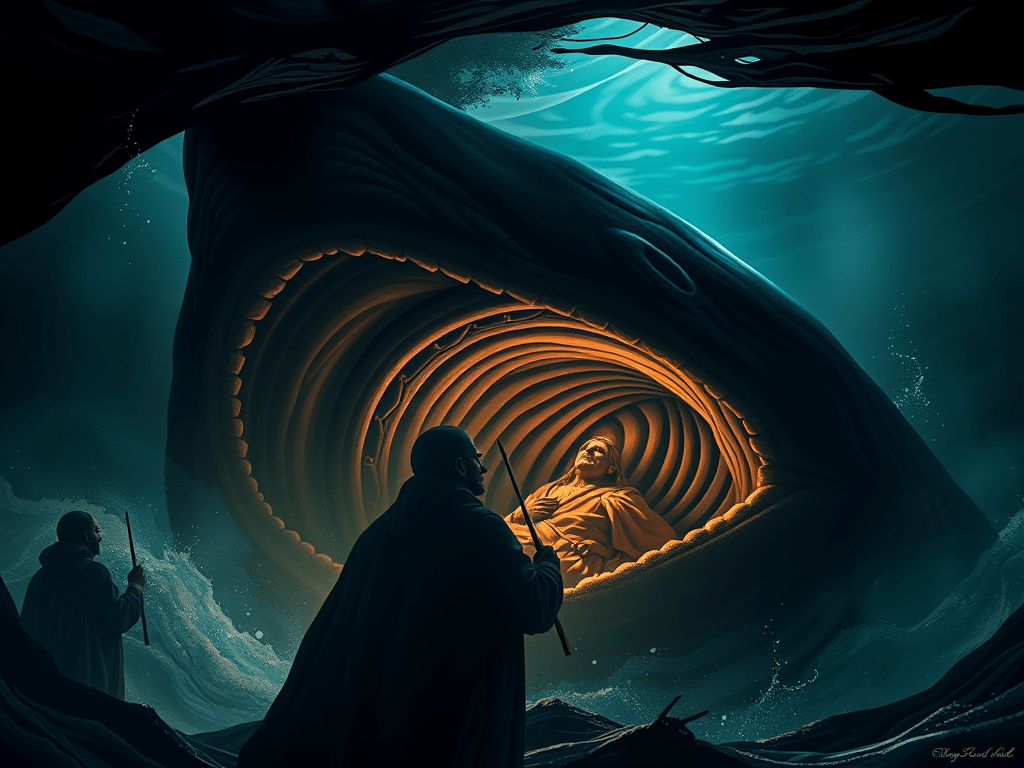
Jonah’s eventual repentance within the whale illustrates the profound transformation required to align with divine purpose. Drawing on his Bahá’í beliefs, Fransson views this moment as emblematic of the human struggle to overcome ego and embrace a higher calling. For Peterson, this marks the resolution of chaos into order—a return to sacred alignment with the moral fabric of the universe. Plato’s insistence on the philosopher’s duty to ascend from the cave and share the light of truth resonates here, demanding courage and humility.
The narrative of Noah underscores the necessity of preparation and the wisdom of discernment. Giants in the land, as Peterson describes, symbolize the overwhelming forces of pride and chaos. Fransson, reflecting on his experience within a high-control religious environment, emphasizes the role of spiritual vigilance in resisting these forces. The ark, built in faithful obedience, becomes a metaphor for the individual’s journey toward truth, shielded against the flood of collective delusion.

The human tendency toward groupthink and its modern manifestation as mass formation psychosis reveals a deep psychological need for belonging and certainty. This inclination, however, often leads to a suppression of independent thought and a retreat into collective illusions. In Plato’s Republic, the prisoners in the cave embody this condition, their reality confined to shadows cast on the wall. They accept the shadows without question, reflecting how individuals often conform to group norms rather than challenge the status quo. Similarly, Jonah’s initial resistance to God’s command represents an avoidance of truth, choosing instead the chaos of the sea, a metaphorical retreat from responsibility and authenticity.
Social media amplifies these dynamics in today’s interconnected world, acting as the cave’s puppet masters globally. Algorithms curate content to reinforce pre-existing beliefs, creating echo chambers where dissenting voices are minimized or silenced. This phenomenon mirrors Plato’s warning about the dangers of persuasive but untruthful rhetoric, a tool wielded to maintain power and illusion. The biblical story of the Tower of Babel also resonates here, as the overreach of human pride and the inability to communicate authentically led to fragmentation and chaos. Social media’s role in perpetuating such fragmentation is evident, fostering division even as it promises connection.
Against this backdrop, critical thinking and independent judgment cannot be overstated. Plato’s philosopher ascends from the cave not merely for personal enlightenment but to return and guide others, demonstrating the moral imperative of pursuing truth. Similarly, Jonah’s journey to Nineveh underscores the transformative power of obedience to divine wisdom and the courage to act against the tide of fear and ignorance. Peterson’s emphasis on the sacrifice necessary to align with higher principles reinforces this theme: the individual must offer their labor and their pride, preconceived notions, and comfort to grow.
Resisting the pressure to conform requires strategies integrating intellectual rigor and spiritual resilience. Wade Fransson’s reflections on the Bahá’í principle of independent investigation of truth highlight the need for individuals to seek knowledge directly, unfiltered by tradition or collective bias. In this pursuit, humility is key, as both Plato and Peterson suggest. The willingness to question, doubt, and engage with opposing viewpoints guards against the complacency of groupthink. Jonah’s repentance in the belly of the whale and his subsequent transformation offer a model for overcoming fear and embracing a higher calling.
Moreover, fostering authentic relationships grounded in a shared commitment to truth rather than conformity provides a bulwark against the forces of mass psychosis. Like Noah’s Ark, a community built on mutual understanding and critical discernment can weather the storms of misinformation and collective hysteria. Resisting conformity, while daunting, is an essential aspect of the human journey. It demands the courage to face the shadows, the wisdom to discern the light, and the resolve to follow the truth wherever it leads.
If you find this stuff fascinating, please check out Daniel Sanderon’s new course on The Cameron Journal Academy, Re-imagining Plato.

Discover more from The Cameron Journal
Subscribe to get the latest posts sent to your email.