

Key Takeaways
- Small openings at joints, penetrations, doors, and roof transitions can create meaningful airflow across a large commercial building.
- A continuous air barrier helps reduce unwanted heat and moisture movement, but it does not replace designed ventilation.
- Testing helps project teams target major leaks before spending time and money on repairs.
- Royal Palm Beach, Florida buildings need materials and details that can accommodate moisture, heat, weather exposure, and building movement.
- Air-sealing work is most effective when designers, trades, inspectors, and facility managers follow one coordinated plan.
Commercial properties in Royal Palm Beach face long cooling seasons, intense sun, wind-driven rain, and high outdoor humidity. Those conditions make the building envelope especially important. Strategic commercial spray foam applications can be one option for addressing difficult-to-reach gaps when they are selected for the assembly and installed as part of a complete air-barrier plan. Air sealing is not simply about stopping drafts. For offices, retail buildings, warehouses, medical spaces, schools, and multifamily common areas, it can support steadier indoor temperatures, better moisture management, cleaner mechanical operation, and more predictable energy use.
Why Air Leakage Deserves More Attention in Royal Palm Beach
Uncontrolled outdoor air can enter through cracks, disconnected materials, utility openings, roof details, and poorly sealed exterior joints. In a hot, humid setting such as Royal Palm Beach in Palm Beach County, that air may bring both heat and moisture into conditioned areas. The HVAC system then has to remove additional heat and moisture while maintaining the temperature expected by occupants. Common warning signs include rooms that feel warmer or stickier than neighboring spaces, recurring condensation, dust around openings, odors moving between areas, persistent comfort complaints, and utility use that does not match normal operations. Leakage is often hidden above suspended ceilings, behind wall finishes, around roof curbs, or where several construction materials meet. For owners evaluating building-envelope improvements in Royal Palm Beach, spray foam insulation in Royal Palm Beach, FL, may be considered alongside sealants, membranes, flashing, gaskets, and weatherstripping. The appropriate approach depends on the location of the opening, the materials involved, expected movement, exposure to water, and future access requirements.
Where Commercial Buildings Commonly Leak
A careful inspection should look beyond obvious wall cracks. The following areas frequently deserve attention in commercial properties:
- Roof edges, parapets, curbs, and roof-to-wall transitions.
- Window frames, curtain-wall joints, storefront systems, and glazing connections.
- Exterior doors, loading docks, service entrances, door sweeps, and weather seals.
- Wall-to-floor, wall-to-roof, and foundation-to-wall connections.
- Electrical conduits, plumbing lines, ducts, fire-protection piping, and other penetrations.
- Expansion joints, control joints, service chases, and mechanical rooms.
- Locations where masonry, metal, concrete, roofing, glazing, and wall systems connect.
How Air Sealing Supports Energy Performance
Air movement can carry sensible heat and water vapor through the enclosure. Limiting unintended airflow can reduce the amount of outdoor air the cooling system must condition, while also helping the building maintain more consistent indoor conditions. The building-envelope research from the U.S. General Services Administration identifies air leakage as a significant factor affecting energy use, thermal comfort, indoor air quality, and the operation of mechanical ventilation systems. A tighter enclosure must still work with a properly designed ventilation strategy. Outdoor air is necessary for indoor air quality, but it should enter through controlled pathways and be conditioned as intended, rather than slipping through random gaps in the envelope.
Start With Testing Instead of Guesswork
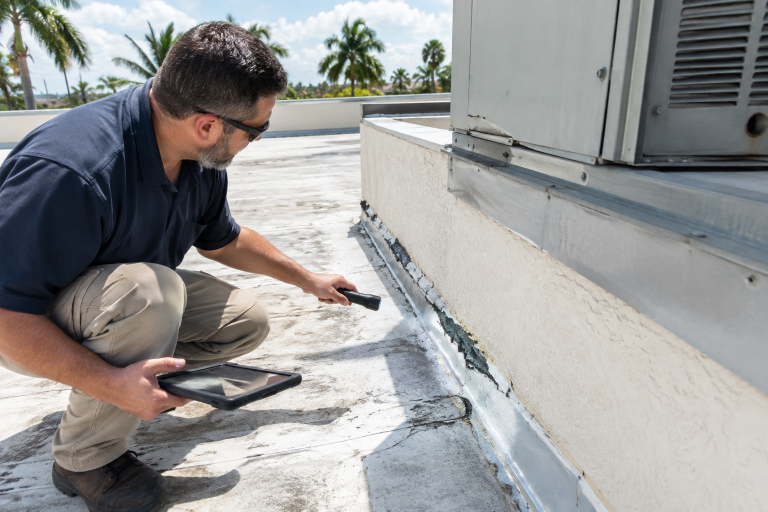
Testing before major repairs gives a project team a clearer starting point. Visual inspections can identify failed sealants, damaged flashing, and obvious openings, while smoke pencils can reveal airflow direction near suspected gaps. Infrared imaging may help identify temperature differences associated with missing insulation or leakage under suitable conditions. For a more complete assessment, pressure testing and whole-building airtightness testing can measure leakage performance and help locate large pathways. Newer diagnostic approaches can combine thermal imaging with digital scans. The Department of Energy has supported work using thermal imaging and LiDAR to identify air-infiltration leaks in commercial building envelopes.
Choose the Right Air-Sealing Approach
No single product solves every opening. Flexible sealants are often suited to joints that move, while flashing and transition materials can connect different air-barrier components. Mechanical gaskets may work well for removable panels or equipment access points. Membranes and coatings can support larger wall or roof assemblies, and door sweeps or weatherstripping can address operable openings. Insulation materials may also limit unwanted airflow when installed continuously and in the right location. However, insulation alone should not be assumed to create a complete air barrier. The detail, material compatibility, installation quality, and continuity from one assembly to the next matter just as much as the product chosen.
Plan Air Sealing During Construction or Renovation
- Assign clear responsibility for the continuous air barrier.
- Mark transitions, penetrations, and concealed connections on project drawings.
- Review material compatibility before installation begins.
- Inspect air-barrier work before walls, ceilings, or roof components hide it.
- Coordinate roofing, glazing, HVAC, electrical, plumbing, and fire-protection trades.
- Test performance before final closeout when the project schedule allows.
- Keep photos, test results, repair notes, and product information in maintenance records.
What Facility Managers Should Check Each Year
Routine maintenance can prevent minor defects from becoming larger envelope problems. Review exterior doors and loading bays for worn seals, inspect roof penetrations after storms or repair work, and look for cracked or separated joint sealants. Facility teams should also note areas with repeated humidity complaints, condensation, staining, or unusual temperature differences. Energy use should be compared with prior periods while accounting for weather, occupancy, operating hours, and equipment changes. When comfort or moisture problems persist after routine repairs, professional diagnostics can help determine whether the cause is air leakage, ventilation imbalance, equipment performance issues, water intrusion, or a combination of issues.
Codes, Documentation, and Common Mistakes
Commercial projects in Royal Palm Beach, Florida, should review the applicable code edition, local permitting expectations, project specifications, and testing requirements before work begins. Building-energy provisions increasingly emphasize continuous air barriers, sealed penetrations, clear details, and verification. Early coordination helps prevent costly corrections after finishes are installed. Frequent mistakes include sealing only visible cracks, using rigid materials at joints that need movement, overlooking small service penetrations, closing walls before inspection, and skipping final testing. Another common error is tightening a building without confirming that ventilation and humidity-control systems remain properly designed and operated.
Questions to Ask Before a Commercial Air-Sealing Project
- Where is the building losing the most conditioned air?
- Has the building been inspected or tested under pressure?
- Which important air-barrier details will become concealed?
- Can the selected materials handle heat, moisture, weather exposure, and movement?
- How will the work affect ventilation, pressure relationships, and indoor air quality?
- Who will inspect the installation and document repairs?
- Will the project include post-work performance testing?
Conclusion
For commercial buildings in Royal Palm Beach, better air sealing can be a practical part of a broader strategy for energy efficiency, comfort, moisture control, and durability. The strongest results come from a measured process: inspect the enclosure, identify major leakage paths, select compatible materials, coordinate the work across trades, and verify the finished performance. Treating air sealing as a whole-building priority, rather than a last-minute repair, gives owners a more reliable foundation for 2026 projects.
Discover more from The Cameron Journal
Subscribe to get the latest posts sent to your email.




