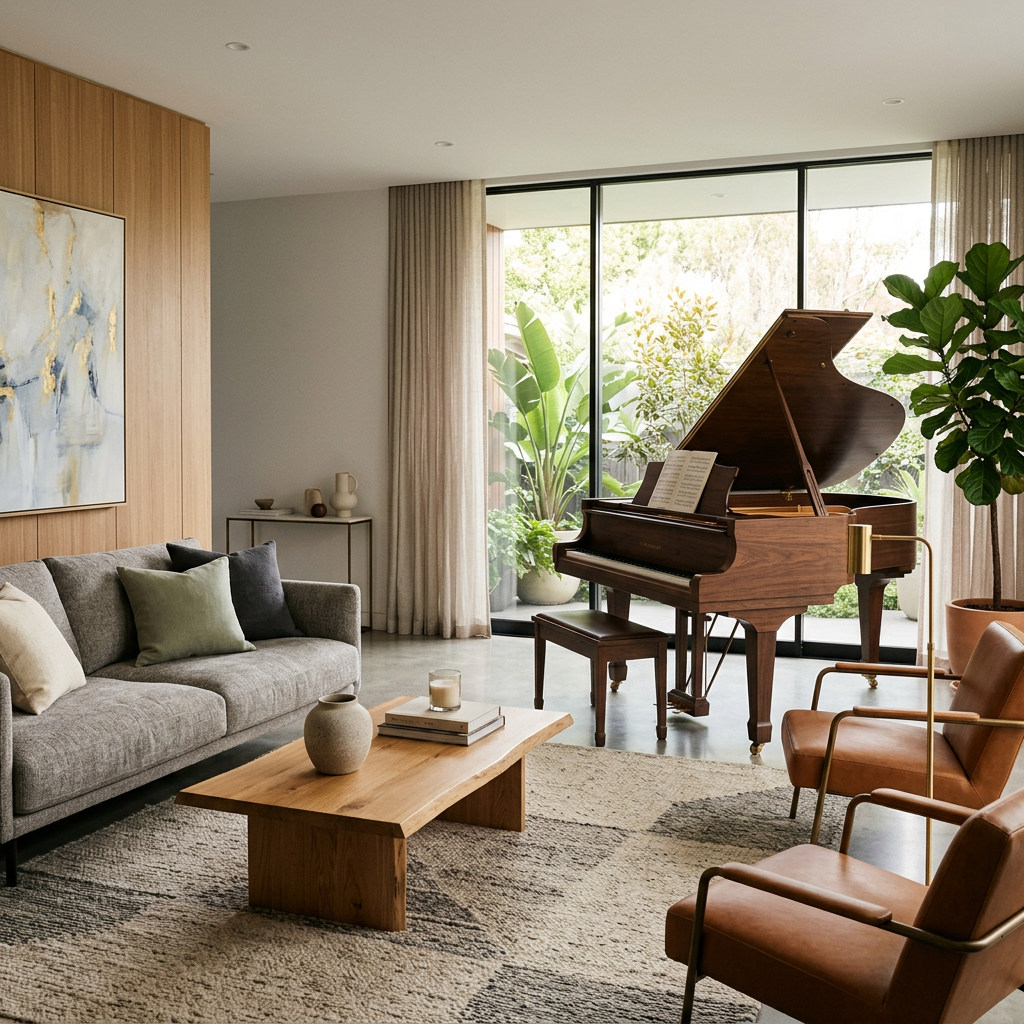
A couch can fill a room. A piano commands one. This is the distinction that designers keep coming back to when houses are full of flat screens, hidden speakers, and matte-black tech that’s all meant to melt away into the background – and it’s why the home piano is quietly starting to become the most important flex in interiors striving for decisions that feel thoughtful, not algorithmic.
The piano as anchor object, not accessory
Most people choose furniture to suit a room, but when it comes to a piano, the opposite is often true. A piano is frequently the defining characteristic of a room. It is unlike most furniture. You notice its mass, its silhouette, how light catches its polished surface. The piano has depth, weight, and presence. A painting or feature wall can be visually striking, but they are flat. A piano demands design around, above, and below it in a way that no other object does. It becomes a focal point, and every room benefits from having one of those. Once you have it, the rest of the room falls into place in relation to it.
Why acoustic wins over digital for design purposes
Digital pianos are suitable for certain environments, like practice rooms, or tiny, sound-challenged flats where sprawl and sonics need to be minimized. But they don’t do a room any favors. Visually they are just one more slab of black plastic in a home already rich with screens and devices. They don’t add any warmth, texture, or craftsmanship to a space. An acoustic piano is the exact opposite. It’s real wood, real cast iron, real strings under tension – tactile in a way nothing digital can be. And as our homes fill more and more with invisible technology, that physical, analog quality is the feature, not the compromise. We actively seek out objects that feel handmade and permanent, and browsing a specialist range of Kawai pianos for sale is a good way to see how a well-built piano checks that box before it ever makes a sound.
Sizing it to the room, honestly
A baby grand needs room to breathe. As a rough guide, spaces of around 200 square feet or more can comfortably host one without it dominating traffic flow or crowding seating. Anything smaller and a baby grand starts to feel like it’s fighting the room rather than anchoring it.
That doesn’t rule out apartments or smaller living rooms. An upright is an order of magnitude smaller in terms of floor real estate, comparable to a reasonable bookshelf, and can sit flush against a wall. The difference is that it carries visual density, visual authority. The keyboard, the lid, the vertical expanse of the case – it reads as an instrument, not a compromise. For the person who believes a real piano is beyond their square footage, the upright is almost always the alternative no one suggested.
Keep the exterior styling a bit simpler, maybe. Leave out the candlesticks. Put it next to something with some air around it, something that suggests an uncluttered and deliberate focal point: an armchair, rather than a stack of board games. It’s not about room. It’s about intention.
Placement matters as much as size. Give the instrument six to eight feet of open floor in front of it if at all possible, both for acoustic reasons and so it doesn’t feel boxed in. Keep it away from radiators, direct sun, and exterior walls prone to damp – temperature and humidity swings are hard on wood and tuning stability alike.
Matching finish to the room’s language
The finish is the first real design decision, and it needs to take its cue from what’s already in the room rather than fighting against it. Polished ebony is more mirror than wood: In a monochrome or minimalist room, it becomes a sculptural, reflective surface, bouncing light and doubling as a dark, glassy focal point. It is very much at home in a space with clean lines and a cooler palette.
A satin finish and the natural wood veneers – walnut, mahogany, rosewood, oak – do something else. They warm the room up. They tie the instrument into the bigger biophilic push toward natural materials, timber tones, and organic texture that has driven residential design for much of the last decade now. In a Scandinavian or Japandi interior, where the whole ethos is “less but better,” a satin walnut upright or grand can be the one beautiful object in the room, surrounded by discipline everywhere else.
Neither finish is better in any objective sense. The point is simply that the piano isn’t a neutral background object like a sofa in a safe grey. It has a strong material identity, and it needs a habitat that either matches it or deliberately contrasts with it.
Styling the piano without cluttering it
The closed lid is a display surface, arguably the most interesting one in the room, and most people either ignore it or overload it. Neither works. A single sculptural object, a considered vase, or a small grouping styled toward the instrument’s curve reads as intentional. Six framed photos and a candle do not.
Feng shui practitioners have long treated the piano as a mass that redirects circulation and energy through a room, and whatever your view on that tradition, the practical version holds up: a piano this size changes how people move around a space. It’s worth planning that flow deliberately rather than discovering it by accident once the movers have left.
The two objections, answered directly
“We don’t have enough space” and “no one at home plays the piano” are common excuses, yet neither holds up under scrutiny.
Regarding space, an upright can be a solution for that, and a baby-grand can fit in more rooms than you’d imagine, especially if you rethink the other furniture in relation to it. Whether a house has enough space for something is often based on how tenaciously they hold onto other things, rather than the size of the new item.
As for the piano being played or not, an artwork doesn’t lose its value if you don’t touch it every day. No one questions the aesthetic quality of a painting based on whether you regularly stroke it. A well-selected piano can serve as an art piece and a family heirloom, and the fact that one day someone might play it is simply an additional plus point, not the reason for it to be there.
Built to outlast the furniture around it
A quality grand piano contains somewhere in the region of 12,000 component parts – and, as the saying goes, 10,000 of them move. A figure widely cited by piano historians and repeated in countless Steinway & Sons marketing materials, it remains a marvel of engineering more than a century and a half after it was first distilled. It’s not a marketing boast. It’s an actual fact, and a concrete indicator that this is an entirely different class of object than a flat-pack chest of drawers made out of four panels and a handful of bolts.
Pianos get serviced, regulated, restrung, and restored across decades. Well-maintained instruments regularly outlive the people who bought them, then pass to the next generation still functioning as intended. In a market increasingly tired of disposable furniture that gets replaced every five to ten years, that longevity is part of the appeal. A piano isn’t bought to be swapped out with the next trend cycle. It’s bought once, cared for, and handed down.
What it does to how a room gets used
When a piano is brought into a home, people tend to spend less time on screens and more time gathered around the instrument. Instead of watching television, people are more likely to share music. Even if no one in the household plays anymore, people will still tinker on the keys. Children may discover a love for playing the piano after being exposed to it in their home. A former piano player may no longer have the opportunity to play once they have children, but a piano in their home will give them the nudge they need to take it up again.
That fits a broader shift toward analog living as a wellness idea – deliberately choosing objects and activities that pull attention back into physical space rather than a screen. A piano does that better than almost anything else you could put in a living room.
Buying it like a design decision, not just a purchase
Once you’ve established your priorities of finish and size, your final decision is going to be which make: and here is where brand heritage and dealer support start to count in ways the first-time buyer might not anticipate. Resale value isn’t quite everything good brand reputation is about (though in fact, a solidly built, high-quality instrument will generally retain a fair amount of its trading value – far more than an inexpensive piece of furniture, at any rate). It’s an assurance of uniform quality, over decades if not centuries, of both build and – more importantly – of tone and touch. An assurance too that, in buying a new or reconditioned piano at least, you’re protected by a guarantee that the initial service is a free one, and that there’s a firm nearby who will continue to stand behind that bit of your home and lifestyle.
This, then, is why a well-designed, hand-finished piano is worth the money and the space. A truly well-built piano becomes part of your living space as quietly and solidly as the walls: something that’s come to be recognized among discerning designers, for its visual and actually its acoustic properties, as a kind of wooden sculpture in its own right. Something with a long and distinguished pedigree, and a promise of longevity if properly cared for.
The room remembers what you put in it
Many pieces of furniture are replaced, given away, or no longer used within ten years. On the other hand, a piano is usually kept, handed down through generations, and used as a functional item and source of music long after the original surroundings have changed. This cannot be said about most items people purchase for their homes, and it’s the reason to consider a piano as a centerpiece for a room design.
Discover more from The Cameron Journal
Subscribe to get the latest posts sent to your email.