
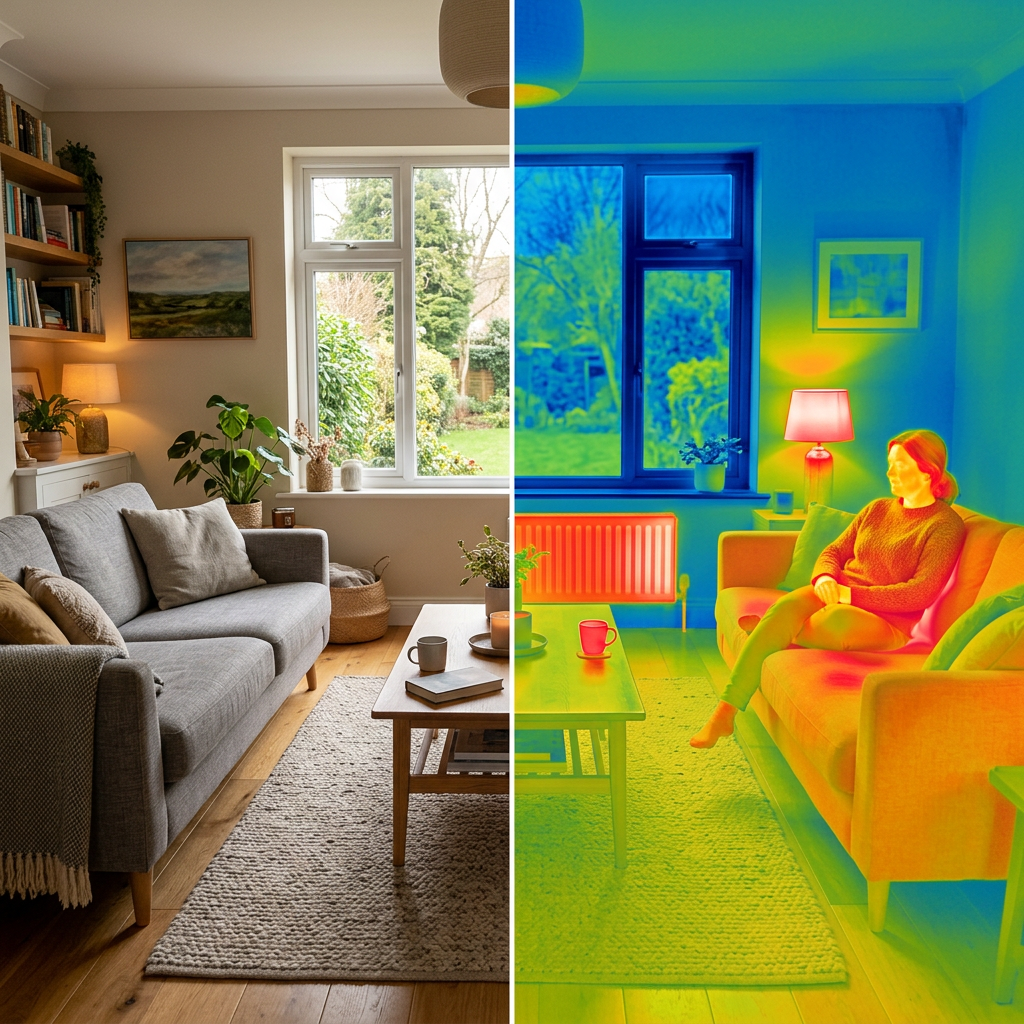
The first clue is usually small: a room that never quite warms up, an outlet cover that seems unusually warm, or a ceiling stain you cannot date. You can guess at the cause, or you can use a camera that maps heat instead of visible light. A cold seam around a window might appear as a blue stripe, while an unusually warm electrical component may stand out against its surroundings.
That is the appeal of thermal imaging for homeowners and people who manage small buildings. It makes temperature differences visible. It is not x-ray vision, and it cannot diagnose a problem by itself. Used carefully, however, it can help you notice an issue early and decide what to investigate next.
How thermal imaging works, in plain English
An ordinary camera records visible light reflected by objects. A thermal camera detects infrared energy from surfaces and converts the readings into a visual image. FLIR and Fluke describe this as a way to display temperature patterns that the human eye cannot see.
Each pixel represents an estimated surface temperature. The result is a heat map rather than a conventional photograph, and the colors only have meaning in relation to the temperature scale shown on the screen.
What these cameras can and cannot show you
Thermal cameras work in darkness because they do not depend on visible light. They are particularly useful for recognizing patterns, such as a cold line where insulation may be missing or a warm area around an electrical connection.
They cannot see through walls or glass. In the thermal band, glass often behaves like a mirror, so the image may show reflected heat rather than what is behind the pane. FLIR highlights this limitation in its guidance. Polished metal can cause similar problems.
Weather and recent activity also affect the image. Sunlight can leave exterior walls warm long after the air cools, while rain, wind, heating cycles, and running appliances can change surface temperatures. A single unusual color is not proof of a defect.
Thermal imagers estimate surface temperatures, and their accuracy depends on factors such as emissivity, distance, focus, and ambient conditions. Emissivity describes how effectively a surface emits infrared energy. Matte and painted surfaces are generally easier to measure than shiny ones. Treat every finding as a lead that needs to be confirmed another way.
Where early detection can help
Thermal scanning is most useful when it sits inside a routine home maintenance habit rather than being used only after something goes wrong. Fluke describes three useful inspection habits. A baseline records how equipment or a room looks under normal conditions.
Fluke describes three useful inspection habits. A baseline records how equipment or a room looks under normal conditions. Trending compares the same location over time. Comparative scanning checks similar items side by side, such as two circuits carrying similar loads.
Useful areas to scan include:
- Heat loss and drafts. Check window frames, attic hatches, baseboards, exterior doors, and garage door seams when indoor and outdoor temperatures differ.
- Electrical warm spots. Scan breaker panel covers, outlet plates, and visible wiring enclosures from the outside. Do not remove covers unless you are qualified and following appropriate safety procedures.
- Motors and appliances. A bearing, compressor, or motor running warmer than a comparable unit may justify closer inspection.
- Moisture clues. The Department of Energy notes that thermal cameras may reveal temperature patterns associated with water leaks in or around walls.
Moisture detection is indirect and depends on the conditions. Damp material may appear cooler because of evaporation or warmer because it retains heat differently. Confirm a suspicious pattern with a moisture meter or ask a qualified plumber or building professional to investigate before opening a surface.
The specifications that matter
Resolution. Thermal resolution is the number of temperature-measuring pixels in the detector. More pixels provide clearer detail, particularly when the target is small or far away. Published FLIR specifications illustrate the range: the E54 has a 320 × 240 detector, while the E96 has a 640 × 480 detector. For basic home scans, how close you can get to the target may matter as much as the raw pixel count.
Thermal sensitivity. Often listed as NETD and measured in milliKelvins, this specification indicates how well a camera can distinguish small temperature differences. A lower number means greater sensitivity. Better sensitivity can help reveal subtle insulation gaps or faint moisture patterns.
Accuracy and temperature range. Accuracy figures are model-specific and commonly combine a fixed temperature allowance with a percentage of the reading. A very high maximum temperature may be useful in industrial settings but is rarely necessary for routine building checks. For early detection, consistent readings and clear comparative images are usually more useful than an extreme measurement range.
Focus and field of view. A wide lens helps scan an entire wall, while a narrower field of view isolates a smaller target from farther away. Focus matters because blurred edges can make both the image and the temperature reading less reliable. Manual focus is valuable when inspecting small components or working at different distances.
Choosing a camera for early detection
Phone attachments can be suitable for occasional checks, such as locating a draft, comparing radiators, or confirming that a vent is delivering conditioned air. Dedicated handheld cameras may add better sensitivity, focus control, interchangeable lens options, longer battery life, and reporting tools for documenting changes over time.
To understand what a professional thermal inspection camera may include, the FLIR Exx-Series provides a useful reference. The E96, for example, has a 640 × 480 detector and can use an optional dual field-of-view lens for wide scans or more distant detail. That lens is not available for every model in the series, which is a reminder to check specifications for the individual camera rather than relying on a product-family summary.
Choose according to the smallest target you need to inspect, the distance from which you will work, and whether you need to save comparable images or prepare reports. A lower-cost camera may be enough for drafts and radiator checks, while electrical or mechanical inspection may justify better focus, sensitivity, and resolution.
A safe first scan
Begin with a non-invasive inspection. Do not open energized electrical panels or remove protective covers unless you are qualified to do so. If a scan suggests a serious electrical problem, keep your distance and contact a licensed electrician.
- Scan when indoor and outdoor temperatures differ, such as early in the morning or after sunset.
- Avoid relying on readings from shiny metal or glass because these surfaces can reflect heat from nearby objects.
- Allow the camera to adjust to the environment before taking measurements.
- Set the temperature span so small differences are visible without exaggerating harmless variation.
- Focus carefully before saving an image.
- Record the time, weather, equipment status, and whether the heating or cooling system was running.
- Scan the same location again under similar conditions to see whether the pattern remains, spreads, or disappears.
A thermal camera is best treated as a tool for asking better questions. It can narrow the search area, document a changing pattern, and help you recognize when it is time to stop guessing and call a professional.
FAQ
Can a thermal camera find a water leak?
Sometimes, indirectly. A camera may reveal a temperature pattern associated with damp material, but it does not detect water itself. Confirm the finding with a moisture meter or a qualified professional.
When should I call a professional?
Call a qualified professional when a finding involves live electrical equipment, suspected structural moisture, overheating machinery, or anything that would require opening a wall, panel, or protective enclosure. A thermal scan is a starting point, not a final diagnosis.
Discover more from The Cameron Journal
Subscribe to get the latest posts sent to your email.




