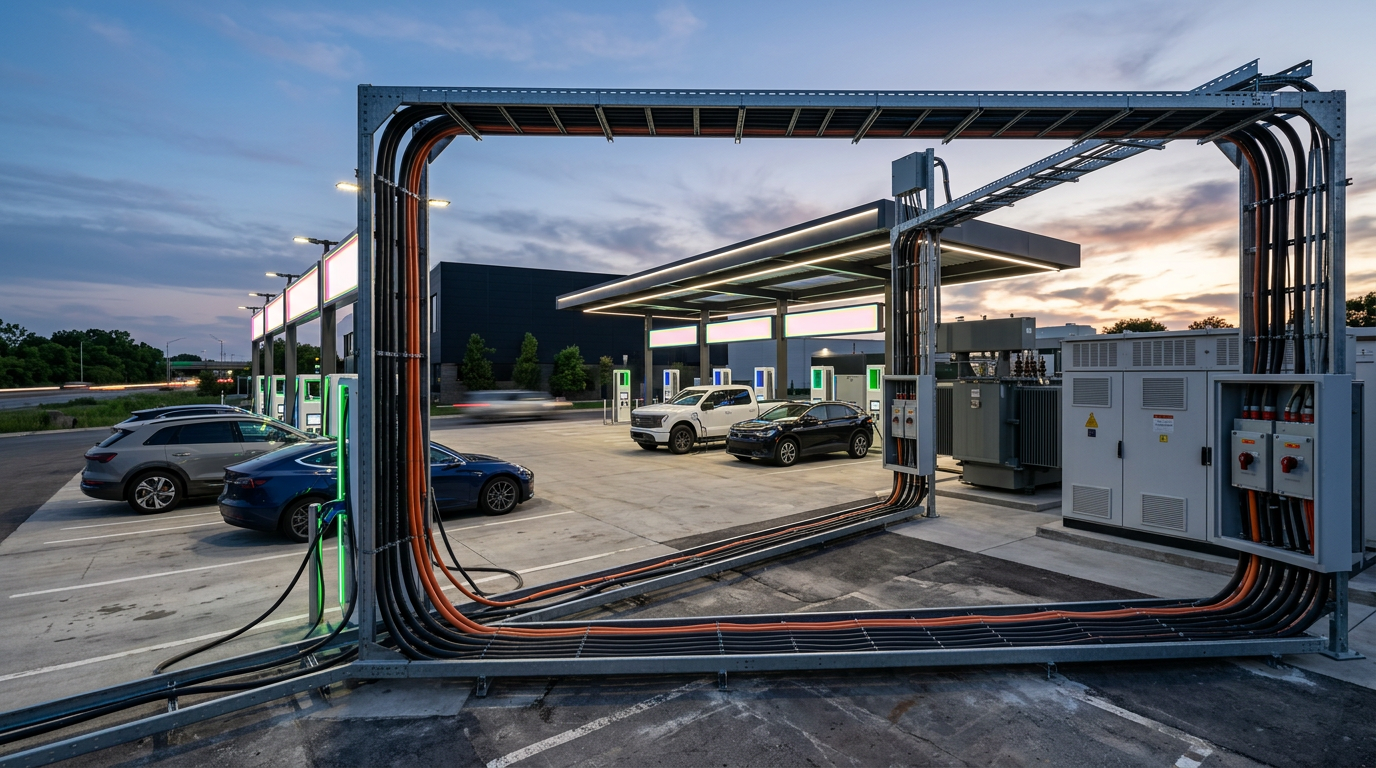
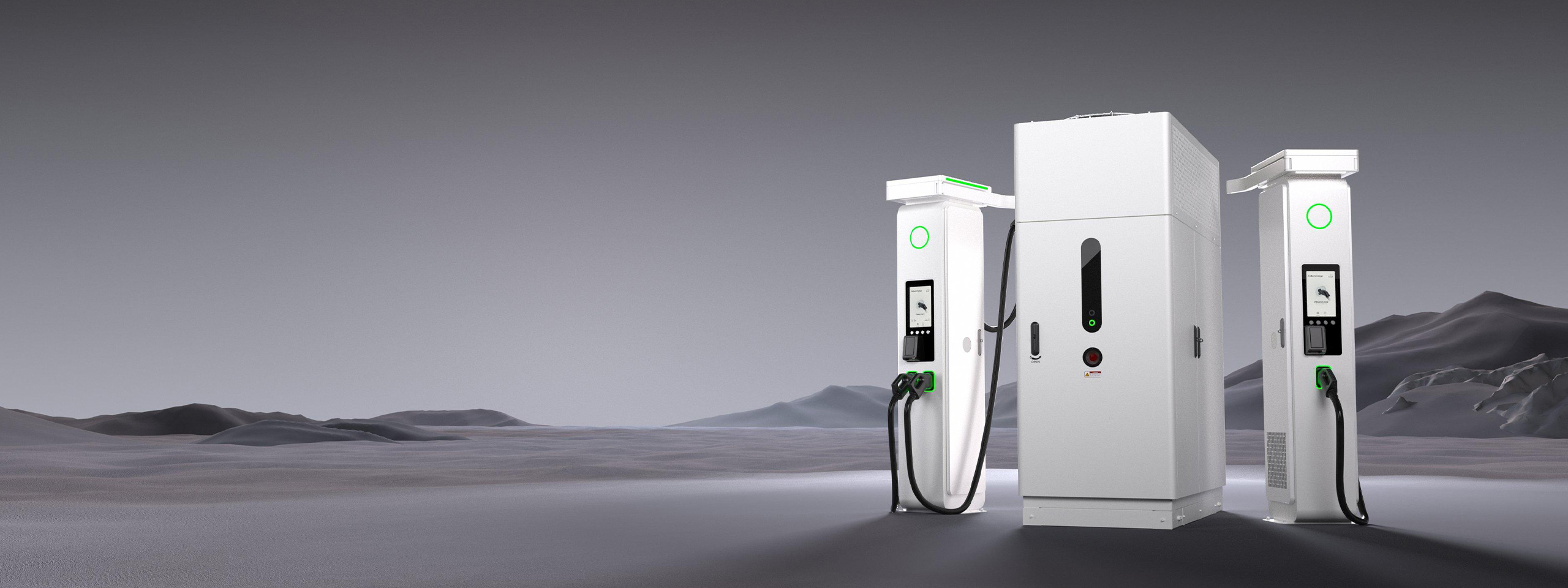
When an existing station expands, old cable routes and transformer capacity may become more restrictive than the charger layout itself. For commercial charging station, system interfaces shape the real outcome. Huawei FusionCharge provides liquid-cooled ultra-fast charging technology for public, inter-city, and fleet installations. A commercial charging station can combine a DC power unit, one or more dispensers, and station-level management, with the final layout selected according to its business and electrical conditions.
Build the complete electrical path
Station equipment extends beyond the dispenser visible to drivers. The installation requires utility supply, protective switchgear, conversion modules, metering, control communications, and safe distribution to each charging outlet.
The site should be sized using expected concurrent sessions, not just the total number of marked spaces. Transformer capacity, spare connection margin, and local power-quality requirements constrain achievable peak demand.
Understand power sharing and liquid cooling
The FusionCharge power-sharing matrix can allocate available converter capacity among outlets as vehicle current requests change. This is particularly relevant when several bays are occupied but not all batteries accept peak power.
The liquid-cooled dispenser provides a thermal path for high-current charging components. Huawei cites an 800 A dispenser rating under specified conditions, but actual power depends on voltage, vehicle limits, and the charger configuration.
Liquid-cooled hardware needs inspections for hoses, fluid paths, cable assemblies, and protective sensors. Service procedures should follow the product documentation and local safety requirements.
Connect operations with energy management
Charger monitoring should record equipment availability, faults, start failures, delivered energy, and session duration. Separating charging time from time spent parked helps determine where capacity is being wasted.
A site-level demand controller may cap total import or adjust power allocation when more vehicles arrive. Such logic needs to respect utility agreements and avoid unexpected interruptions to customer sessions.
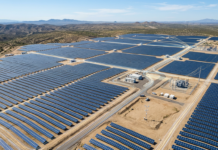
Solar power can contribute to daytime charging but remains weather-dependent. Storage dispatch, charger scheduling, and grid imports therefore require coordinated controls rather than independent equipment settings.
An energy-storage integration study needs an energy balance, not just a peak-power estimate. Dispatch limits, replenishment time, usable battery capacity, and grid tariff periods determine whether storage can help a busy charging site.
Prepare for uptime and future expansion
Commissioning should include tests with different vehicle types, simultaneous charging, protective shutdowns, communications loss, and recovery after maintenance. These activities validate station behavior under realistic operating conditions.
Operators should establish clear responsibilities for customer support, onsite repair, remote diagnostics, and periodic inspection. A station may have electrical capacity available yet lose revenue from an unresolved connector fault.
A commercial charging station is a coordinated electrical service, not just a collection of charging stalls. Its performance comes from the interplay of power conversion, cooling, site control, customer access, and the ability to maintain equipment over time. For commercial charging station, Future expansion is easier to manage when spare capacity and integration points are documented from the start.
Discover more from The Cameron Journal
Subscribe to get the latest posts sent to your email.