
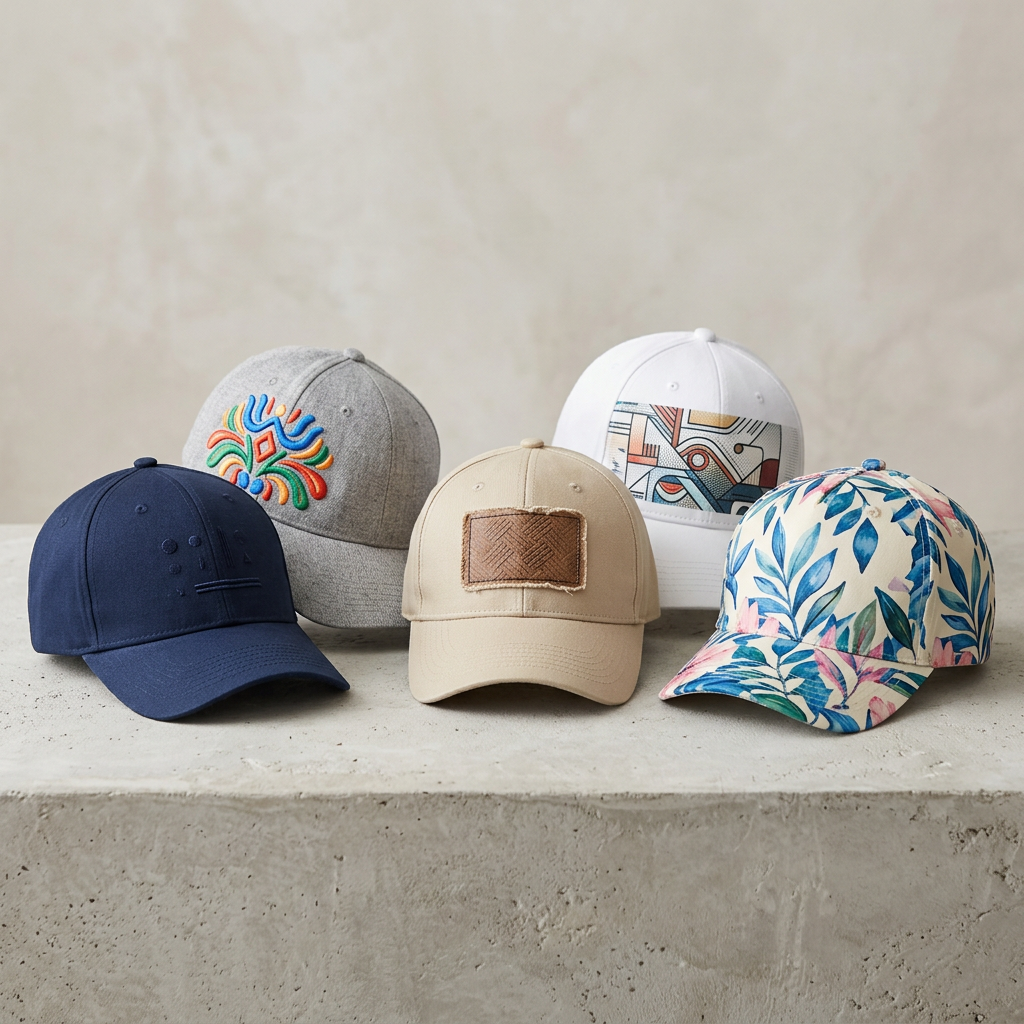
Two people can order the same blank cap with the same logo and end up with completely different products.
The variable is the decoration method, and it is the decision that determines how the finished piece looks, feels, and holds up.
Most disappointing results trace back to a mismatch here rather than to poor manufacturing. The logo was fine, the cap was fine, and the method was wrong for both.
Key takeaways
- Method selection is driven by artwork type first, then by the hat style you have chosen.
- Regular embroidery is the durability benchmark but limits you to around six thread colors from a palette of 15.
- Unlimited color embroidery exists for artwork that regular stitching cannot reproduce faithfully.
- Patches give a defined edge and a premium feel, and they suit logos that need to read as a badge.
- DTFlex handles photo-realistic and bold graphic work that stitching flattens.
- Sublimation covers cut-and-sew styles edge to edge with color that resists cracking and fading.
- Not every method is available on every silhouette, so confirm compatibility before finalizing artwork.
The two questions that decide everything
Start with what your artwork is. A clean logo with flat colors and legible type points to stitching, while a photograph, a gradient, or an illustration with fine detail points to printing.
Then ask what the hat is. Structured crowns take dense stitching well; unstructured styles do not, and cut-and-sew construction is what makes all-over printing possible in the first place.
Answer those two and the field narrows to one or two viable options. Everything after that is refinement.
Regular embroidery
This is the method most people picture when they think of a branded cap. Thread is stitched directly into the fabric, producing a raised, textured finish that reads as premium at arm’s length.
Its strength is longevity. Stitching does not crack, peel, or fade the way surface decoration can, which is why it dominates corporate, team, and uniform headwear.
The constraint is color. Regular embroidery typically allows up to six colors drawn from a palette of 15, which is plenty for most logos and immediately limiting for anything with a gradient.
It suits baseball caps, trucker hats and beanies particularly well. Clean lettering, simple marks and monogram-style work all reproduce faithfully at cap-front scale.
Unlimited color embroidery
This solves the exact problem regular embroidery creates. Where artwork needs more than six colors or carries detail that flat stitching would simplify away, unlimited color embroidery reproduces it without forcing a redesign.
The finish is denser and more dimensional than standard stitching. Multicolor logos, illustrated marks, and gradient-adjacent artwork all come out closer to the original.
Availability is narrower than for regular embroidery. It runs across a smaller set of models, typically 20 or more depending on the catalog, so check your chosen silhouette supports it before committing to the artwork.
Patches
Patches sit in their own category because the decoration is made separately and then attached. That separation is what gives them a defined edge and a badge-like presence that direct decoration cannot match.
Embroidered patches carry the same thread texture as direct stitching, with a border that frames the design.
Woven patches allow finer detail than embroidery because the threads are thinner, which suits intricate marks and small text.
Leather and faux leather patches read as premium and suit heritage or outdoor branding. PVC and rubber patches are weather-resistant and give a molded, three-dimensional look that works for technical and streetwear styles.
The trade-off is flexibility. A patch adds stiffness to the panel it sits on, which is fine on a structured front and less comfortable on a soft, unstructured crown.
DTFlex printing
Direct-to-film printing puts full-color artwork onto the hat as a thin, flexible layer. It handles photographic imagery, gradients, and dense graphic detail that thread simply cannot render.
Sharpness is the selling point. Fine lines and small type that would blur or disappear in stitching come out crisp.
It is available on select print-ready styles rather than across the whole catalog. That restriction is worth checking early, since discovering it after the design is finished means starting over.
Sublimation and all-over printing
Sublimation bonds dye into the fabric rather than sitting on top of it. The result is color that will not crack or fade with wear, because there is no surface layer to damage.
Coverage is the real advantage. All-over designs run edge to edge across panels, seams, and brims in a way no other method can manage.
The catch is construction. Sublimation works on select cut-and-sew styles because the panels are printed before the hat is assembled, so it is not an option on pre-made blanks.
Quick comparison
| Method | Best for | Color range | Durability | Typical styles |
| Regular embroidery | Clean logos and text | Up to 6 from 15 | Very high | Baseball caps, truckers, beanies |
| Unlimited color embroidery | Detailed, multicolor logos | Unlimited | Very high | Caps, beanies, bucket hats |
| Patches | Badge-style branding | Varies by patch type | High | Structured caps, snapbacks |
| DTFlex | Photos, bold graphics | Full color | High | Select print-ready hats |
| Sublimation | Edge-to-edge designs | Full color | Very high | Select cut-and-sew styles |
Matching the method to the hat, then ordering

Compatibility is the step people skip. Before you finalize anything, confirm that the method you want is offered on the silhouette you want, because the reverse discovery costs a redesign.
The practical way through is to work inside a catalog that shows you both at once. You can design a hat with Printful by opening the product catalog, picking a style, applying your logo or text in the free hat designer, and placing the order once you have reviewed the quote.
Printful is a print-on-demand company, so every piece is made to order with no minimums, which means a single embroidered cap for yourself is as normal an order as a run of 50 for a team.
Printify runs a comparable made-to-order model if you want to weigh platforms against each other.
Either way, the made-to-order structure is what removes the traditional barrier of committing to bulk before you have seen the result.
Ordering one piece as a test is worth the small cost. Seeing how your artwork actually reproduces in thread or print resolves questions that no on-screen mockup fully settles.
Preparing artwork for each method
Stitched methods want simplification. Remove gradients, thicken fine lines, and check that your smallest type is still legible when scaled to roughly three inches wide.
Print methods want resolution. Supply high-resolution files, and remember that a background that looks white on screen will print as white unless the file has genuine transparency.
Patches want a clear boundary. The shape of the patch is part of the design, so decide whether you want a standard shape or a cut that follows your logo outline.
Vector is the safest starting point across all of them. It scales without degrading and converts more predictably into both stitch paths and print files.
Durability and care
Embroidery and sublimation are the most forgiving over time. Neither has a surface layer that can peel, which is why both hold up through repeated wear.
Printed decoration lasts well but responds to care. Avoid high heat and aggressive washing, and spot-clean rather than machine-washing where possible.
Patches depend on attachment. Sewn patches outlast adhesive-backed ones by a wide margin, so check how yours is applied if the piece will see heavy use.
Conclusion
Pick the method from the artwork, not from the aesthetic you admired on someone else’s cap. A photo-realistic design will never work in six thread colors, and a clean wordmark gains nothing from full-color printing.
Then check compatibility with the style before you finish the file. That one step prevents the most expensive version of this mistake, which is discovering the mismatch after the design is done.
Test with one piece if the order matters. What you learn about scale, color, and texture carries into every unit you order afterward.
Frequently asked questions
Which method is best for a small, detailed logo?
Woven patches or DTFlex, depending on the look you want. Regular embroidery will simplify fine detail at that scale.
Can I combine methods on one hat?
Often yes, such as an embroidered front with a printed side mark. Each placement is priced separately, so cost rises with every addition.
Does embroidery work on beanies?
Yes, and it is one of the most common applications. Knit fabric takes thread well, though very dense designs can distort the stretch.
Why is my color slightly off from my brand palette?
Thread palettes are finite, so embroidery matches to the nearest available shade rather than reproducing an exact hex value. Printing methods track brand colors more closely.
Do I need a minimum order to access any of these methods?
No. Print-on-demand production applies the same methods to a single unit as to a bulk run.
Discover more from The Cameron Journal
Subscribe to get the latest posts sent to your email.




